(Viber, Whatsapp, Cell) +977 9851022814

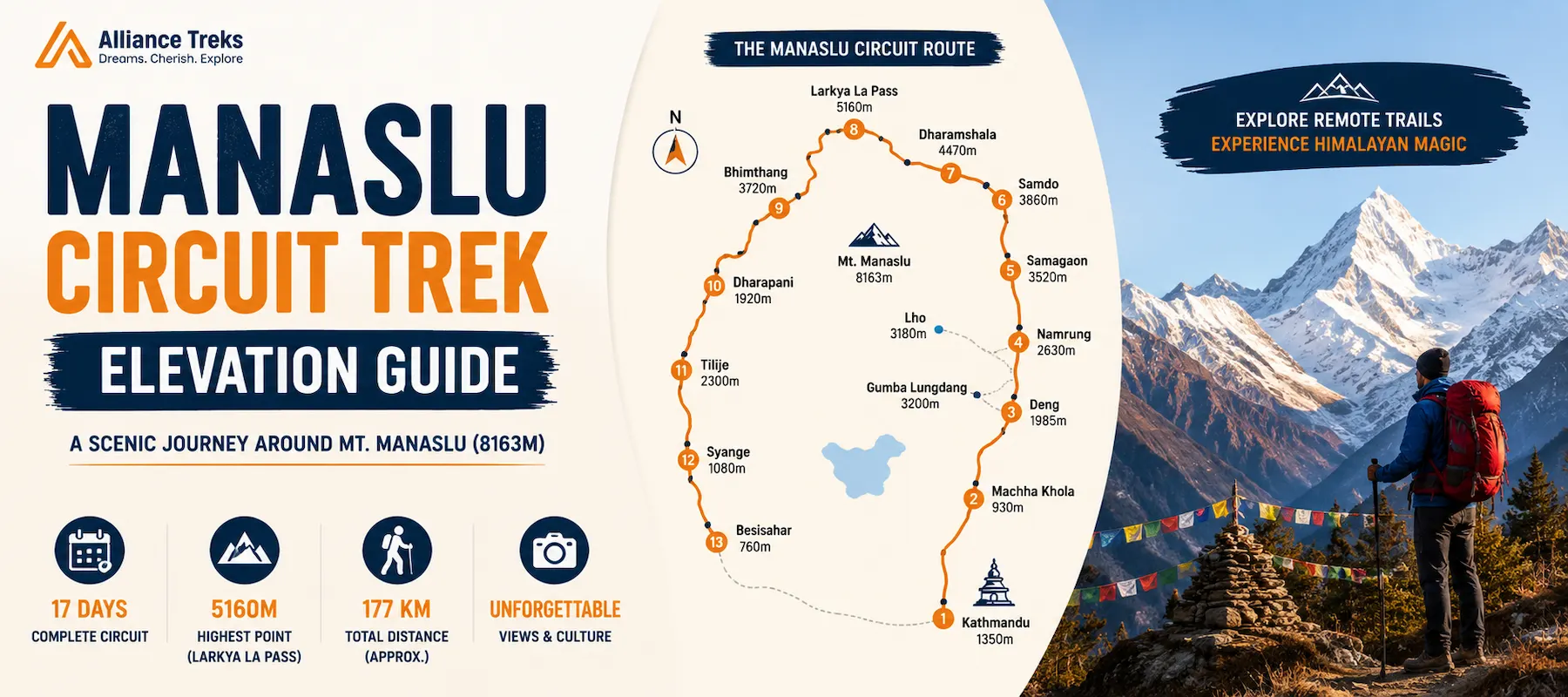
Highest point: Larke La Pass at 5,160m (16,930 feet)
Duration: 17 days total, with 13 days of actual trekking
Elevation gain pattern: Gradual ascent over 7 days from 930m to 3,865m, then sudden jump to 5,160m on Day 12, then descent over 3 days
Most challenging sections: Days 11-12 (Dharamsala to Larke La Pass to Bimthang) crosses the pass where altitude is most extreme
Acclimatization built-in: Two designated acclimatization days at Samagaun (Day 8) and Samdo (Day 10) allow your body to adapt before the pass
Key advantage: The route is designed for altitude acclimatization. You don’t jump straight to 5,160m. The 17-day schedule allows proper adjustment.
The most crucial on the Manaslu Circuit Trek is elevation. Elevation is more than weather, more than fitness, it’s what makes you feel.
If you live at sea level, your blood is able to transport oxygen efficiently. Your heart beats normally. Your lungs work easily. Your mind is sharp and clear.
At 5,160m, the amount of oxygen is half as much as at sea level. Your heart has to beat more quickly. You have to work your lungs harder to breathe. Your brain doesn’t get as much oxygen. Things are difficult for your body – walking slowly, thinking clearly, sleeping well.
This trek is 17 days in length, not 12, because of this elevation. These additional days are for acclimatization—to get your body used to lower oxygen before trying the pass.
The elevation also has an impact on comfort during the day. Sleep well and feel refreshed at 2,000m. Sleep is disturbed at 4,000m and you are exhausted. Sleep is virtually impossible at 5,160m, your body will not allow you to get a decent sleep.
As you climb a mountain, the temperature gets colder. The temperature decreases by approximately 1°C for every 100m of ascent. Between 930m and 5,160m it is a 4,230m gain, which equates to about 42°C. The ride begins with a warm subtropical start and ends with cold alpine conditions.
Understanding the elevation of each day helps you prepare properly. Here’s the complete profile:
Day 1 & 2: Kathmandu at 1,350m
The starting point is the capital city of Kathmandu at moderate height. The first days are for orientation and cultural sights. Your body is at sea-level (if you flew from sea level). Some mild jet lag and initial altitude effects may lead to a slight feeling of tiredness. Don’t overthink it. Rest and hydrate. Day 2 covers Kathmandu sightseeing visit to Boudhanath Stupa, Pashupatinath Temple and Patan Durbar Square. Save energy.
Day 3: Machha Khola (930m)
It takes approximately 10-11 hours by car to reach Machha Khola (930m) from Kathmandu (1350m). Yes, down. You actually dive 420m! The drive goes through terraced fields, river valleys and mountain roads. It’s long and tiring to sit but the altitude is lower than Kathmandu. You feel good inside your body. It is easy to sleep at 930m. This is the bottom leg of the entire walk.
Day 4: Jagat at 1,340m
The first day of trekking. The approach is by a jeep track which rises 410m from Machha Khola. Your body will hardly notice. You travel through subtropical forests, cross suspension bridges and experience the valley of Budhi Gandaki River. Energy is high. Sleep is good. Headaches? Unlikely.
Day 5: Deng at 1,860m
Yesterday’s elevation rise: 520m. Trek start to top: 930m. You’re still in familiar terrain. Subtropical forests continue. Villages are traditional and familiar. You feel good. For most first-time trekkers, there have been no effects of altitude!
Day 6: Namrung at 2,630m
Elevation gain: 770m. Total distance travelled from start: 1,700m. The terrain suddenly becomes more different. Alpine forests appear. Temperature drops. You notice that on the uphills you are breathing slightly harder. Sleep may be slightly disturbed – awake once or twice. Nothing serious. The body only just realising that it’s in space.The body just realises that they are in space.
Day 7: Samagaon at 3,530m
Elevation gain: 900m. From start: 2,600m. You’re now in the serious elevation range! Some trekkers begin to notice slight effects at 3,530m, including a headache, a slight decrease in appetite, and an increase in fatigue when going uphill. Your guide is attentive. At Samagaon you see the towering Mount Manaslu (8,163m) above you. It offers a gorgeous vista. Worrying exhaustion combines with reverence.
Day 8: Samagaon at 3,530m (Rest Day)
The flight is at constant altitude. No additional elevation gain. Your body has time to adapt. Here you have two choices – you can stay in the village or do a hike to Manaslu Base Camp (4,800m) or Birendra Lake (high alpine lake ~ 4,200m).
The hike to Manaslu Base Camp is recommended by many guides. Why? You are going up higher (4,800m) to experience the thin air and then coming down to 3,530m to rest and recuperate. Climb high; sleep low” is the best way to acclimatize. The higher elevation is felt, your body adjusts, then recovers at lower elevation.
The sleep at Samagaon (3,530m) will be disturbed. May have a lot of night wakings. You may experience restlessness. This is normal at this elevation. Your body is adapting. At the end of this day you are more at ease than 24 hours before!
Day 9: Samdo at 3,865m
Ascent from Samagaon: 335m. Take the trek from the beginning: Total: 2935m. This is a short day and it’s on purpose. It is a small village called Samdo, where you will acquire only a little altitude, and which is a remote village near the Tibetan border.
Samdo is a bald and tall guy. It’s a desolate terrain. The wind is constant. The temperature is definitely low. Vegetation is sparse. You’re now in true high-altitude terrain! You may experience more fatigue. For some trekkers, the effects of altitude are slight: headache, nausea and restlessness. This is expected. You are under the supervision of your guide.
Day 10: Samdo at 3,865m (Rest Day)
Additional acclimatization day at the same elevation. In the morning again, you can then hike onto the ridges or viewpoints which are higher (4200m+), then come back down to Samdo for the night. It is hard to sleep at 3,865m. May experience 4-5 hours of sleep per night rather than 8 hours. Your body is trying to adjust to the thin air.
This is the critical push to LARKE LA PASS (Days 11-12)
Day 11: Dharamsala (Larke Phedi) at 4,460m
Ascent: 595m from Samdo. From the start of the trek: Total: 3,530m. This is the place where altitude starts to be a serious issue. You are now at an altitude of 4460m well above where serious mountain sickness can develop (usually 2500m+ but much more severe at 3500m+).
The base camp for Larke La Pass is Dharamsala. It is an extremely barren landscape; there are no trees, little vegetation, and no rock or earth. The wind is intense. The temperature is cold (5-10°C during the day, -5 to -10°C at night). The tea houses are very basic: no heating, no insulation, and there is a communal dining area.
Sleeping is hard in Dharamsala. You may already have feelings of altitude sickness – headache, nausea, breathlessness, even at rest, loss of sleep. The night before the pass crossing is the toughest night in terms of physical effort. Maximum stress on your body due to altitude.
Your guide will ask: “How are you feeling? Headache? Nausea? Tired?” Be honest. This is very important information.
Day 12: Larke La Pass at 5,160m → Bimthang at 3,720m
This is the day. Wake up at 3-4 AM (sunrise time for views). You’ve eaten a light breakfast. Hiking begins in the dark at about 4-5 AM. Larke la Pass is 3-4 hours uphill from Dharamsala.
To Larke La Pass: You will be rising 700m up. The air pressure is very low. The movements seem to be in slow motion. Your heart pounds. You have heavy breathing and are not getting enough air. During the climb, many trekkers suffer from physical ailments:
The guide sets a slow pace. Everyone moves together. It’s not a race. It’s all about getting used to the weather and surviving. Arrive at the pass, take pictures if you have the stamina (15-30 minutes), and start down the mountain.
From Larke La Pass: You walk 1,440m to Bimthang. It’s a long and challenging descent on the knees. Altitude decreases rapidly. Your body starts to recover as soon as you reach Bimthang (3720m). Oxygen increases. Breathing becomes easier. By nightfall at Bimthang, one is quite different from the pass.
Day 13: Tilije at 2,300m
From Bimthang, this rises to 1,420m, the elevation loss. Maximum drop from the pass: 2,860m. Your body is completely different. Oxygen returns. Energy returns. Appetite returns. Sleep is significantly enhanced.
You are now heading down at a great speed. The landscape transforms back to forests. The temperature rises. Each step down increases the oxygen content of the air. This day is when the trekkers usually get that “reborn” feeling, where they feel exhausted and fatigued are no longer in their way, and their energy and attitude come back.
Day 14: Dharapani at 1,860m
The rise is from the elevation of the town of Tilije. The overall difference in altitude from pass to summit: 3,300m. You’re now at a familiar height. The setting is subtropical. Villages are familiar. Your body is normal. Sleep is deep. You’ve made it.
Day 15: Kathmandu at 1,350m
From Dharapani, drive back to Kathmandu (6-7 hours by car). You are once again in the city. Oxygen is abundant. Your body is almost back to normal. The physical stress is now over and so are the physical signs of exhaustion. Many trekkers get very deep sleep, for the first 14 days.
Days 16-17: Kathmandu at 1,350m (Rest & Departure)
Rest Days in Kathmandu. Recovery time. Reflection time. Many Trekker’s get emotional, this is the end of the adventure. Elevation, beauty of the mountains, personal growth, it all comes together.
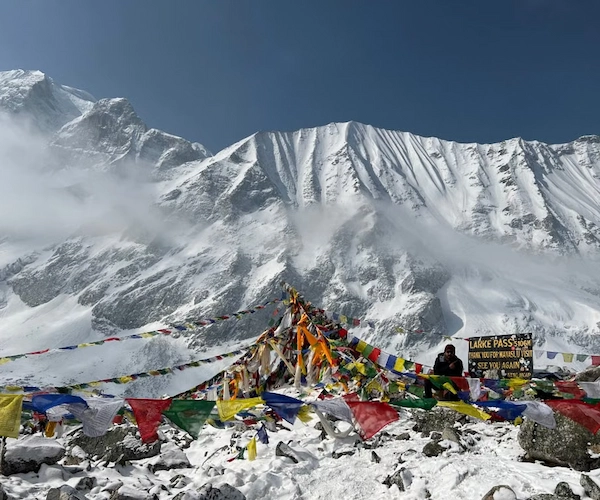
Larke La Pass (5,160m / 16,930 feet) is the heart of this trek. Understanding it is essential.
A high mountain pass—a saddle between two peaks. At 5,160m, it’s at the elevation where oxygen is critically thin. Many people experience altitude sickness here. Some experience severe symptoms. The pass is not technically difficult (no rock climbing), but the altitude is extreme.
The challenge:
Larke La Pass is challenging because:
You can find various effects in your body at various elevations. Knowing these bands will aid in knowing what to expect.
Sea Level to 1,500m: Comfortable Zone
Days 1-3 are in this band. You don’t feel different or out of place. No altitude symptoms. Oxygen is plentiful. Sleep is easy. Energy is high.
Your trip to Machha Khola (930m) and back to Kathmandu (1350m) is in this band. Altitude sickness is not experienced here when traveling through changes in elevation.
1,500m to 2,500m: Slight Adaptation Zone
Days 4-5 occur here. You start to feel the effects of the altitude, but not that much yet. Slight effects possible:
Mild tiredness
Slightly faster heartbeat on an uphill
Sleep may be slightly disturbed
Minor headache possible
The majority of trekkers find this band comfortable.
3,500m to 4,500m: Adaptation Zone
Days 6-8 occur here. They need to adapt in order for your body to adapt. This is where altitude sickness starts to become a possibility. Common effects:
This band can be controlled through proper acclimatization. For this band, the two acclimatization days (Day 8 at Samagaon, Day 10 at Samdo) have been arranged.
3,500m to 4,500m: Serious Adaptation Zone
Days 9-11 occur here. The risk of developing altitude sickness increases. Common effects:
This zone is a challenge for many trekkers. Others have mild to severe altitude sickness. For this reason Day 11 at Dharamsala (4,460m) may be the most difficult night (even though symptoms are at their worst before the pass).
From 4500m up to 6300m: Extreme Altitude Zone
This area is crossed on Day 12 when reaching the Larke La Pass (5,160m). Acute mountain sickness (AMS) and high altitude cerebral edema (HACE) are serious hazards at this point.
Effects:
Here it’s a short day (hours across the pass), then a descent. Day 13 at Tilije (2300m) is safe from extreme altitude.
The Manaslu Circuit trek is an altitude acclimatization trek. This is important to understand because you will know the reason for 17 days instead of 12.
A body’s physiological response to low oxygen is called acclimatization. In the absence of oxygen, your body makes adjustments:
If left to its own devices, the following adaptations will occur. Time is given on the Manaslu itinerary.
Days 1-3: Sea Level Adjustment (Kathmandu to Machha Khola)
You start at 1,350m, drive to 930m. Your body’s at sea-level equivalent. It is only travel and acclimatization hasn’t started.
Days 4-7: Gradual Ascent Phase (930m to 3,530m)
The journey takes you to the top of 2,600m over 4 trekking days. Rate: ~650m per day. This will be slow enough to make your body adapt without overwhelming.
The main guideline is to “Climb high, sleep low.
Example: Day 7 is Samagaon (3530m) up. Rather than sleep high, you sleep at 3,530m. The altitude is felt, but your body adapts over night and is better prepared the following day.
Day 8: Active Acclimatization Day
You stay at 3,530m. But, you trek to the Base Camp of Manaslu (4800m) or to a high point (~4200m), and then head back to the height of 3530m for night.
Why? The rule of “climb high, sleep low” is the best approach to acclimatization. Exposed at 4800m and stimulated/forced to adapt, then descend to 3530m, which is a better place for sleep/rest. The next day, your body should feel better.
Days 9-10: Mid-Elevation Push
You climb to Samdo (3,865m) with just 335m above what you did yesterday. Slow. Manageable. You will have another acclimatization day (Day 10).
Once again, it’s possible to walk up in the morning and back down to bed at night.
Day 11: Pre-Pass Staging
You head up to Dharamsala (4,460m), 595m gain. This is where acclimatization is important. You have now started to enter into altitude sickness territory. The night here is difficult. Sleep is poor. By morning, however, your body has adapted to 4460m.
Day 12: The Pass
Day 12 is a steep 700m climb to 5,160m, the tallest point reached during the whole hike. But here’s the crucial point: Your body has 8 days of gradual acclimatization before this point.
Acclimatization is essential if one is dropped at 5,160m without acclimatization (like a helicopter drop) or serious altitude sickness will be nearly universal. However, following 8 days of acclimatization, most healthy trekkers are able to cross the pass with some moderate altitude sickness.
The Result:
This is a 17-day trekking schedule with acclimatization days incorporated that allows for about 80-90% of the trekkers to successfully climb to 5160m. The success rate without acclimatization would be 30-40%.
The major health hazard of Manaslu is altitude sickness. It’s important to know how it works.
If you reach high elevations too fast and without acclimatization, the body will not be able to obtain sufficient oxygen. This causes altitude sickness. There are numerous types:
Acute Mountain Sickness (AMS): Most common type.
Symptoms:
The onset of AMS is usually between 6-24 hours after reaching altitude. This may be mild (manageable) or moderate (very uncomfortable). The majority of trekkers will suffer from some AMS above 3000m.
High Altitude Cerebral Edema (HACE): A rare but serious condition. Brain swelling occurs.
Symptoms:
HACE requires immediate descent. It’s an emergency situation.
High Altitude Pulmonary Edema (HAPE): This is a rare, but serious condition. The lungs are filled with fluid.
Symptoms:
The best rule for HAPE is to descend immediately. It’s a medical emergency.
Recognize vs. Normal Altitude Response: Many trekkers are confused about this: There are certain altitude symptoms that are just normal and expected. Not all headaches or nausea at high altitude is due to altitude sickness.
Normal responses to altitude (typical at 3,000m+):
These are not symptoms of altitude sickness. These are simply your body’s adjustments.
If these symptoms become severe or debilitating or get worse after acclimatization, it is considered as altitude sickness.
Serious altitude sickness can be indicated by the following:
If you are experiencing these, it means that the descent is required.
Understanding how much elevation you gain/lose each day helps with planning.
| Day | From | To | Elevation | Daily Gain/Loss | Cumulative Elevation |
|---|---|---|---|---|---|
| 3 | Kathmandu (1,350m) | Machha Khola (930m) | 930m | -420m | 0m (start) |
| 4 | Machha Khola (930m) | Jagat (1,340m) | 1,340m | +410m | +410m |
| 5 | Jagat (1,340m) | Deng (1,860m) | 1,860m | +520m | +930m |
| 6 | Deng (1,860m) | Namrung (2,630m) | 2,630m | +770m | +1,700m |
| 7 | Namrung (2,630m) | Samagaun (3,530m) | 3,530m | +900m | +2,600m |
| 8 | Samagaun (3,530m) | Samagaun (3,530m) | 3,530m | 0m (Rest Day) | +2,600m |
| 9 | Samagaun (3,530m) | Samdo (3,865m) | 3,865m | +335m | +2,935m |
| 10 | Samdo (3,865m) | Samdo (3,865m) | 3,865m | 0m (Rest Day) | +2,935m |
| 11 | Samdo (3,865m) | Dharamsala (4,460m) | 4,460m | +595m | +3,530m |
| 12 | Dharamsala (4,460m) | Larke La (5,160m) → Bimthang (3,720m) | 5,160m → 3,720m | +700m / -1,440m | +4,230m → +2,790m |
| 13 | Bimthang (3,720m) | Tilije (2,300m) | 2,300m | -1,420m | +1,370m |
| 14 | Tilije (2,300m) | Dharapani (1,860m) | 1,860m | -440m | +930m |
| 15 | Dharapani (1,860m) | Kathmandu (1,350m) | 1,350m | -510m | +420m |
| 16 | Kathmandu (1,350m) | Kathmandu (1,350m) | 1,350m | 0m (Rest Day) | +420m |
| 17 | Kathmandu (1,350m) | Departure | 1,350m | 0m (Departure) | +420m |
Larke La Pass stands at 5,160 meters (16,930 feet) above sea level. While it is lower than Mount Everest, it is still a very high Himalayan pass where altitude and weather demand proper preparation and acclimatization.
Yes. Altitude sickness can begin above 2,500 meters. Many trekkers first notice mild symptoms around Samagaun (3,530m). The scheduled acclimatization day there significantly reduces the risk of more serious altitude-related problems.
Both treks reach similar elevations, but the challenge is different. Everest Base Camp reaches 5,364m, while Larke La Pass reaches 5,160m. Larke La involves a steeper one-day ascent before crossing the pass, making it physically demanding despite its slightly lower altitude.
The lowest point is Machha Khola (930m) on Day 3. From there, the trail gradually climbs through the Manaslu region until reaching the highest point at Larke La Pass.
The standard itinerary includes two acclimatization days: one at Samagaun (3,530m) and another at Samdo (3,865m). These rest days help your body adapt before ascending to Dharamsala and crossing Larke La Pass.
Consult your doctor before your trek. Some trekkers use Diamox (Acetazolamide) to reduce the risk of altitude sickness, but it should only be taken under medical advice since it may cause side effects such as tingling sensations or changes in taste.
Yes. If you experience severe symptoms such as confusion, loss of coordination, or a severe headache, your guide will arrange an immediate descent. Descending to a lower altitude is the safest and most effective treatment for altitude sickness.
Drink at least 3–4 liters of water daily during the trek. Staying well hydrated helps reduce the risk of altitude sickness and improves recovery. Pale-colored urine is generally a good sign that you’re drinking enough.
Dharamsala sits at 4,460 meters, where oxygen levels are significantly lower. Many trekkers experience restless sleep due to altitude, combined with anticipation of the Larke La Pass crossing the following morning. This is common and usually improves after descending.
Not necessarily. Even very fit trekkers can develop altitude sickness. Good fitness makes walking easier, but proper acclimatization, a gradual ascent, adequate hydration, and following your guide’s advice are much more important for staying safe at high altitude.
Manaslu Circuit Trek’s 5,160m Larkya La Pass is achievable for most healthy trekkers. The trick is to know about elevation and respect the acclimatization process.
Manaslu’s elevation is not an obstacle; it’s a journey. You will begin at 930m and then climb up to 3,865m over the course of 8 days (2 acclimatization days). Your body adapts. Then, on Day 12, you cross the pass when your body is as adapted as it will be before you cross it.
Symptoms seen at elevation are normal and expected. These are the common problems faced by most of the trekkers above 3,500m which include headache, nausea, reduced appetite, and interrupted sleep. They are not failures; they are your body adapting.
The treatment is a descent. Severe symptoms on the pass or descent can be reduced by descending to lower altitudes where symptoms are vastly reduced.
Respect the itinerary. It has been designed by guides who have led thousands across this pass. Follow it. Avoid acclimatization days. Avoid running faster than the guide says to. The 17-day time schedule is put in place for your safety and success.
The prize is out of this world. The hike is at a height of 5160m at the Larke La Pass, with a view of 30 to 40 km over snowy Himalayan peaks, which is why thousands of people undertake it every year. The realisation comes from the altitude. The difficulty makes the view meaningful because we can appreciate it.
The majority of trekkers on the route, who acclimatize, drink plenty of water, and follow their guides, reach the pass of Larke La without a problem and continue their trek. You can be one of them!
Alliance Treks & Expedition Pvt. Ltd. Once is not enough for naturally and culturally Himalayas