(Viber, Whatsapp, Cell) +977 9851022814

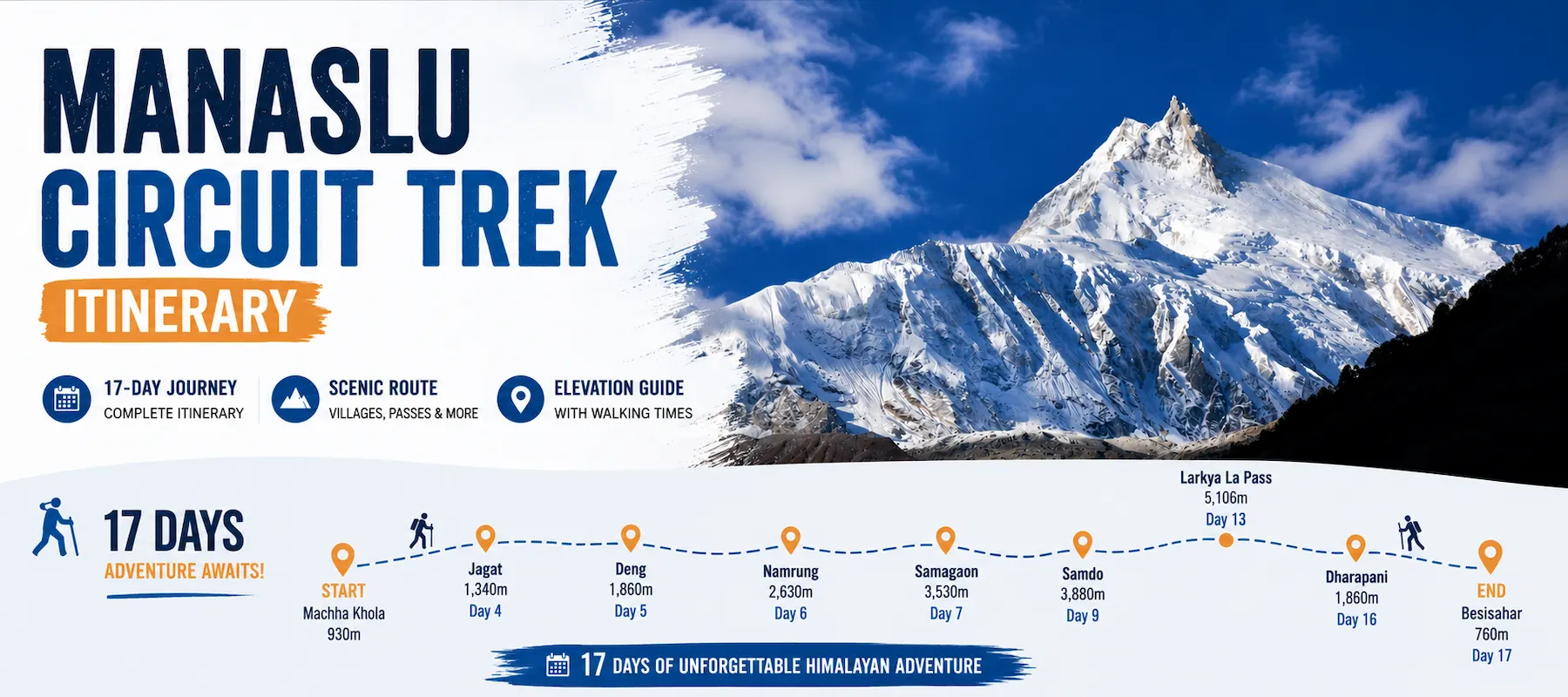
The Manaslu Circuit Trek isn’t just a trek. It’s a journey to around the 8th highest mountain on earth through one of the most remote and authentic regions in Nepal.
Since 1990, I have led more than 500 hikers on this trail. Most come with questions: not so many as Everest, they’ve heard. Standing at Larke La Pass (5,160m) on Day 12 as the Himalayan giants roll out interminably below them, they can see why we have dubbed this trek the ‘hidden masterpiece’.
In contrast to the heavily trafficked roads to Everest Base Camp and/or Annapurna, the Manaslu Circuit is protected and restricted: protected by permits and protected by geography. This translates into fewer crowds, more quiet and a more authentic wilderness experience. The villages en route (Samagaon, Samdo and Namrung) are not spoiled by mass tourism. People here are warm. The views are spectacular. This is a real challenge.
With this comprehensive guide, each day of the journey is revealed from the elevation and the amount of walking to the level of difficulty to the terrain to what you’ll see and what you’ll feel. From planning your adventure to just knowing what to expect, everything is here.
| Detail | Value |
| Total Days | 17 days |
| Walking Days | 13 days |
| Rest/Travel Days | 4 days |
| Total Distance | 180–200 km |
| Highest Point | Larke La Pass – 5,160 m |
| Starting Altitude | Kathmandu – 1,350 m |
| Average Daily Walk | 4–7 hours |
| Trek Grade | Challenging |
| Best Season | September–November, March–May |
| Permits Required | MRAP, MCAP, ACAP, TIMS, and Tsum Valley Entry Permit |
Day 1: Arrival in Kathmandu (1350m) after a day’s flight.
Your arrival is at Tribhuvan International Airport. We’ll meet with your representative. It takes about 30 minutes to drive to Thamel. The hotel you stay at is very simple but very comfortable—Atithi Hotel & Apartment.
Kathmandu is chaotic. Buses beep, streets are narrow, there is incense smoke in the air, prayer bells ring and street vendors shout. However, it’s also magical. The temples are old. The energy is virile. Rest today. Tomorrow is the day you’re going to explore the city.
Day 2: Kathmandu Sightseeing & Trek Preparation (1,350m)
Breakfast at 7 AM. You will be on a private tour of Kathmandu’s UNESCO World Heritage Sites by 9 AM:
Bouddhanath Stupa: one of the largest stupa in the world. Circumambulate it clockwise. Spin the prayer wheels. Feel the spirituality.
Pashupatinath Temple: sacred Hindu temple on the bank of Bagmati River. Watch sadhus (holy men) bathe. Witness cremation rituals. It is the untouched spiritual Nepal.
Patan durbar square: Ancient Palace, Temples, Courtyards. The architectural style of the Malla era. Photography paradise.
You meet your guide and porter by 5 PM. Brief meeting. Documents handed over. Questions answered. Dinner is early. Pack tonight. Sleep by 10 PM.
Day 3 – Drive from Kathmandu to Machha Khola (930m) | 10-11 hours drive
Early wake. 6 AM breakfast. You will be on the bus at 7 AM and be at Machha Khola by 9:30 AM. It’s a long but beautiful drive. You cross the Kathmandu Valley, down to the Terai and up the hills again. Roads wound round and round, river valleys, terraced fields and small villages. You have lunch at a roadside sandal restaurant (dhaba). The food is simple, but satisfying.
At the end of the afternoon, you arrive at Machha Khola (930m) which is a small village on Budhi Gandaki river. It is the gateway to the restricted Manaslu area. No hot water, squat toilet, cold room: Your teahouse is basic. But it’s clean. Dinner is dal bhat (rice and lentils). The long drive gives us a good night’s sleep.After a long drive we sleep well.
Day 4: Trek to Jagat (1,340m) | 5-6 hours walking | +410m elevation
The hike is along the Budhi Gandaki River and goes through the subtropical forest. Cliffs plunging into the water. Suspension bridges shake when you walk across them. Children run beside you shouting “Namaste!,” through small villages, Dolan, Soti Khola.
In the afternoon, you reach Jagat (1340m) where there is an official permit checkpoint. At the restricted area permit is checked. Your guide is responsible for the paperwork. You rest.
There are several teahouses in Jagat. The locals have been accustomed to trekkers. The dinner is dumplings (momos) and soup. YOU SLEEP WELL- YOUR LEGS FEEL THE WALK!
Day 5: Trek to Deng (1,860m) | 5-6 hours walking | +520m elevation
The path increases in difficulty. You come out of the subtropical forest and into temperate forest with rhododendrons, pines, oak trees. The terrain is lusher, wild. In crossing several river bridges, you are crossing several bridges. The ground is quite rocky in parts.
In the afternoon you reach the small Gurung village of Deng (1860m). Prayer flags are fluttering in the wind. On the top of this ridge there is a monastery. The air is cooler. After 2 days you’ve climbed 930m. Your thighs know it.
Day 6: Trek to Namrung (2,630m) | 5-6 hours walking | +770m elevation
Another steep day. The forest continues. There are more prayer flags and mani walls (stones inscribed with prayers). It is a landscape that is shifting – you have stepped into the Tibetan cultural zone! The houses now have flat roofs and are painted traditional colours.
The pretty village of Namrung (2,630m) overlooks Ganesh Himal and the surrounding ranges. A small monastery, friendly faces, stone houses. The air is a lot cooler. You’re acclimatizing to the altitude. Tonight, sleep is good.
Day 7: Trek to Samagaon (3,530m) | 6-7 hours walking | +900m elevation
It’s a large climbing day. The forest transitions to open valleys. You pass through yak’s field. Path turns to rocks, becomes less vegetated. The snow tops are now visible.
Mid-morning Mount Manaslu (8163m) comes into sight in the distant horizon. It’s big, a triangular peak dominating the whole landscape. Your guide will tell you. All the trekkers pause to gaze.
Samagaon (3530m) is a bigger village with more lodges, a monastery and local shops. This is the place where many trekkers stay for 2-3 days for acclimatization. It is definitely thin air. You have increased difficulty breathing during light activity. Headaches are common. Drink water. Rest.
Day 8: Acclimatization Day in Samagaon (3,530m)
You rest. A trek to Manaslu Base Camp (4800m) or Birendra Lake is a good acclimatisation walk but not too strenuous.
Base Camp is a 4-5 hour hike. The track heads up cliffs and leads to glaciers. The scale of Manaslu’s gigantic north face is felt when you are standing at Base Camp and gazing up at the towering peak. This summit has been the site of fatalities for climbers. It commands respect.
Or, you can go to Birendra Lake, which is shorter and less difficult (2-3 hours round trip). Glacial lake with peaks in the background. Stunning photography.
You are required to come back to Samagaon by afternoon. Take a nap and drink water and food. Tomorrow is a short day.
Day 9: Trek to Samdo (3,880m) | 3-4 hours walking | +350m elevation
A short day. The trail continues to ascend gradually. The landscape is becoming more and more treeless – alpine tundra. Prayer flags are waving in the wind. Samdo is a remote village near the Tibetan Border. There are very few teahouses. The indigenous inhabitants are Tibetan. It is possible to view Tibet from here.
Samdo is the highest village on the trail before the pass. There is a considerable elevation. Your body is making red blood cells. I may have difficulty sleeping. This is normal.
Day 10: Sampling & Exploring (Samdo)
Samdo (3,880 m) is our next stop for Day 10: Acclimatization Day.Day 10: Acclimatization Day (Samdo 3,880 m)
Another rest day. Your body needs it. Here, the altitude is serious, at 3,880m. Mild altitude sickness symptoms – headache, nausea, insomnia – are experienced by some trekkers.
A hike along local ridges provides glimpses of Tibet. The border is near. Yak herds graze. Prayer flags are scattered all over the ground. One of the most far-flung inhabited regions of Nepal.
Take the day off, eat, drink water and get used to the surroundings. This day is frequently the decisive day in becoming a successful climber or a casual retreater from the pass because of altitude.
Day 11: Trek to Dharamsala (4,460m) | 4-5 hours walking | +580m elevation
The ascent continues. Dharamsala (also called Larke Phedi—”phedi” means base) is the staging point for crossing the pass. Rocky and windy landscape. Snow patches appear.
You’re now at 4,460 metres, higher than the highest point on the Everest Base Camp trek! The air is very light. The steps must be done thoughtfully. Some trekkers experience an increase in the intensity of their headaches. This is a case of the power of altitude.
There are simple accommodation facilities in Dharamsala. The food is warm. You have trouble sleeping—the body doesn’t sleep well at this height. Now you’re almost to the biggest challenge.
Day 12: Cross Larke La Pass (5,160m) & Trek to Bimthang (3,720m) | 8-9 hours walking
That is the glitz and glamour. You wake at 4 AM. Breakfast early, at 5 AM. Your guide serves meals. At 6 AM it’s time to hit the trail.
It is about 3-4 hours hike up to Larke La Pass from Dharamsala. The trail is uphill and rocky. Snow and ice is present. You are having difficulty breathing. Your speed drops start to drop a lot. This is the reality of trekking at high altitudes.
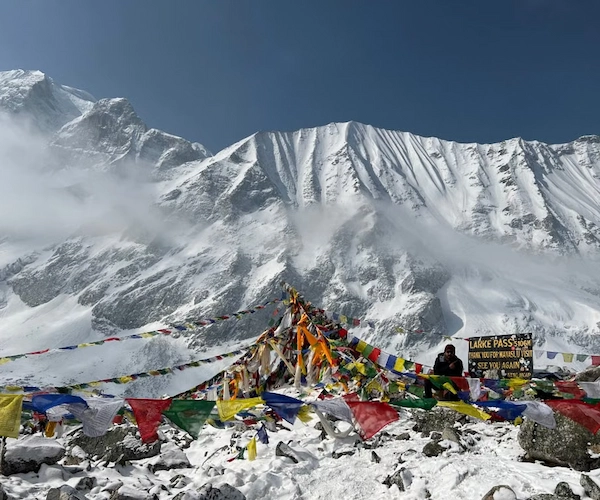
By 9-10 AM, you reach Larke La Pass (5,160m). Stop. Turn around. It is hard to put into words what a view this is. In the north snow-covered peaks of the Himalayas. To the south, giant mountains, like Annapurna II. You’re at a crossroads between worlds.
Many of the trekkers cry here. Not because it hurts, but because of its size. You’ve reached 5,160 meters. You’ve crossed one of Nepal’s most challenging passes.
It’s a long descent after 30-60 minutes. Bimthang is 4-5 hours downhill. Tomorrow you will feel it on your knees, but the pleasure of the crossing is so great that it will make up for it.
By the end of afternoon you arrive at Bimthang (3,720m) amidst the glacial valleys and the peaks. You’re exhausted but euphoric. The toughest is over.
Day 13: Trek to Tilije (2,300m) | 6-7 hours walking | –1,420m descent
The descent is long but rewarding; The terrain slowly becomes varied. Alpine tundra transitions to forests. The temperature of the air increases. Vegetation returns.
Tilije is a peaceful village at an altitude of 2,300m. Your knees hurt because you have come down the hill. You’re down now though; oxygen is more available. Breathing is easier.
Day 14: Trek to Dharapani (1,960m) | 5-6 hours walking | –340m descent
The last day of the trek. The path passes through some villages and forests. Dharapani is a bigger town – a stop on the famous Annapurna Circuit Trek. Now, the section of Manaslu Circuit is complete.
In the late afternoon, you will reach Dharapani. You have been walking for 13 days! You are now at 5160m. You have climbed up a pass in the Himalayas. You have successfully made one of the toughest treks in Nepal.
That night, celebration dinner. Your guide and porters are on hand. Everyone is smiling. Tomorrow, you return to Kathmandu.
Day 15: Drive from Dharapani to Kathmandu via Besisahar | 7-8 hours drive
You’re picked up by one of the locals Jeeps in the early morning and driven to Besisahar (1.5 hrs). There is a public bus from Besisahar to Kathmandu (5-6 hours).
The road is rough and dusty with plenty of reflection. The scene changes as you watch mountains turn into hills and hills into valleys. At night, you are again in the bustling city of
Kathmandu. It’s not the same today. You’ve changed.
Day 16: Free Day in Kathmandu (1,350m)
Rest. Explore. Shop for souvenirs. Try out cafes in Thamel. Get a massage. Wash your clothes. Process your experience.
Day 17: Departure
Get ready for breakfast at your hotel. Take on the plane to the airport. Flight home.
You have finished your 17 day Manaslu Circuit trek.
This trek is rated Challenging, and here’s what that means:
| Factor | Challenge Level |
| Altitude | High (5,160m) – requires acclimatization |
| Distance | Long (180–200 km over 13 walking days) |
| Technical Skills | Low – no climbing equipment needed |
| Terrain | Mixed – forests, rocky slopes, alpine passes |
| Daily Walking Hours | 4–7 hours average |
| Hardest Days | Day 12 (Larke La Pass), Day 11 (Dharamsala) |
Verdict: September-November offers perfect trekking conditions.
You cannot walk into this trek unprepared. The Larke La Pass demands fitness.
Special Tip: If you can comfortably hike for 7+ hours with a 15 kg pack and handle altitude, you’re ready.
What happens: You reach Samagaon feeling fine, skip the acclimatization day, and push straight to Dharamsala. Altitude sickness hits. You’re vomiting at the pass. You turn back.
Fix: Follow the itinerary exactly. Days 8 and 10 (acclimatization days) are sacred. Climb high, sleep low.
What happens: You sleep in on Day 12, eat a slow breakfast, start the pass at 8 AM. By 2 PM, you’re still climbing. The sun sets. You descend in darkness. Dangerous.
Fix: Wake at 4 AM on Day 12. Breakfast by 5 AM. Start climbing by 6 AM. Reach the pass by 10-11 AM.
What happens: You bring 18 kg. Your porter struggles. You move slowly. Your knees hurt. By Day 6, you’re exhausted.
Fix: Pack maximum 12-15 kg. Your porter carries 15-20 kg. Use a packing checklist.
What happens: Headache on Day 7. You ignore it. By Day 9, you’re confused and vomiting. Severe altitude sickness.
Fix: Talk to your guide immediately if you feel odd. Headache + nausea + insomnia = altitude sickness. Rest, drink water, rest more. Descend if needed.
What happens: You drink 1-2 liters daily. Your headache worsens. You assume it’s altitude (maybe it is, maybe it isn’t).
Fix: Drink 3-4 liters daily. Your urine should be clear. Boiled water is provided at every lodge.
Possibly. Around 40–50% of trekkers experience mild altitude symptoms, but severe cases are uncommon with proper acclimatization. Days 8 and 10 are the most important for adjusting to the altitude.
No. The Manaslu Circuit is a restricted trekking region, so a licensed guide is mandatory. Trekking with an experienced guide also improves your safety and overall experience.
Not if you cross it under normal conditions. Starting early, monitoring the weather, and following your guide’s instructions significantly reduce the risks. Most problems occur when trekkers start late or ignore changing weather.
Your guide will assess the situation and arrange the safest option, including turning back or descending if necessary. Your safety always comes before completing the trek.
A common guideline is USD $10–15 per day for your guide and USD $7–10 per day for each porter. While tipping is optional, it is a meaningful way to recognize excellent service.
Autumn (September–November) offers the clearest skies and most stable weather, making it the most popular season. Spring (March–May) is another excellent choice, with pleasant temperatures and blooming rhododendron forests.
Much less crowded than the Everest Base Camp or Annapurna Circuit treks. Its restricted-area status keeps visitor numbers low, making it ideal for trekkers seeking solitude, authentic mountain culture, and quieter trails.
Alliance Treks & Expedition Pvt. Ltd. Once is not enough for naturally and culturally Himalayas