(Viber, Whatsapp, Cell) +977 9851022814

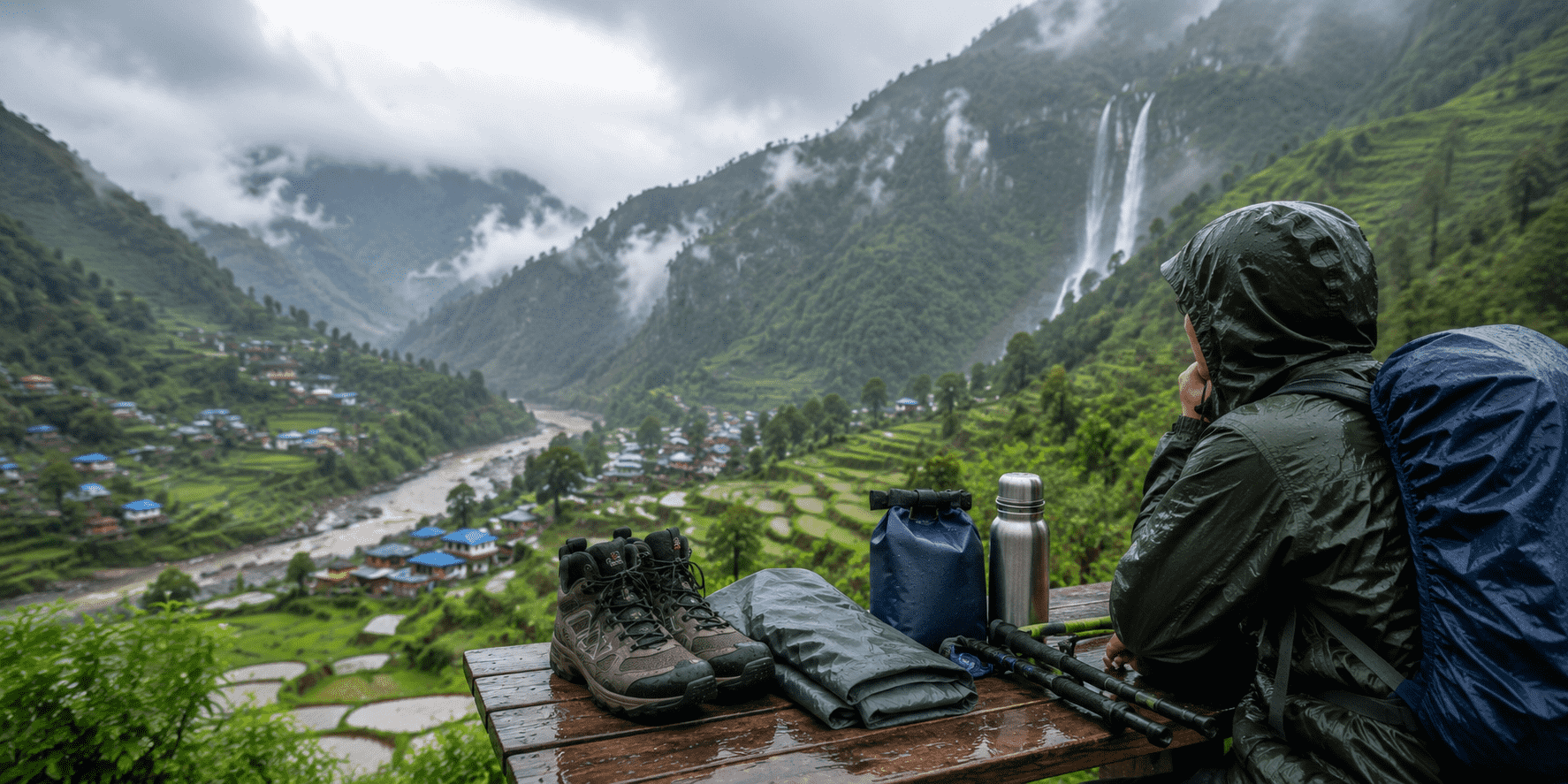
Nepal Monsoon packing list is the most thing people picture when they first book their trip.
During monsoon Nepal is greener, louder, more alive, and honestly — once you’ve been here in monsoon — more beautiful than the postcard version. The terraced hillsides look like something out of a painting that’s been left out in the rain in the best possible way. Waterfalls appear on cliffs that are bone dry in October. Festivals like Janai Purnima fill the temples with pilgrims and the air with incense and chanting. The crowds that descend on Kathmandu every autumn? Largely absent.
But Nepal during monsoon season does ask something of you. It asks that you come prepared.
At Alliance Treks, we’ve been planning and guiding Nepal trips for 34 years — including through some genuinely impressive monsoons. The travellers who have the best time during Nepal’s rainy season are almost never the ones who packed the most. They’re the ones who packed the right things. This blog is our attempt to tell you exactly what those things are.
Before we get into the list, it helps to understand what Nepal’s monsoon actually looks like on the ground — because packing for it means packing for several different conditions at once.
Nepal’s monsoon runs roughly from June through September, with peak rainfall in July and August. But it’s not the same everywhere. In Kathmandu, monsoon means warm, humid days with heavy afternoon or evening downpours — mornings are often clear and perfectly pleasant. In the mid-hills, it means persistent mist and frequent rain throughout the day. At altitude — on treks like Gosainkunda or the Annapurna Circuit — it means cold nights, wet trails, and weather that changes faster than you’d expect.
A Nepal monsoon vacation packing list therefore needs to cover: city days in Kathmandu, possible day hikes or cultural excursions, and for some travellers, multi-day monsoon treks. The good news is that these three contexts have more overlap than you’d think, and a well-planned bag of around 10–12 kg can handle all of them comfortably.
This is where most people either get it right or spend their first two days in Kathmandu buying replacements at Thamel’s outdoor shops (which, to be fair, are excellent — but you’ll pay more than you need to).
A quality rain jacket — not a poncho. The temptation to pack a cheap poncho is understandable. Resist it. A proper waterproof and windproof jacket with a hood — something in the Gore-Tex or similar membrane range — will serve you across every situation Nepal monsoon throws at you. It doubles as a layer on cold mountain mornings. A poncho, on the other hand, turns into a sail on windy ridgelines and is genuinely miserable on any trail with low-hanging vegetation.
A rain cover for your daypack. Most good daypacks come with one built in. If yours doesn’t, buy a separate pack cover before you leave. Your camera, phone, and passport do not want to find out what a Nepali downpour feels like from the inside of an unprotected bag.
A dry bag or two. Small roll-top dry bags — even cheap ones — are worth their negligible weight. Keep your electronics, documents, and a change of clothes in one. On a trek, this small habit separates the people who have a miserable wet night from the people who don’t.
A compact travel umbrella. For Kathmandu city days, an umbrella is actually more practical than a rain jacket. Locals use them. They’re lighter, cooler, and perfectly adequate for the kind of short, sharp showers that characterise monsoon mornings in the valley. Pack both the jacket and the umbrella — they serve different moments.
Ask any experienced trekker what single item matters most for a Nepal monsoon vacation and the answer is almost always footwear. Wrong shoes in monsoon conditions don’t just make you uncomfortable — they make trails dangerous.
Waterproof trekking boots with ankle support are essential if you’re planning any hiking or multi-day trekking. Look for boots with a Vibram or similar rubber sole — the grip on wet rock and muddy trail is genuinely different from standard soles. Make sure they’re broken in before you travel. New boots on a monsoon trail are a recipe for blisters.
Lightweight sandals or slip-ons for temples and guesthouses. You’ll be removing your shoes constantly — at temple entrances, at guesthouses, at people’s homes if you’re invited in. A pair of simple Crocs or Tevas that can get wet and dry quickly will save you considerable time and frustration.
Gaiters — often overlooked, almost always appreciated. Short trail gaiters keep mud and water out of your boot tops on wet trails. If you’re trekking during monsoon, pack them. Your socks will thank you.
A practical note from 34 years of guiding: leeches are real on monsoon trails in Nepal’s forested areas below 2,500m. They are harmless but surprising. Tucking your trousers into your socks and using gaiters is the most effective deterrent. Salt packets are a traditional remedy if one does attach — your guide will always have some.
The key principle for Nepal monsoon vacation clothing is layers and quick-dry fabric. Cotton is the enemy — it stays wet, gets heavy, and takes forever to dry in humid conditions. Everything touching your skin should be synthetic or merino wool.
3–4 quick-dry t-shirts or base layers. Synthetic or merino. You’ll sweat in the humidity of the valley and possibly get rained on — these need to dry overnight in a guesthouse room, which they will if they’re the right fabric and cotton if they’re not.
2 pairs of lightweight trekking trousers. Ideally zip-off styles that convert to shorts — useful in warm valley sections and convertible to full-length on mountain trails or at temples. Avoid jeans entirely. Wet denim is heavy, slow to dry, and chafes on long walking days.
A warm mid-layer. A fleece or lightweight down jacket is necessary for anyone going above 3,000m, and genuinely useful in Kathmandu on cool monsoon evenings. Packable down jackets compress to almost nothing and weigh very little.
Modest clothing for temples and cultural sites. Nepal is a deeply religious country and dress expectations at temples are real — shoulders and knees covered. For women especially, a light cotton salwar kameez (the traditional South Asian tunic-and-trouser set, easily bought in Kathmandu’s Thamel or Asan markets for a few hundred rupees) is both respectful and practical for the climate. For men, lightweight long trousers and a collared shirt cover most situations.
Thermal base layers if you’re trekking above 3,500m. The Gosainkunda area at 4,380m is cold at night even in August. Don’t underestimate altitude temperature drops.
2–3 pairs of moisture-wicking underwear and trekking socks. Merino wool socks are worth the price — they resist odour, regulate temperature, and stay comfortable even slightly damp.
Monsoon season in Nepal brings specific health considerations that your packing list needs to address directly.
Water purification. Tap water in Nepal is not safe to drink at any time of year, and during monsoon the risk of waterborne illness increases as drainage systems are under pressure. Pack water purification tablets or a quality filter bottle (LifeStraw or Sawyer Squeeze are both reliable). At most guesthouses and tea houses you can buy or boil water, but having your own purification means you’re never dependent.
Oral rehydration salts (ORS). Readily available in Kathmandu pharmacies, but worth bringing a small supply. Monsoon heat and trekking exertion can dehydrate you faster than you expect, and stomach issues — while not inevitable — are more common in the rainy season.
A solid first aid kit. At minimum: blister plasters, antiseptic wipes, bandages, ibuprofen and paracetamol, antihistamines, antidiarrhoeal medication, and any prescription medication you take regularly with extra supply. For trekkers: include altitude sickness medication (Diamox — consult your doctor before travel) and moleskin for blister prevention.
Insect repellent with DEET. Mosquitoes are more active during monsoon in Nepal’s lowlands and valley areas. A repellent of at least 30% DEET concentration is recommended. Apply especially in the evenings.
Sunscreen — yes, even in monsoon. UV exposure is significant at altitude even on overcast days. Clouds filter light but not UV radiation. Pack SPF 50 for any days above 2,000m.
Hand sanitiser and wet wipes. Water for handwashing is not always immediately available on trails. These are small and earn their space many times over.
A quality waterproof phone case or pouch. Your phone is your map, camera, communication device, and flashlight. Protect it. Universal waterproof pouches that work with any phone size are cheap and reliable.
A portable power bank. Power cuts are more frequent in Nepal during monsoon season. Guesthouses on trekking routes may have limited charging. A 20,000mAh power bank keeps your phone and camera alive for several days between mains charges.
A headlamp with spare batteries. Essential for trekkers. Also useful in Kathmandu guesthouses during power cuts, which do happen. Keep it in your daypack, not your main bag.
A universal travel adapter. Nepal uses Type C, D, and M plugs. A universal adapter covers all situations.
A waterproof camera or action camera if photography matters to you. Monsoon light in Nepal — particularly the soft, diffused quality of a cloudy afternoon in the Kathmandu Valley or the dramatic contrast when clouds break over a Himalayan ridge — is genuinely beautiful. A camera that survives rain is an investment you won’t regret.
A waterproof document wallet. Your passport, visa, travel insurance documents, and emergency contacts should be in a waterproof sleeve at all times during monsoon travel. Losing these to a downpour is a consular nightmare you don’t need.
Cash in Nepali rupees. Many smaller temples, street stalls, and rural guesthouses do not accept cards. ATMs in Kathmandu are reliable; outside the city they become less predictable. Carry enough cash for at least 2–3 days at any given time.
A printed copy of your travel insurance. Medical evacuation from a remote trekking area requires insurance that covers helicopter rescue — make sure yours does, and carry a physical copy.
Trekking poles. On monsoon trails, muddy descents become significantly more manageable with poles. Collapsible aluminium or carbon poles pack down small and are worth every gram on a wet trail.
A lightweight microfibre towel. Guesthouses in Nepal provide towels, but on trekking routes they’re often thin and slow to dry. A microfibre travel towel dries in minutes and takes up almost no space.
Zip-lock bags in multiple sizes. Laughably low-tech and astonishingly useful. Keep snacks dry, organise small items, protect electronics in a pinch. Pack ten. Use all of them.
A small padlock. For hostel lockers and guesthouse rooms. Small, light, worth having.
Reusable water bottle. Nepal is actively working to reduce single-use plastic waste in its national parks and trekking areas. Bring a durable reusable bottle and use the purification system above — it’s better for your wallet and significantly better for Nepal’s trails and rivers.
Just as important as what goes in is what stays home.
Heavy cotton clothing — as mentioned, cotton is the wrong fabric for monsoon Nepal. Leave it.
Multiple pairs of jeans — one at most, for Kathmandu evenings. They’re heavy, slow to dry, and take up space that better items need.
Expensive jewellery or valuables — Kathmandu is generally safe, but there’s no reason to travel with items you’d be devastated to lose. Leave them.
More than one week’s worth of clothing — Nepal has laundry services everywhere, including on most major trekking routes. Pack for 5–6 days and wash as you go. Overpacking is the single most common mistake first-time visitors make.
Excessive medical supplies — a solid basic kit is essential, but there are well-stocked pharmacies in Kathmandu and Pokhara. You don’t need to carry a field hospital.
Knowing what to pack is half the equation. The other half is having the right team on the ground when you arrive.
Alliance Treks has been planning Nepal vacations — including monsoon season tours, cultural festival trips, and Kathmandu Valley experiences — for 34 years. We know the trails that hold up in heavy rain and the ones that don’t. We know which guesthouses are genuinely comfortable during monsoon and which aren’t. We know how to build an itinerary around Nepal’s monsoon calendar so that the rain becomes part of the experience rather than an obstacle to it.
Whether you’re visiting Nepal for the first time and want a guided cultural tour of Kathmandu, Pokhara, and the surrounding valleys, or you’re a returning trekker looking for a monsoon route that most agencies won’t touch — we’ve done it, and we’d like to help you do it too.
Plan your Nepal monsoon vacation with Alliance Treks →
Yes — with the right preparation. Monsoon Nepal is less crowded, more affordable, and extraordinarily green. Festivals like Janai Purnima make late July and August particularly special. The key is packing correctly and choosing an itinerary suited to the season.
Yes, with important caveats. High-altitude treks above 3,500m are generally manageable with a good guide and proper gear. Some lower trails become slippery or affected by landslides. Alliance Treks recommends trekking routes that are proven for monsoon conditions — ask us before you book.
Waterproof trekking boots — if you’re trekking. A quality rain jacket — if you’re city-based. Everything else is secondary to keeping your feet dry and your core warm.
Aim for 10–12 kg total for a two-week Nepal monsoon vacation. Anything more and you’ll feel it — especially on temple stairs, cobbled Kathmandu streets, and any trail gradient above mild.
The best packing list for a Nepal monsoon vacation is the one that lets you forget about your bag and pay attention to where you are.
Nepal’s monsoon season asks very little of you, really. A decent jacket. Boots that grip wet stone. Clothes that dry overnight. The willingness to get a little wet and find it beautiful anyway.
Everything else — the festivals, the food, the kindness of the people, the green hills, the rivers in full thunder — Nepal provides.
Come prepared. Come open. The monsoon will do the rest.
If you’re ready to experience Nepal beyond the usual tourist season, Alliance Treks can help you plan a safe, comfortable, and memorable monsoon journey. From cultural tours and wildlife safaris to customized private itineraries, our local experts take care of every detail so you can simply enjoy the experience. Contact us today to start planning your Nepal monsoon vacation.
Alliance Treks & Expedition Pvt. Ltd. Once is not enough for naturally and culturally Himalayas