(Viber, Whatsapp, Cell) +977 9851022814

Monsoon visit to Nepal is far more rewarding than most people imagine, revealing breathtaking scenery, fewer crowds, and unique experiences that are impossible to find during the peak trekking seasons. Most people will tell you to avoid Nepal in the monsoon. Ask anyone planning a trip and you’ll hear the same advice on repeat: go in October for clear skies, or March for the rhododendrons, and whatever you do, skip June, July, and August. The rain will ruin everything, they say.
We’ve spent over three decades guiding travelers through these hills at Alliance Treks, in every season the calendar offers, and we’re here to gently disagree. Not loudly — monsoon does come with real trade-offs, and we’ll be honest about those too. But there’s a version of Nepal that only exists in the rain, a quieter, greener, more intimate country that the October crowds will simply never meet. If you’re the kind of traveler who finds beauty in moody skies as easily as blue ones, keep reading. Here are seven reasons monsoon visit to Nepal might just be the best time to fall in love with Nepal.
It helps to understand the season itself before diving into why it’s worth braving. Nepal’s monsoon typically arrives in the second week of June and lingers through early September, occasionally stretching closer to mid-September in recent years as weather patterns shift. The rain is heaviest in July and August, but it rarely falls in one long, miserable stretch. Most days follow a familiar rhythm: a fresh, often clear morning, building clouds through the afternoon, and a proper downpour by evening or overnight. That pattern alone changes how you should think about traveling here in summer — it isn’t twelve straight weeks of grey skies, but rather a season with its own particular clock, one that rewards travelers who plan around it instead of fighting it.
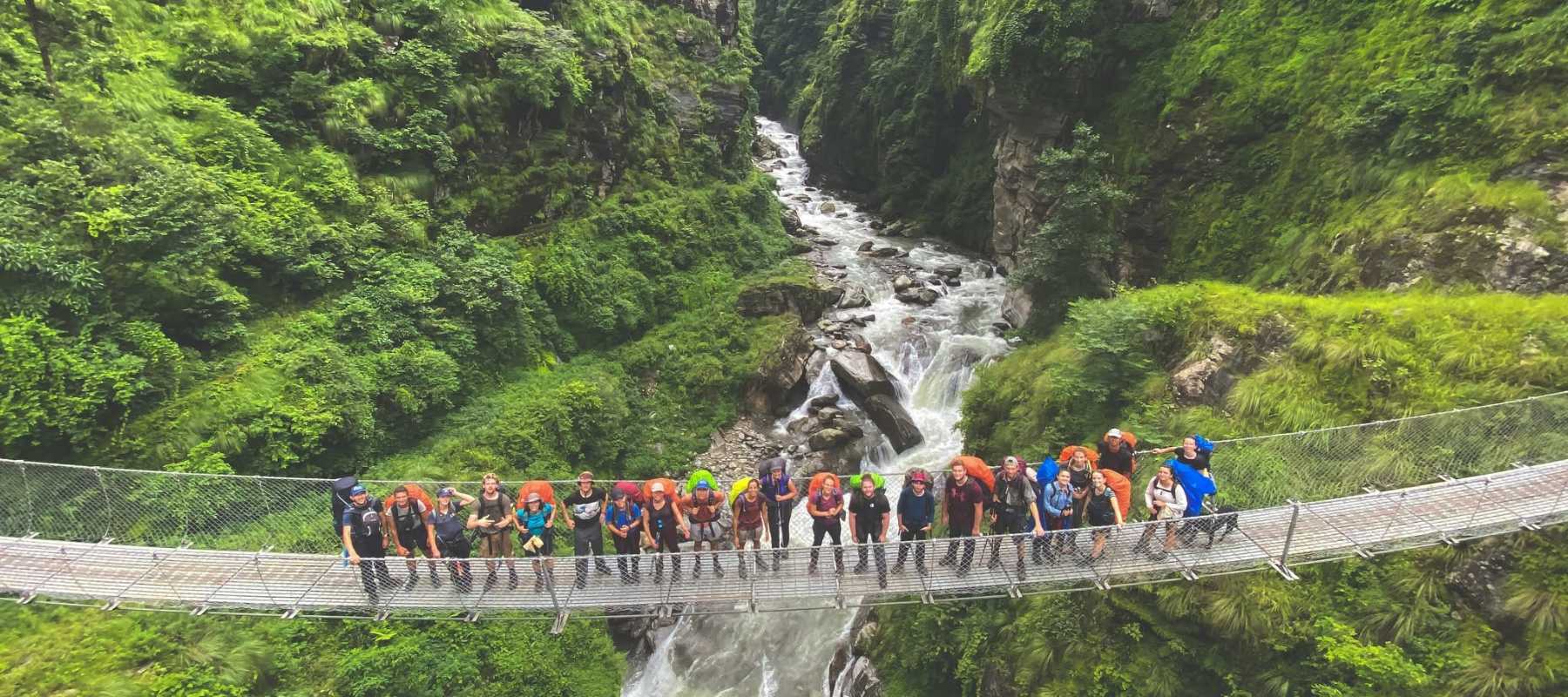
There’s a particular shade of green that only shows up in Nepal between June and August, and no photograph quite does it justice. A monsoon visit to Nepal reveals a side of the country that few travelers ever experience. The dust of the dry season washes away, and rice terraces that looked dry and tired in April swell into brilliant, cascading sheets of color, tier after tier down the hillsides, almost too vivid to be real. Waterfalls appear on cliff faces where there was nothing before. Forests that felt still in spring start to drip and hum with new life.
If you’ve only ever seen Nepal in autumn’s earthy gold, monsoon will genuinely surprise you. This is a different country wearing a different face — alive, urgent, growing right in front of you. Photographers who make the trip during these wet months often say it produces their most striking work, simply because nowhere else looks quite like this for the other nine months of the year.
There’s also something quietly moving about watching a landscape work this hard to renew itself during your monsoon visit to Nepal. Hike through the Kathmandu Valley’s outskirts, or along the lower trails near Pokhara, and you’ll see hillsides that were brown and brittle just weeks earlier now bursting with rice seedlings, wildflowers pushing through every gap in the stone terraces, and butterflies that seem to appear out of nowhere the moment the rain lets up. We’ve had guests stop mid-sentence on a trail simply to look around, almost in disbelief that this is the same country they walked through during a previous, drier visit.
Here’s something nobody mentions enough: monsoon is the off-season, and off-season means space. Real space. The kind where you can sit on a teahouse porch in Bandipur, watching rain sweep across the valley below, without another traveler in sight. Where Poon Hill Trek or the cobbled streets of Bhaktapur Durbar Square, normally shoulder-to-shoulder with visitors, suddenly feel like they belong only to you.
A monsoon visit to Nepal reveals a side of the country that remains hidden during the busy trekking months. We’ve watched guests go quiet in these moments — not because the view took their breath away in the usual dramatic sense, but because of how rare true stillness has become when traveling. No queue for a teahouse bunk. No jostling for the same photo angle. Just you, the rain, and a version of Nepal that feels personal rather than performed.
This matters more than it might sound. Anyone who has visited a famous landmark only to spend the visit dodging selfie sticks and waiting in line knows that crowds change the emotional texture of a place. A nearly empty Durbar Square in the rain, pigeons sheltering under temple eaves, a single tea seller calling out from his stall, feels closer to how these spaces were actually meant to be experienced — lived in, not performed for cameras. Even popular trekking lodges that overflow with bunk-bed-to-bunk-bed crowding in October will often have entire rooms free in July, giving you the rare luxury of choosing your own pace rather than racing other trekkers to secure a bed before dark.
Travel is never just about the destination — it’s about what the destination costs you to reach, too. During monsoon visit to Nepal, hotel rates dip, trekking permits and packages often come with off-season pricing, and even smaller guesthouses are happy to negotiate. Lower demand means better deals, plain and simple.
For travelers stretching a budget to make a long-held dream trip happen, this matters. It can mean the difference between a rushed week and a properly unhurried two weeks, or between watching your funds carefully and actually relaxing into the experience. Nepal doesn’t ask you to pay peak-season prices to fall in love with it.
This is the part most travel articles bury, and it might be the single best-kept secret in Nepali travel: not all of Nepal floods during monsoon. Tucked behind the high wall of the Himalayas, regions like Upper Manang trek, and Dolpo sit in what’s called a rain shadow — the clouds dump their moisture on the southern slopes and arrive here almost spent.
Upper Mustang in particular is extraordinary during these months. The ancient walled city of Lo Manthang, its whitewashed buildings stacked against ochre cliffs, looks more like Tibet than the Nepal most people picture. Trails that compete for space on the Annapurna Circuit in October sit nearly empty here. The light during monsoon is dramatic and shifting, clouds building over the southern peaks without ever quite arriving, casting shadow and sun across red rock valleys in a way that feels almost cinematic. If you’ve ever wanted to step into “old Nepal,” largely untouched and genuinely remote, this is your season to do it.
Dolpo, further west and even less visited, offers a similar reward for travelers willing to commit to a longer, more remote itinerary. This region remained closed to outside visitors until 1989, and it still feels like a place that exists slightly outside of time — ancient monasteries, wind-scoured trails, and horses moving across barren high-altitude plains while monsoon clouds gather harmlessly over the mountains to the south. These rain-shadow treks do require special permits, and they’re not the easiest routes for first-time trekkers, but for experienced hikers, they represent some of the most rewarding walking anywhere in the Himalaya — made only better by the fact that almost no one else is doing it alongside you in these particular months.
Monsoon visit to Nepal isn’t a quiet season culturally — it might be one of the busiest. This is when the agricultural and spiritual calendar comes alive in ways visitors rarely get to see.
In late June, Dhan Ropai (also called Ropai Diwas or National Paddy Day) fills the rice paddies with mud-splashing, folk songs, and entire farming communities planting the year’s rice by hand — and increasingly, travelers are invited to join in, feet in the mud, right alongside them. Yes, you can participate in this joyful celebration yourself; learn what to expect in our guide to the Dhan Ropai Festival in Nepal.
In August, Janai Purnima draws pilgrims to the high-altitude waters of Gosaikunda Lake for a sacred thread-changing ritual, while Gai Jatra, the colorful “Festival of Cows,” turns Kathmandu’s streets into a joyful, slightly chaotic parade. None of this exists for an audience. It exists because it always has, every single year, rain or no rain — and that’s exactly what makes witnessing it feel like such a privilege.
If the sound of rushing water does something to you, a monsoon visit to Nepal is your season. Rivers that trickle gently in the dry months swell into something far more powerful, and for adrenaline seekers, this is peak white-water rafting season on rivers like the Trishuli and Bhote Koshi, where the rapids reach their most thrilling levels.
Even if rafting isn’t on your list, the sheer presence of water everywhere — waterfalls cascading off cliffs that were bare in spring, rivers running fast and white through gorges, and the constant gentle hum of rainfall on a teahouse roof at night — adds a sensory richness to the trip that dry-season travel simply doesn’t offer. A monsoon visit to Nepal reveals a side of the country that few travelers get to experience. Nepal in monsoon sounds different. It feels alive in a way that’s hard to describe until you’ve sat through it yourself.
This is the reason that matters most to us. When the crowds thin out, something shifts. During your monsoon visit to Nepal, with no doubt, shopkeepers have time for an actual conversation instead of a quick transaction. Guides aren’t rushing between back-to-back groups. Farming families, deep in the work of the planting season, welcome you not as a tourist passing through but as an extra pair of hands for the day.
We’ve had guests tell us that a single rainy afternoon spent under a teahouse awning, talking with a host family while the rain hammered the tin roof above them, meant more than any clear-sky summit photo from a previous monsoon visit to Nepal. There’s an intimacy to traveling somewhere during its hardest, wettest, least “Instagram-perfect” season. It strips away the performance and leaves something closer to the truth of the place — and of the people who live there all year round, rain included.
There’s a kind of trust that builds, too, when you choose to show up for a place during its harder months rather than only its easiest ones. Local families notice. Shopkeepers remember the travelers who came through in July, soaked and laughing about it, more than the ones who passed through on a perfect October afternoon indistinguishable from a hundred others. Monsoon visit to Nepal proves that you are one of the travelers who genuinely wanted to be there, rain or not — and that intention has a way of opening doors, both literal and otherwise, that stay closed to the crowd that only comes when conditions are convenient.
We wouldn’t be doing our job if we didn’t mention the real trade-offs. During monsoon visit to Nepal you may experience fights, especially the short mountain hop to Lukla, get delayed or cancelled more often due to low visibility. Leeches show up on lower-altitude forest trails — harmless, but not everyone’s favorite travel companion. Trails get muddy and slippery, particularly on popular routes like Everest Base Camp trek or the Annapurna Circuit trek, so this isn’t the ideal season for first-time trekkers tackling those specific paths. And yes, the iconic snow-capped panoramas you’ve seen in postcards are often hidden behind cloud, with only occasional clear windows, usually early morning after a night of rain.
None of this makes monsoon visit to Nepal any less memorable or a wrong decision. It makes it a different time to visit — one that asks for a bit more flexibility and rewards you with a side of Nepal that dry-season visitors simply don’t get to see.
Is Monsoon Visit to Nepal safe enough?
Yes, with sensible planning. Stick to lower-risk regions during the heaviest rain, avoid known landslide-prone roads after intense downpours, build buffer days into your itinerary for possible flight delays, and choose an experienced local operator who knows current trail and road conditions. Millions of people live, work, and travel through Nepal during these months every single year.
Can you still trek Everest Base Camp or Annapurna Base Camp during monsoon visit to Nepal?
You can, but it’s genuinely demanding — trails turn muddy and slippery, leeches are common on lower forest sections, and mountain views are frequently obscured by cloud. We generally steer first-time trekkers toward rain-shadow alternatives like Upper Mustang or Manang during these months and save the classic routes for spring or autumn.
What should I pack for a monsoon visit to Nepal?
A good waterproof jacket and pants, quick-dry clothing, sturdy waterproof boots, a rain cover or dry bag for your backpack and electronics, and basic leech protection (or simply leech socks) for lower-altitude forest trekking. Humidity makes everything feel warmer than the thermometer suggests, so breathable layers matter as much as waterproofing.
Will I be able to see the mountains at all?
Sometimes, yes — particularly in the early morning after a night of rain, when the air is briefly washed clear before clouds build again through the day. Long, dramatic panoramic views are rarer than in autumn, but they’re not impossible, and the trade-off is a landscape that looks nothing like the postcard version everyone else has seen.
Is monsoon a good time for a first visit to Nepal?
It depends on what you’re after. If your priority is classic Everest or Annapurna trekking with reliable mountain views, autumn or spring will serve you better. But if you’re drawn to cultural immersion, rain-shadow trekking, lower costs, and a quieter, greener Nepal, monsoon can make for an unforgettable first encounter with the country — just one that looks a little different from the brochures.
After thirty-four years of walking these trails in every season, we’ve learned that the “best” time to visit Nepal depends entirely on what you’re looking for. If you want crisp mountain panoramas and predictable trails, autumn will serve you well. But if you’re drawn to lush green hillsides, rain-shadow treks through Upper Mustang or Dolpo, living festivals like Dhan Ropai, and a quieter, more honest version of this country — monsoon has a great deal to offer you, and we’d love to help you experience it properly.
Contact Alliance Treks, Reach out to our team, and we’ll help you build an itinerary that leans into the season’s strengths and plans smartly around its challenges. The rain isn’t something to wait out in Nepal. Some years, it’s the very reason to come.
Alliance Treks & Expedition Pvt. Ltd. Once is not enough for naturally and culturally Himalayas