(Viber, Whatsapp, Cell) +977 9851022814

Janai Purnima is one of those festivals that finds you before you find it.
I want to be honest with you about something before we get into this. Most travel blogs will tell you to avoid Nepal during monsoon. They’ll talk about the rain, the leeches on mountain trails, the occasional flight delay out of Kathmandu. And those things are all real. But here’s what those blogs don’t tell you: the monsoon is when Nepal shows you who it actually is. The valleys go so green they almost look fake. The rivers wake up. The temples smell of wet stone and marigold. And right in the middle of all that — usually in late July or August — Janai Purnima arrives like it was never going to be any other way.
At Alliance Treks, we’ve been guiding travellers through Nepal’s festivals and mountains for 34 years. Janai Purnima during monsoon season is one of the experiences we recommend most — not because it’s easy or convenient, but because it’s real in a way that very few travel experiences still are.
So, let’s talk about Janai Purnima in Nepal — what it is, why it matters, where to be, and why 2026 might be exactly the right year to finally make the trip.
Janai Purnima (जनै पूर्णिमा) is observed on the full moon day of Shrawan, the fourth month of the Nepali calendar, during the heart of the monsoon season. This year, the festival falls on 12 Bhadra 2083 BS (28 August 2026), when devotees across Nepal gather to celebrate faith, protection, and tradition. The name breaks down simply: Janai is the sacred thread worn by Hindu men of Brahmin and Chhetri communities, and Purnima just means full moon.
But reducing Janai Purnima to a definition is like describing music as “sound organized over time.” Technically correct but missing the whole point.
What actually happens on Janai Purnima in Nepal is a kind of collective exhale. Brahmin and Chhetri men change the sacred thread — the Janai or yajnopavita — that they’ve worn over their left shoulder since their Bratabandha ceremony (the coming-of-age ritual that initiated them into Hindu adulthood). The old thread goes into sacred water. A new one, blessed by a family priest, takes its place. It’s renewal in its most literal form — the body marking the passage of another year with something as simple as a piece of cotton.
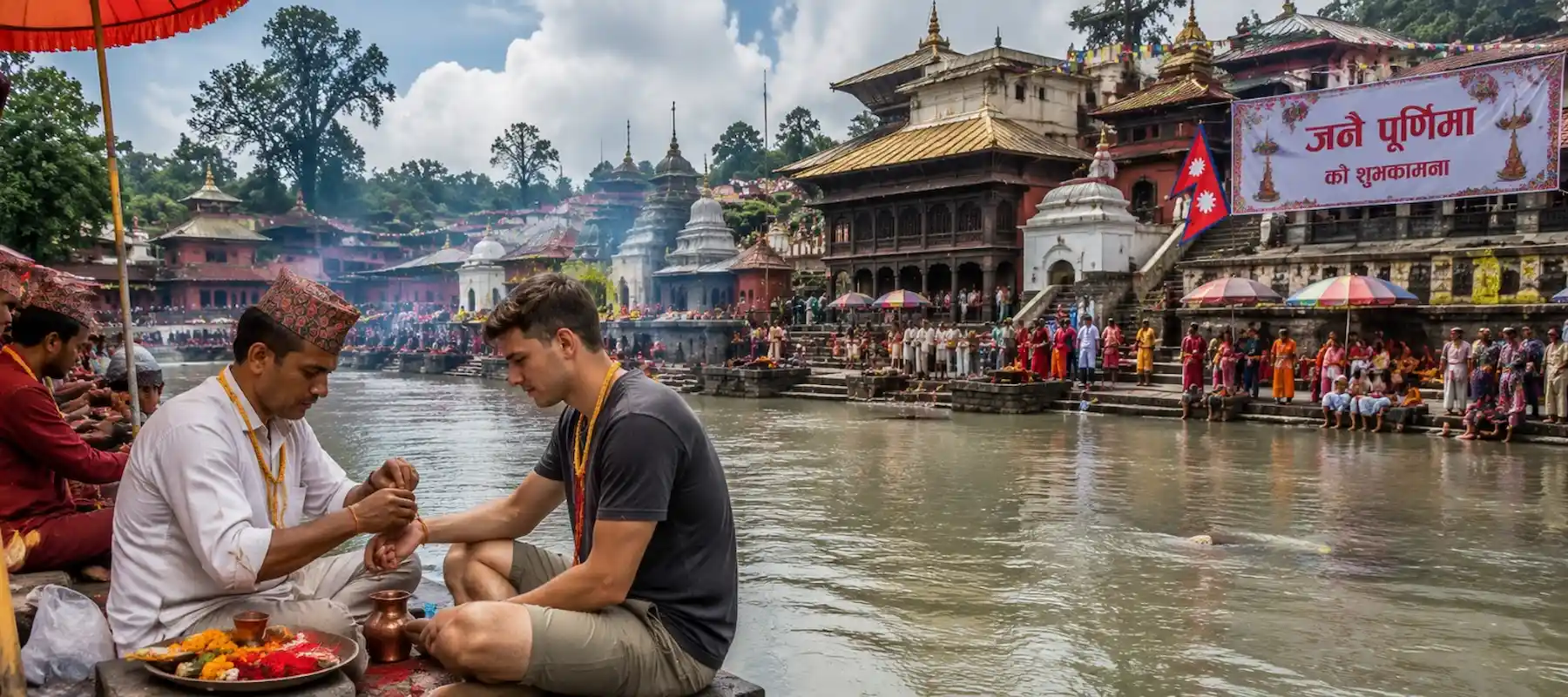
And then there’s the Doro — a yellow thread tied around the wrist of anyone who comes to receive it. Women, children, people from other castes, tourists who wander up and look curious enough. A priest or an elder ties it on with a short blessing, and you walk away wearing this small, unassuming thing that somehow feels significant in a way that’s difficult to explain rationally.
I’ve received a Doro at Janai Purnima in Nepal. I kept it on for three weeks before it finally fell off. That might sound silly. It didn’t feel silly.
The other thing that defines the Janai Purnima festival is the food — specifically, Kwati. This is a soup made from nine different sprouted beans: black gram, green gram, soybean, field pea, chickpea, horse gram, rice bean, garden pea, and cowpea. Every household has a slightly different recipe. It’s served from big pots near temples, eaten in family kitchens, and sold from little stalls by women who wake up before dawn to have it ready. It tastes like something your grandmother would make if your grandmother happened to be Nepali and extremely wise about what your body needs in the middle of monsoon season — which is exactly what it is. Warming, hearty, and surprisingly addictive.
Janai Purnima 2026 falls on 26th July 2026, on the Shrawan Purnima. If you’re reading this while planning your trip, that’s the date to build around. Arrive at least two to three days early — the buildup is worth it — and plan to stay a day or two after, when the temple atmosphere remains charged and the crowds thin out just enough to breathe.
The Nepal Tourism Board publishes the confirmed public holiday calendar each year, which is worth checking before you book anything.
Nepal is a country where religion is not separate from daily life. It’s woven into it — in the way people greet each other, the small shrines tucked into every street corner, the flower offerings left at crossroads before the working day begins. Janai Purnima is one of the moments in the year when that underlying spiritual current rises to the surface and becomes visible.
The Janai isn’t just jewelry. It’s a vow — a daily reminder of the religious and ethical responsibilities that come with being initiated into Hindu life. Changing it on Janai Purnima is not a casual ritual. The priest recites specific mantras. The old thread is released into the river with intention. The new one is placed with care. For the men who practice this, it’s a moment of accountability: here is another year. What did I do with it? What am I recommitting to?
Watching this happen up close at Pashupatinath — especially before the tourists arrive and while the ghats are still mostly quiet — is genuinely moving. There’s nothing performative about it. These are private moments happening in public, and the fact that you’re witnessing them feels like a small privilege.
The Doro tradition deserves more attention than it usually gets in travel writing about Janai Purnima. Because what it actually represents is inclusion. In a festival that’s partly about caste-specific ritual, the Doro cuts the other direction entirely — it’s available to everyone. The priest ties it on whoever holds out a wrist. The blessing is the same regardless of where you come from.
Many of our guests have received a Doro at Janai Purnima and told us afterward they kept it on for weeks without quite knowing why. That’s the festival doing what it’s always done.
There’s something worth sitting with in that. A festival with deep roots in hierarchical tradition also contains this explicit gesture toward universality. Nepal is full of contradictions like that, and they’re part of what makes it endlessly interesting.
If you’re only going to be in one place on Janai Purnima, make it Pashupatinath. The temple sits on the western bank of the Bagmati River and is the most important Shiva temple in Nepal — and for many Hindus, one of the most sacred in the world.
On Janai Purnima, the ghats start filling before 4am. Pilgrims take a ritual bath in the Bagmati regardless of how cold the monsoon water gets. Priests set up along the steps with bundles of new Janais, bowls of red powder, flowers, and incense. The chanting starts early and doesn’t stop.
Non-Hindu visitors can’t enter the inner sanctum, but the outer areas are open, and honestly, the outer areas are where the most human moments happen anyway. An elderly man helping his adult son through the thread-changing ritual. A group of women from a village somewhere outside Kathmandu, laughing together while they wait their turn at the ghat. A young sadhu, barely twenty, sitting cross-legged in the rain like the rain isn’t happening.
Get there by 5am if you can manage it. Bring a light rain jacket. Go slowly.
The Kumbheshwar Temple in Patan is a five-storey pagoda that’s visually one of the most impressive structures in the Kathmandu Valley. On Janai Purnima, the pond inside the temple complex becomes the centre of the celebration. According to local belief, this pond is spiritually connected to the high-altitude lake at Gosainkunda — which means that bathing here on Janai Purnima carries the same religious merit as making the full pilgrimage up into the mountains.
The atmosphere here is less intense than Pashupatinath and, in some ways, more intimate. You’ll see neighborhood communities rather than national-scale pilgrimages. Flower sellers crowd the outer gates. The air around the pond gets thick with incense. It’s the kind of place where you end up staying two hours longer than you planned.
At 4,380 metres in the Langtang range, Gosainkunda Lake is where the most serious pilgrims go for Janai Purnima. The trek takes most people three to four days from Dhunche or Syabrubesi, through rhododendron forest and cloud-covered ridgelines, arriving at an alpine lake that — depending on the weather — looks like it’s sitting at the edge of the world.
Thousands of pilgrims make this journey specifically for the Janai Purnima full moon. They camp around the lake, light fires, and bathe in freezing water at altitude as a form of devotion that goes well beyond casual.
If you’re considering the Gosainkunda Trek for Janai Purnima, it’s wise to plan ahead, as the trail becomes exceptionally busy in the days leading up to the festival. To make your journey smooth and hassle-free, contact Alliance Treks—we’ll take care of all the necessary permits, logistics, and provide an experienced licensed guide to help you navigate the trail safely, especially during the monsoon season when conditions can be more challenging.
Let’s address the rain directly, because it deserves honesty.
Yes, it rains during monsoon in Nepal. Sometimes heavily. Sometimes every afternoon. Sometimes at inconvenient moments when you’re halfway between temples and didn’t bring your jacket.
But here’s the thing about visiting Nepal during monsoon for Janai Purnima — the rain is part of it. The whole point of Shrawan month in Hindu and agricultural tradition is that it’s monsoon season. The festivals of Shrawan — and Janai Purnima is the most significant — were designed around the rhythms of rain. The Kwati beans are sprouts that have been germinating through the early monsoon weeks. The river rituals happen when the rivers are actually rivers again. The greenness of the hills, the smell of the air, the particular quality of light through monsoon clouds — it all belongs together.
People who visit Nepal specifically during monsoon for Janai Purnima tend to come back saying the same thing: “I didn’t expect it to be that beautiful.” Because it is. The Kathmandu Valley in late July looks nothing like the dusty, hazy version you’ll see in March or October. Everything is saturated and alive. The mountains are usually hidden, yes — but the valleys themselves are the landscape during monsoon, and they’re extraordinary.
Practical monsoon note: carry a small umbrella rather than a heavy rain jacket. Pack clothes that dry quickly. Wear shoes you don’t mind getting wet. And genuinely, don’t let the weather forecast stop you from being outside. The locals aren’t inside.
A few honest notes on participating respectfully in the Janai Purnima rituals:
Clothes matter. Temples in Nepal, especially during festivals, have dress expectations. Shoulders covered, knees covered. Bring a shawl or a long scarf — it takes up almost no space in a bag and solves every situation.
Ask before photographing. The bathing rituals on the ghats are personal moments. Some people won’t mind; others will. The default should be to ask, not to assume. A smile and a questioning gesture with the camera usually gets a clear answer either way.
The Doro is available to you. If you’d like a Doro tied on your wrist, approach a priest or join the queue at one of the temple stalls. A small donation is appropriate — just follow what the people around you are doing. You don’t need to be Hindu, Nepali, or anything specific. You just need to hold out your wrist and mean it a little.
Slow down. The biggest mistake most visitors make at Janai Purnima is treating it as a checklist. Pashupatinath first, then Kumbheshwar, then back to the hotel for the next destination. Give one place the whole morning. Sit down somewhere. Drink tea from a thermos someone’s grandmother is selling for twenty rupees. Let the festival come to you rather than chasing it.
When to arrive: For Janai Purnima 2026 on 26 July, aim to land in Kathmandu by 22–23 July at the latest. This gives you time to recover from travel, get your bearings in the city, and start noticing the pre-festival atmosphere building around the temples.
Flights into Kathmandu: Tribhuvan International Airport connects to Delhi, Doha, Dubai, Singapore, Bangkok, and Kuala Lumpur among others. Monsoon period typically means lower fares than October–November peak season, though weather-related delays do happen — build some buffer into your schedule if you have onward connections.
Visa: Nepal offers visa on arrival at the airport for most nationalities. Current fees and requirements are listed at Nepal Immigration — check before you travel as these can update.
Getting around Kathmandu during the festival: The roads around Pashupatinath and the old city fill up significantly on Janai Purnima day. A hotel in Thamel or Boudha puts you close enough to walk or take a short taxi to the main sites. Agree on a price with your taxi driver before you get in, especially during festival days when metered drivers tend to disappear.
A guide on the day: Not essential, but genuinely useful if it’s your first Janai Purnima. A local guide who grew up with the festival can explain what’s happening in real time, introduce you to priests and pilgrims, and take you to the corners of the celebration that casual visitors don’t find. Look for guides registered with Trekking Agencies’ Association of Nepal (TAAN) or through your guesthouse.
The core ritual of changing the Janai is specific to Hindu men of certain communities. But the broader celebration — Doro tying, Kwati feasting, temple visits, family gatherings — is open and welcoming. Many non-Hindu Nepalis participate, and visiting travelers are received warmly.
Yes, with access to the outer temple areas and ghats. The inner sanctum is restricted to Hindu worshippers, but this represents a small fraction of the experience. Most of what makes Janai Purnima at Pashupatinath powerful happens outside.
Nepal remains one of the more affordable destinations in Asia. Budget travelers can manage comfortably on USD 30–50 per day including accommodation, food, transport, and temple entry fees. The festival itself doesn’t cost anything to participate in — the Doro is offered as a blessing, not sold.
That’s the wrong question. The right question is: will you regret it if you don’t come? Based on every conversation I’ve had with people who were in Nepal during Janai Purnima — yes, probably.
Nepal has a hundred reasons to visit and a hundred festivals that would justify a flight. But Janai Purnima has something specific going for it that most festivals don’t: it happens when the country is at its most itself. Not polished for tourism, not perfectly photogenic in the golden-hour way that gets a million Instagram reposts. Just real. Wet and warm and alive and devout and communal in a way that the modern world has largely decided it doesn’t have time for anymore.
The sacred thread festival in Nepal is a reminder that some things still mean what they always meant. A thread is a promise. A bowl of soup is a form of care. A knot tied at a wrist is a person saying: I hope you’re protected. I’m thinking of you.
Monsoon visit to Nepal is something you cannot afford to miss. Come for Janai Purnima 2026. Let it rain!!
The best memories aren’t always found on famous trails. Sometimes they’re waiting in a sacred thread, a shared meal, and a festival that brings an entire community together. Join Alliance Treks and discover Nepal at its most authentic. Contact Alliance Treks today!!
Alliance Treks & Expedition Pvt. Ltd. Once is not enough for naturally and culturally Himalayas