(Viber, Whatsapp, Cell) +977 9851022814

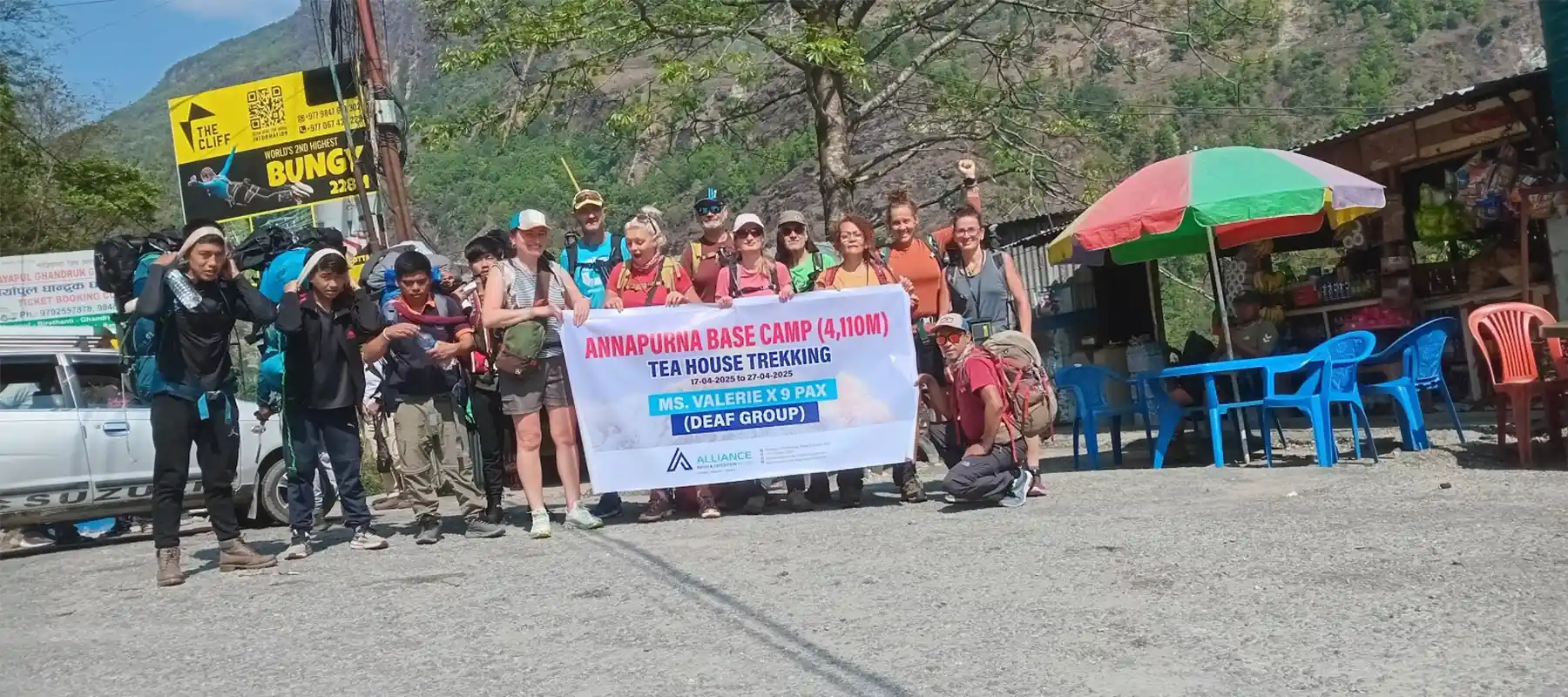
Trekking Nepal as a deaf traveler is not only possible but incredibly rewarding, and with the right support from experienced specialists like Alliance Treks, the Himalayas become more accessible than ever before. There is a moment we witness again and again at Alliance Treks. A deaf trekker reaches a mountain ridge for the first time, perhaps on the Annapurna Base Camp trek or the Langtang trail. Suddenly, the giant Himalayan peaks appear right in front of them. Nobody needs to say anything. The view says it all. The mountains have a way of leaving everyone speechless, whether they can hear or not.
What makes that moment possible is not luck. It is planning, preparation, and a trekking company in Nepal that has genuinely invested in making the mountains accessible to everyone — including deaf and hard-of-hearing travellers, and differently-abled trekkers of all kinds.
Alliance Treks is a Kathmandu-based Nepal trekking company with years of experience organising deaf trekking in Nepal and inclusive trekking packages for differently-abled travellers. We are not a company that added a “special needs” checkbox to a booking form and called it inclusive. We built our differently-abled trekking Nepal programme from the ground up — with deaf guides, visual communication systems, adaptive routes, and real relationships with Nepal’s Deaf community.
This is who we are, what we do, and why deaf travellers and differently-abled trekkers from across the world choose Alliance Treks when they want to trek Nepal.
Alliance Treks has been operating in Nepal for years, running trekking expeditions across every major Himalayan route — from the Everest Base Camp trek and the Annapurna Circuit to Langtang, Manaslu, and beyond. But what sets us apart from other Nepal trekking companies is our deep, long-standing commitment to inclusive and differently-abled trekking in Nepal.
We are not the largest trekking company in Kathmandu, and we are not trying to be. We choose quality over quantity, focusing on personal care, thoughtful planning, and safe, well-supported journeys that our guests truly value and trust. What we are is the most prepared when it comes to planning and running treks for deaf travellers in Nepal, hard-of-hearing trekkers, physically differently-abled clients, and people who have been told by other operators that the Himalayas are not for them. Trekking Nepal as a deaf traveler is absolutely possible with the right support, preparation, and guiding team.
The Himalayas are for everyone. Alliance Treks exists to make that a reality, not a slogan.
Our Inclusive Trekking Nepal Record — Alliance Treks has successfully planned and guided deaf trekking Nepal expeditions, treks for physically differently-abled travellers, and mixed-ability group trips across Nepal’s most iconic and remote routes. Every trip is custom-built. None are copy-pasted.
This is the part that makes Alliance Treks genuinely different from every other trekking company in Nepal that claims to be deaf-friendly.
We have deaf guides. Not guides who have completed a one-day sensitivity training. Not guides who have learned three signs from a YouTube video. We have trained, experienced, Nepali deaf guides who work with our deaf trekking Nepal groups — people who communicate in Nepal Sign Language (NSL) and who understand, from the inside, what it means to navigate the mountains without sound.
Deaf trekking is one part of who we are. Alliance Treks also specializes in differently-abled trekking Nepal more broadly — planning and guiding treks for travelers with physical disabilities, mobility impairments, visual impairments, and other access needs.
We approach every differently-abled trekking Nepal enquiry the same way: we ask first, we listen carefully, and then we plan. Trekking Nepal as a deaf traveler is just one example of how we carefully design journeys around individual abilities and real human needs. No two differently-abled trekkers have the same needs, and no two Alliance Treks differently-abled trekking packages are the same.
| Service | Who It’s For | What Alliance Treks Provides |
|---|---|---|
| Deaf Trekking Packages | Deaf and hard-of-hearing trekkers | Deaf guide in Nepal, Nepal Sign Language (NSL) and visual communication, sign-language-aware itineraries |
| Differently-Abled Trekking | Wheelchair users and mobility-impaired travelers | Adaptive routes, porter support, accessible teahouse pre-booking, and medical coordination |
| Blind and Low-Vision Trekking | Visually impaired travelers | Fully tactile-guided treks, experienced sighted guides, and detailed audio briefings |
| Group Inclusive Expeditions | Mixed-ability trekking groups | Custom group logistics, multi-need guide teams, and inclusive camp setups |
| Custom Accessible Itineraries | Any differently-abled traveler | Bespoke planning from Kathmandu to summit, with no cookie-cutter packages |
If you have been told by another Nepal trekking company that your disability means you cannot trek in Nepal, please contact us before accepting that answer. We have taken people into the Himalayas who were told it was impossible. Often, the right planning makes it not just possible but extraordinary.
Our deaf trekking Nepal planning process is detailed, personal, and built around the individual. Here is exactly how we approach it.
Every Alliance Treks deaf trekking Nepal booking starts with a conversation — not a booking form. We want to understand your hearing level, your communication preferences, your sign language (NSL, ASL, BSL, or other), your trekking experience, your fitness, and what you are hoping to get out of your Nepal trek. This conversation shapes everything that follows.
Based on your profile, we assign the right guide or guide team for your deaf trekking Nepal trip. If our deaf Nepali guide is available and the right fit, we assign them. If a two-guide team (one deaf, one hearing) better serves the itinerary and safety requirements, we structure it that way. We are transparent about what we are providing and why.
We design your Nepal deaf trekking itinerary with teahouse density, rescue access, communication infrastructure, and acclimatisation in mind. For deaf trekkers, we pre-book teahouses where possible and brief teahouse owners in advance about our deaf trekking group. Teahouse owners on Nepal’s trails are often the first responders in any emergency — they need to know your communication needs before you arrive.
Every Alliance Treks deaf trekking Nepal group receives a full pre-departure briefing in Kathmandu before hitting the trail. We cover your custom hand signal system, emergency protocols, your guide’s background, your TIMS card registration (with your Deaf status officially noted), altitude sickness awareness, and a full test of your communication technology.
On the trail, your Alliance Treks deaf guide and guide team are with you every step. We do not drop you at the trailhead and check in by radio. Our guides walk with you, communicate with you, and handle every teahouse interaction, local village exchange, and emergency situation with full awareness of your needs.
After every deaf trekking Nepal trip, we debrief with our clients. What worked. What could be better. How to improve for the next deaf or differently-abled trekker we bring to Nepal. This feedback loop is how Alliance Treks has built the most refined inclusive trekking Nepal programme in the country.
Not every Nepal trekking route suits every traveler, and for deaf or differently-abled trekkers, route selection matters even more. Alliance Treks selects routes based on teahouse density, trail traffic, rescue access, altitude, and guide availability. Here are the routes we run most often for our deaf trekking Nepal and differently-abled trekking Nepal clients.
| Trek Route | Duration | Max Altitude | Deaf Guide Available | Notes for Differently-Abled Trekkers |
|---|---|---|---|---|
| Annapurna Sanctuary | 10–12 days | 4,130m | Yes | Alliance Treks’ top pick. Lower altitude, dense teahouse network, and manageable for a wide range of abilities. |
| Langtang Valley | 7–10 days | 3,870m | Yes | Shorter, quieter, and excellent for first-time differently-abled trekkers with strong guide support. |
| Everest Base Camp | 12–16 days | 5,364m | Yes | The most requested deaf trekking Nepal route. Well-serviced trail with helicopter rescue access from Lukla. |
| Annapurna Circuit | 14–21 days | 5,416m | Yes | Excellent cultural immersion. Visual communication is natural on this busy and well-supported route. |
| Gokyo Lakes | 12–15 days | 5,360m | On Request | A quieter alternative to Everest Base Camp. Requires good fitness and benefits from custom planning. |
| Mardi Himal | 6–8 days | 4,500m | Yes | A newer and less-crowded route, ideal for differently-abled trekkers seeking a quieter Nepal trekking experience. |
Alliance Treks Route Advice — We never recommend a route based on what is popular. We recommend based on your ability, your experience, your communication needs, and the time of year. Tell us your situation honestly and we will tell you exactly which Nepal trek is right for you.
One of the most common questions we get from deaf travellers considering Nepal is: how does communication actually work on the trail? Here is our honest answer, built from years of deaf trekking Nepal experience.
Our deaf guides communicate in Nepal Sign Language. For NSL users, this means completely natural communication throughout your trek. For ASL, BSL, or Auslan users, our deaf guide will adapt and establish a shared visual communication system on Day 1 — a process that typically takes less than an hour and works seamlessly on the trail.
On every Alliance Treks deaf trekking Nepal trip, we establish a custom hand signal vocabulary with your guide team on the first morning. Stop. Danger. Turn around. Rest. Altitude issue. Emergency. Water. Beautiful view. These signals are agreed, practiced, and second nature before the trail demands them.
Our guides carry notepads. We recommend every deaf trekker also carry one in their hip belt pocket — a Rite in the Rain notebook with a pencil (pens freeze above 4,000 metres). We also advise downloading Google Translate with the offline Nepali language pack before leaving Kathmandu. Internet disappears above Namche Bazar and Manang. Offline tools keep working.
Alliance Treks strongly recommends every deaf trekker on a Nepal trek carry a satellite communicator. Above 3,500 metres, mobile signal ends. A satellite communicator allows two-way text messaging regardless of signal — meaning you can communicate with your guide team, emergency contacts, and rescue services entirely in writing, from anywhere on the mountain.
Nepal’s mountain teahouses are already built for visual communication. Picture menus, pointing, writing numbers in the air, and gesture are standard practice at altitude, where wind makes verbal communication unreliable even for hearing trekkers. Deaf travellers often find teahouse communication more intuitive than they expected. Alliance Treks pre-briefs teahouse owners on our deaf trekking Nepal itineraries so they know before you arrive.
Safety is where Alliance Treks is most rigorous. The Himalayas are spectacular and they are serious. For deaf trekkers and differently-abled trekkers in Nepal, safety planning requires more layers than a standard trek, and we provide every one of them.
Acute Mountain Sickness (AMS) is the primary health risk on Nepal treks. The good news: nearly all AMS symptoms are non-auditory and self-felt — headache, nausea, dizziness, breathlessness, swelling, poor coordination. Deaf trekkers are not at any disadvantage in recognizing AMS. Our guides are trained in Wilderness First Aid and monitor our deaf trekking Nepal groups constantly for altitude sickness signs. You can learn more about AMS symptoms, prevention, and treatment in detail in our altitude sickness guide.
Alliance Treks prepares a laminated emergency card in Nepali for every deaf or differently-abled trekker on our Nepal trips. The card states your Deaf status, your insurance details, your blood type, and your emergency contacts. Your guide carries a copy. You carry a copy. Rescue coordination teams in Nepal are familiar with these cards from our groups.
When Alliance Treks registers your Trekkers’ Information Management System (TIMS) card in Kathmandu before your Nepal trek, we note your Deaf status on the official record. This means any rescue team, ranger post, or emergency coordinator you encounter on the trail has advance notice that written or visual communication is required.
Alliance Treks requires every client on a deaf trekking Nepal or differently-abled trekking Nepal package to hold insurance that explicitly covers helicopter evacuation in Nepal. We help our clients verify their coverage before departure. In a high-altitude emergency, this insurance is the difference between a helicopter arriving in hours and a situation that becomes life-threatening.
Alliance Treks does not operate in isolation from Nepal’s Deaf community. We have built genuine relationships with the National Federation of Deaf Nepal in Kathmandu, which allows us to do things that other Nepal trekking companies simply cannot.
This relationship matters. It means our deaf trekking Nepal programme is not designed from the outside looking in. It is built from within a community, with real input, real relationships, and real accountability.
People sometimes ask us whether Nepal is really the right choice for a deaf traveller or a differently-abled trekker. Our answer is always the same: with the right company, Nepal is one of the best choices in the world.
Here is why.
Booking with Alliance Treks starts with a conversation, not a booking form. We want to understand your needs before we put an itinerary together, because the right Nepal deaf trek or differently-abled trekking Nepal package is one that is built around you — not one pulled from a catalogue.
Here is what we need to know from you:
We recommend contacting us at least 8 to 12 weeks before your planned departure. This gives us time to assign the right deaf guide, coordinate with the Nepal Deaf Association if relevant, design your itinerary, prepare your emergency documentation, and brief every teahouse and contact on your route.
Contact Alliance Treks — Email us at [email protected] or visit alliancetreks.com. Tell us your situation and we will come back to you with honest advice, a realistic itinerary, and a clear picture of what your Nepal deaf trek or differently-abled trekking Nepal experience will look like from Day 1 to the summit.
Yes. With proper planning, suitable routes, and experienced support, trekking in Nepal is possible for many differently-abled travellers. Alliance Treks designs accessible trekking itineraries, including lower-altitude routes for wheelchair users and travellers with mobility challenges. Share your needs honestly with us, and we will advise what is realistically possible and safe for you.
Yes, but they are limited to specific lower-altitude and adapted routes. Some trails around the Kathmandu Valley and certain cultural trekking regions can be adjusted for accessibility. Alliance Treks carefully matches each traveller’s physical needs with the safest and most suitable trekking experience available.
Yes. For deaf trekkers, a guide is essential for safety, navigation, and communication support. At Alliance Treks, our guides are trained to work closely with deaf travellers and ensure clear visual communication throughout the journey. Trekking in the Himalayas without a guide can increase risks, especially in remote and high-altitude areas.
Our deaf Nepali guides primarily use Nepal Sign Language (NSL). Since NSL differs from ASL, BSL, and other systems, our teams create a shared visual communication method with each group at the beginning of the trek. This system is simple, practical, and becomes effective for smooth communication throughout the journey.
All guides are trained in wilderness first aid and altitude sickness awareness. Because most symptoms are physical and not auditory, deaf trekkers can also self-monitor effectively. We include proper acclimatisation days in every itinerary and have emergency evacuation procedures in place, including satellite-based communication if required.
Yes. We offer both private and group trekking experiences for deaf travellers. Group trips are often arranged for deaf clubs, organizations, and mixed-ability teams from different countries. Group size and support staff are adjusted based on the needs of the participants to ensure safety and comfort.
Nepal’s Himalayas have been waiting for you. The trails are there. The teahouses are lit. The peaks are turning pink at dawn right now, somewhere above the clouds.
Alliance Treks is the Nepal trekking company that will take you to them — deaf, differently-abled, or any other version of yourself that the standard trekking industry has not known how to serve.
We have deaf guides on the ground. We have years of differently-abled trekking Nepal experience behind us. We have a safety record we are proud of and a community of deaf and differently-abled trekkers around the world who came to Nepal with us and came home changed.
Come and trek Nepal with Alliance Treks. We will handle the rest. Contact us today.
Alliance Treks & Expedition Pvt. Ltd. Once is not enough for naturally and culturally Himalayas