(Viber, Whatsapp, Cell) +977 9851022814

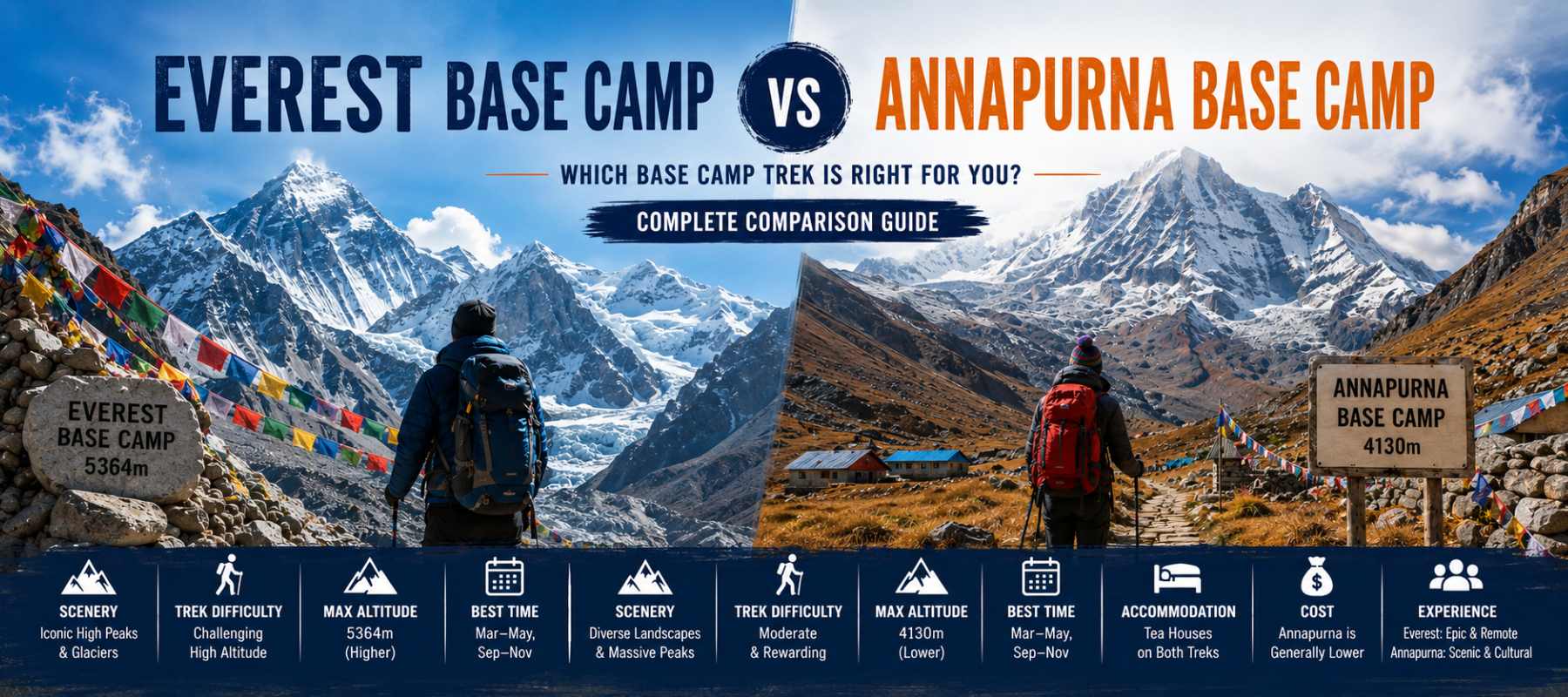
EBC vs ABC trek is the question that fills the inboxes of Nepal trekking companies every single week. Furthermore, it is also one of the most genuinely difficult trekking questions to answer well — not because the treks are similar, but because the right answer is completely different depending on who is asking. Moreover, both Everest Base Camp and Annapurna Base Camp are extraordinary routes that justify every superlative thrown at them. Additionally, they are both iconic, both physically demanding in different ways, and both capable of producing the kind of experience that changes how you think about the world. Consequently, this guide does not pick a winner. It picks the right one for you.
Alliance Treks has been guiding trekkers through Nepal for over 34 years. Furthermore, our team has walked both these routes more times than anyone on our staff can count. Moreover, we have taken nervous first-timers and seasoned mountaineers to both base camps, in every season, in every kind of weather. Additionally, after all of that experience, the EBC vs ABC trek question still does not have a single answer. Consequently, what we have is something better: a clear, honest breakdown of every factor that matters, so that by the time you finish this blog, you know exactly which trail is calling your name.
The EBC vs ABC debate has been going on for decades, and for good reason — both are among the finest treks in the Himalayas, yet they offer completely different experiences. Everest Base Camp takes you into the heart of the Khumbu, where glaciers, Sherpa culture, and the world’s highest peaks dominate the landscape. Annapurna Base Camp, meanwhile, leads into the breathtaking Annapurna Sanctuary, a natural amphitheatre surrounded by towering Himalayan giants.
The real question is not which trek is better, but which trek is better for you. Your available time, fitness level, budget, altitude tolerance, and travel style all play a role in the decision. Many trekkers choose EBC for its fame or ABC because it seems easier, only to discover it was not the experience they were actually looking for. Choose the trek that matches your goals, and you are far more likely to have the adventure you imagined.
Here is every major factor in the EBC vs ABC trek comparison, side by side:
| Factor | EBC Trek | ABC Trek |
|---|---|---|
| Base Camp Altitude | 5,364m / 17,598ft | 4,130m / 13,549ft |
| Highest Point | Kala Patthar 5,555m | Annapurna Base Camp 4,130m |
| Total Distance | ~130 km round trip | ~115 km round trip |
| Duration | 12–14 days | 7–10 days |
| Daily Walking | 5–8 hours | 4–6 hours |
| Altitude Sickness Risk | High | Moderate |
| Acclimatisation Days | 2 Mandatory | None Required |
| Difficulty Grade | Strenuous | Moderate to Strenuous |
| Starts At | Lukla (flight from Kathmandu) | Nayapul (drive from Pokhara) |
| Main Culture | Sherpa / Tibetan Buddhist | Gurung / Magar / Hindu-Buddhist |
| Teahouse Quality | Well-developed, pricier | Excellent, more affordable |
| Scenery Type | High-altitude glacial panorama | Forest, villages, and mountain cirque |
| Best For | Altitude experience and Everest prestige | Diversity, affordability, and first-time trekkers |
| Cost (Approx.) | Higher (Lukla flights and longer itinerary) | Lower (no domestic flight required) |
You can explore both routes in detail on the Alliance Treks website: Everest Base Camp Trek and Annapurna Base Camp Trek. Both pages include current itineraries, costs, and departure dates.
Altitude is the biggest difference between the EBC and ABC treks, and it influences everything from difficulty to acclimatisation. Everest Base Camp sits at 5,364 metres, while Kala Patthar, the trek’s highest viewpoint, reaches 5,555 metres. At these elevations, oxygen levels are roughly half of what they are at sea level, making proper acclimatisation essential. That is why the EBC itinerary includes scheduled acclimatisation days at Namche Bazaar and Dingboche. Unlike ABC, altitude sickness is a real and constant consideration on the Everest Base Camp trek.
Annapurna Base Camp, on the other hand, sits at 4,130 metres. Furthermore, this is still a serious high-altitude environment — well above the 3,500-metre threshold where AMS risk begins in earnest. Moreover, the critical difference from an altitude management perspective is that the ABC trek uses a natural ‘climb high, sleep low’ rhythm built into its topography, repeatedly gaining and losing altitude as it moves through the Annapurna Sanctuary approach. Additionally, this pattern gives the body more frequent acclimatisation benefit than the linear ascent of the EBC route. Consequently, most trekkers on the ABC route complete it without requiring dedicated rest days, though maintaining a steady pace and adequate hydration remains essential.
Verdict: EBC is harder at altitude. — EBC reaches 5,555m at Kala Patthar vs ABC’s 4,130m. The difference of 1,425 metres is not cosmetic — it changes how your body behaves, how your head feels, and how carefully you need to plan your ascent.
Note: If you have never been above 4,000 metres before, Annapurna Base Camp is the smarter first step. The ABC trek gives you a genuine high-altitude Himalayan experience without the acclimatisation intensity of EBC. Furthermore, many Alliance Treks clients do ABC first and EBC the following year — armed with altitude experience that makes the Khumbu considerably less daunting.
This is where many EBC vs ABC comparisons oversimplify the reality. While Everest Base Camp is generally considered harder because of its extreme altitude, the daily trekking experience is more complex. Annapurna Base Camp features steeper trails and countless stone staircases, which many trekkers find tougher on their legs and knees. In truth, both treks are challenging in different ways. EBC tests your ability to cope with altitude, while ABC often demands more from your muscles and joints on a day-to-day basis.
The Everest Base Camp trek is graded as strenuous primarily because of the altitude demands rather than the gradient. Furthermore, the trail itself is relatively well-graded and does not involve technically difficult terrain. Moreover, the challenge comes from the cumulative effect of days above 4,000 metres, sleeping above 5,000 metres at Gorakshep, and maintaining physical function in an environment where basic tasks require noticeably more effort. Additionally, the walking days on EBC are longer on average — five to eight hours compared to ABC’s four to six. Consequently, EBC requires a higher baseline of sustained endurance fitness, while ABC requires specific strength in the legs for steep climbs and descents.
Verdict: EBC is harder overall. — But ABC hits harder on specific days. Fit trekkers with strong legs sometimes find ABC more physically demanding day-to-day, while EBC’s altitude demands accumulate more gradually but more seriously.
Note: Do not choose ABC because you think it will be easy. The stone staircase sections in the Modi Khola valley and the steep ascents through the Annapurna Sanctuary approach will test your legs properly. Furthermore, the descent from base camp on the final day is long and knee-intensive. Moderate means genuinely challenging — it does not mean comfortable.
Choosing between EBC and ABC for scenery is largely a matter of personal preference. The Everest Base Camp trek delivers a dramatic journey through the Khumbu, from suspension bridges and Sherpa villages to glaciers and the towering peaks surrounding Everest. The experience builds steadily toward unforgettable views from Kala Patthar and the Khumbu Icefall, creating a strong sense of achievement.
The Annapurna Base Camp trek offers greater landscape variety. The trail passes through terraced farms, rhododendron forests, and deep valleys before revealing the spectacular Annapurna Sanctuary. Surrounded by Annapurna I, Machapuchare, and other Himalayan giants, trekkers enjoy panoramic mountain views from every direction. While EBC is about the grandeur of Everest, ABC provides a more diverse and immersive mountain experience.
One of the biggest differences between EBC and ABC is the cultural experience. The Everest Base Camp trek passes through the heart of Sherpa country, where Tibetan Buddhist traditions shape daily life. Monasteries, prayer flags, mani walls, and the rich history of Himalayan mountaineering give the Khumbu a unique atmosphere that is deeply connected to the mountains.
The Annapurna Base Camp trek offers a more diverse cultural journey. The trail passes through traditional Gurung and Magar villages, including Ghandruk, one of Nepal’s most beautiful mountain settlements. As you climb higher, the focus gradually shifts from village life to the natural beauty and spiritual significance of the Annapurna Sanctuary. While EBC provides a deep immersion into Sherpa culture, ABC showcases a broader mix of communities and landscapes.
When it comes to cost, Annapurna Base Camp is generally the more affordable option. Everest Base Camp requires flights to Lukla, higher permit fees, and more expensive teahouses, particularly at higher elevations. The longer itinerary also increases accommodation and meal costs, making EBC typically 20–30% more expensive than ABC.
In contrast, ABC begins with a relatively inexpensive drive from Pokhara and features lower accommodation, food, and permit costs. Its shorter duration further reduces overall expenses. For trekkers seeking excellent value without sacrificing spectacular Himalayan scenery, Annapurna Base Camp is often the more budget-friendly choice.
Verdict: ABC wins on cost. — No domestic flight, shorter duration, lower permit fees, and more affordable teahouses make ABC the better-value option for most trekkers. EBC costs more at every stage.
Time is often the deciding factor when choosing between EBC and ABC. The Everest Base Camp trek typically takes 12–14 days on the trail, but when you add travel to and from Kathmandu and allow for possible Lukla flight delays, most trekkers should plan for 16–17 days in Nepal. For travellers with limited annual leave, fitting EBC into a standard two-week holiday can be challenging.
The Annapurna Base Camp trek is much easier to fit into a shorter trip. Most itineraries take 7–10 days, and the drive from Pokhara avoids the flight delays associated with Lukla. The shorter duration also leaves time to explore Pokhara or add side trips such as Poon Hill. For travellers on a tighter schedule, ABC is usually the more practical and flexible choice.
If you only have ten days total in Nepal and want to do a proper base camp trek, ABC is the only realistic option. Furthermore, EBC in ten days is technically possible but involves a compressed itinerary that significantly increases altitude sickness risk by removing the acclimatisation days that the route requires. Alliance Treks will not run a compressed EBC itinerary for safety reasons — if time is tight, do ABC properly rather than EBC quickly.
One factor unique to the Everest Base Camp trek is the flight to Lukla. Tenzing-Hillary Airport is famous for its short mountain runway and weather-dependent operations. Because flights require clear visibility, delays and cancellations are common, especially during the busy spring and autumn trekking seasons. As a result, anyone planning an EBC trek should include extra buffer days in their itinerary rather than relying on a fixed schedule.
The alternative for flight-averse trekkers is to drive to Salleri or Phaplu and walk to Lukla — adding two to three days to the itinerary but eliminating the flight entirely. Furthermore, helicopter access is also available at significantly higher cost for trekkers whose schedule has been destroyed by flight delays. Moreover, the ABC trek has none of this complexity: the drive from Pokhara to Nayapul takes ninety minutes on a paved road and operates in virtually all weather conditions. Additionally, the absence of this logistical variable makes ABC considerably easier to plan around a fixed return flight home. Consequently, if schedule reliability matters to you, the Lukla factor is a genuine point in ABC’s favour.
“We had a group stuck at Lukla for three extra days in October. Beautiful days, as it happened — but they missed their flights home. The mountains decide the schedule, not the airline.” — Alliance Treks Operations Manager, Kathmandu
After three decades of helping people answer the EBC vs ABC trek question, the Alliance Treks team has noticed that the decision usually comes down to five minutes of honest self-reflection rather than any particular comparison metric. Furthermore, the table below is designed to make that self-reflection concrete. Moreover, tick the boxes that apply to your situation and the column with the most ticks is your answer. Additionally, if the ticks split evenly, consider your fitness level and time budget as the tiebreakers. Consequently, the right choice is almost always the one that matches where you actually are rather than where you wish you were.
| Your Situation | Choose EBC | Choose ABC |
|---|---|---|
| You want to say you stood at Everest | ✓ EBC | — |
| You have done EBC and want something new | — | ✓ ABC |
| You have only 7–10 days available | — | ✓ ABC |
| You have 12–14 days available | ✓ EBC | ✓ ABC |
| You are doing your first Nepal trek | — | ✓ ABC |
| You want high-altitude experience | ✓ EBC | — |
| Budget is a concern | — | ✓ ABC |
| You want diverse landscapes | — | ✓ ABC |
| You want Sherpa culture immersion | ✓ EBC | — |
| You dislike the idea of a domestic flight | — | ✓ ABC |
| You want the more dramatic single view | ✓ EBC | — |
| You want rhododendrons and forests | — | ✓ ABC |
Still unsure? The Alliance Treks team answers the EBC vs ABC trek question personally for every enquirer. Contact us through the Alliance Treks contact page and tell us your fitness level, available days, and what matters most to you on a trek. We will tell you honestly which route suits you — even if the answer is neither, and something like the Poon Hill trek is actually the better starting point.
For first-time trekkers in Nepal, Annapurna Base Camp is often the ideal starting point. With a typical duration of 7–10 days, it offers stunning mountain scenery, rich local culture, comfortable teahouse trekking, and a rewarding physical challenge without the extreme altitude of Everest Base Camp. Just as importantly, it helps you understand how your body responds to trekking in the Himalayas and prepares you for bigger adventures in the future.
If you already have high-altitude trekking experience or have always dreamed of standing beneath Everest, then EBC may be the better choice. It is longer, more demanding, and more expensive than ABC, but the rewards are unforgettable. From the first views of Ama Dablam to sunrise at Kala Patthar overlooking Everest and the Khumbu Icefall, EBC delivers one of the world’s most iconic trekking experiences.
EBC is generally considered harder overall due to the extreme altitude — sleeping above 5,000 metres at Gorak Shep and reaching 5,555 metres at Kala Patthar creates physiological demands that ABC simply does not match. Furthermore, the longer duration and greater acclimatisation requirements add to the challenge. Moreover, on a day-to-day physical level, some trekkers find ABC’s steep stone staircases and relentless gradients more immediately punishing than EBC’s more gradual trail. Consequently, the honest answer is: EBC is harder on the lungs and head, while ABC is harder on the legs.
Both treks deliver world-class Himalayan scenery and neither is objectively superior. Furthermore, EBC builds toward a single dramatic payoff — Kala Patthar’s panoramic view of Everest at close range is unlike anything else in trekking. Moreover, ABC places you inside an intimate glacial amphitheatre surrounded by thirteen peaks over 7,000 metres simultaneously, including Machhapuchhre. Additionally, EBC scenery is dramatic and stark, while ABC scenery is more varied, passing through forests, villages, and finally the Annapurna Sanctuary. Consequently, the choice depends on whether you prefer one iconic mountain viewpoint or a constantly changing landscape.
Yes, but it requires at least three to four weeks in Nepal and careful planning. Furthermore, the treks are located in different regions, so additional travel days are necessary. Moreover, many trekkers find that completing ABC first helps prepare their body for the higher altitude demands of EBC. Consequently, doing both is possible and rewarding if you have sufficient time available.
Annapurna Base Camp is generally the better first Nepal trek for most people. Furthermore, the lower altitude reduces the risk of altitude-related problems, the trek requires fewer days, and overall costs are usually lower. Moreover, ABC still provides an authentic Himalayan trekking experience with spectacular mountain scenery and rich local culture. Consequently, it is often considered the ideal introduction to trekking in Nepal.
Both treks are best during spring (March to May) and autumn (September to November). Furthermore, spring on the ABC route features blooming rhododendron forests, while autumn provides exceptionally clear mountain views on both treks. Additionally, EBC experiences much harsher winter conditions than ABC due to its higher elevation. Consequently, many trekkers consider October ideal for EBC and April ideal for ABC.
Choosing between EBC and ABC is a good problem to have because there is no wrong answer—both are among the world’s greatest trekking experiences. Each offers unforgettable mountain scenery, rich cultural encounters, and a sense of achievement that stays with you long after the trek ends. The key is choosing the route that best matches your time, fitness, expectations, and travel goals.
With more than 30 years of experience guiding trekkers across Nepal, Alliance Treks has helped thousands of travellers find the right adventure for them. Whether you are drawn to the legendary trails of Everest or the dramatic beauty of the Annapurna Sanctuary, our team can help you make the right choice with honest, expert advice. Get in touch today and let us help you plan a trek that exceeds your expectations from the very first step.
Plan your EBC or ABC trek with Alliance Treks — Alliance Treks & Expedition (P.) Ltd.
Alliance Treks & Expedition Pvt. Ltd. Once is not enough for naturally and culturally Himalayas