(Viber, Whatsapp, Cell) +977 9851022814

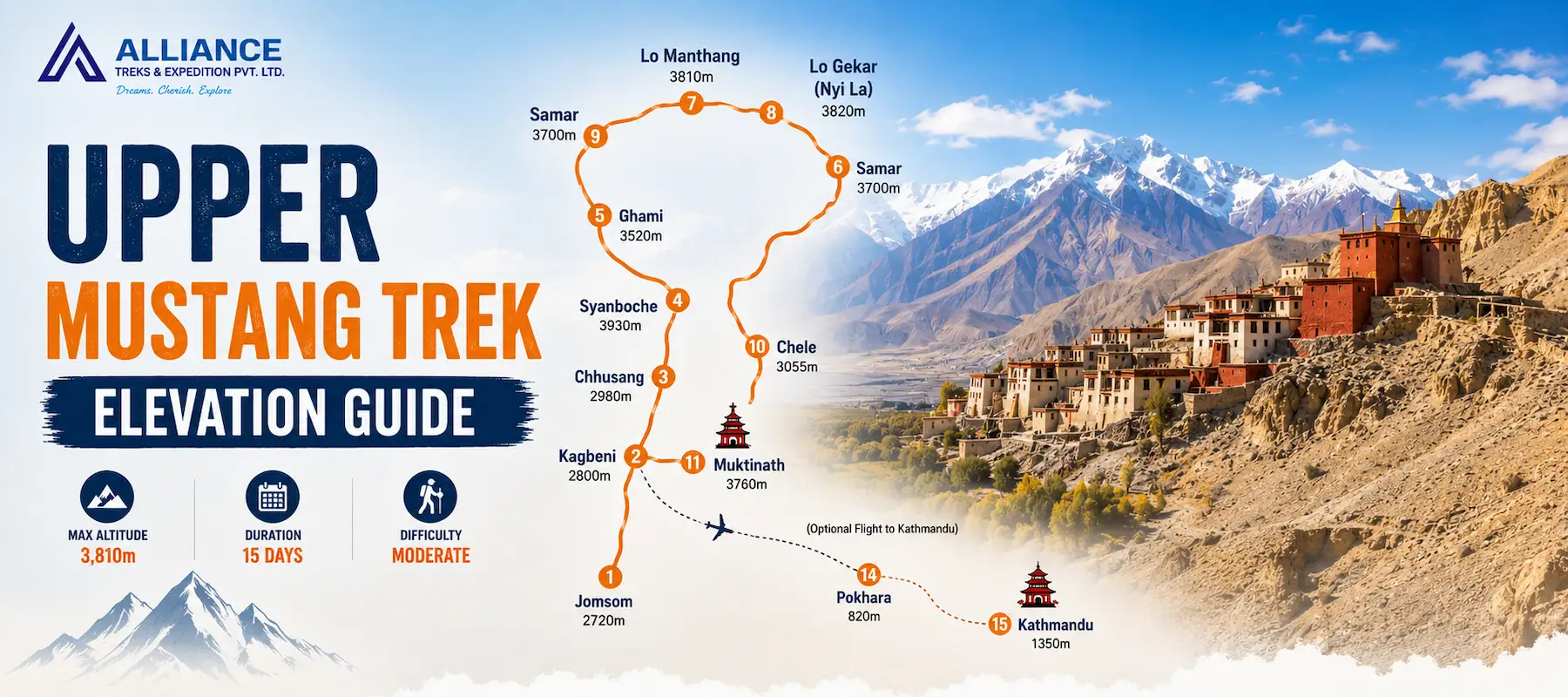
The simple facts: Highest point: Lo Manthang at 3,810m (12,500 feet)
Duration: 15 days total, with 13 days of actual trekking
Elevation gain pattern: Gradual ascent from 820m (Pokhara) to 2,800m (Kagbeni) by Day 4, then steady climb to 3,810m (Lo Manthang) by Day 10
Lowest point: Pokhara at 820m (start and return)
Maximum single-day gain: About 700-800m (Days 4-5)
Acclimatization strategy: Built-in naturally through gradual ascent; no designated acclimatization days needed (unlike Manaslu)
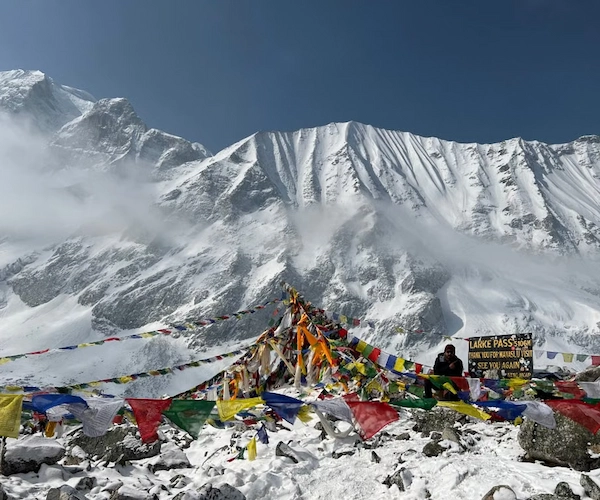
Key advantage: Maximum elevation (3,810m) is lower than Larke La Pass on Manaslu (5,160m) or Kanchenjunga passes (5,458m), making altitude sickness less likely
Unique factor: The arid plateau creates different altitude effects than other treks—drier air, stronger wind, less moisture
Upper Mustang’s elevation is fundamentally different from other major Nepal treks. Understanding these differences shapes your experience.
The maximum elevation is lower. At 3,810m, Lo Manthang is lower than:
Lower maximum elevation means altitude sickness is significantly less common on Upper Mustang than these other treks. Most trekkers handle 3,810m easily, while Larke La Pass affects many trekkers with moderate altitude sickness.
The plateau environment changes altitude effects. Upper Mustang sits on an arid, high-altitude plateau. Unlike forested valleys in central Nepal, the plateau is:
These factors matter more than raw elevation. The barren landscape and constant wind make 3,810m feel more extreme than the numbers suggest.
The ascent is more gradual. You don’t jump straight to altitude. You start at Pokhara (820m), gradually ascend over 10 days to Lo Manthang (3,810m). Average daily gain is 300m—very manageable. No single day exceeds 800m gain. This gradual approach means your body adapts naturally without special acclimatization days.
The destination is cultural, not altitude-focused. Other treks emphasize the altitude challenge (reaching a pass, summiting a peak). Upper Mustang emphasizes arriving at Lo Manthang—an ancient Tibetan city. The elevation is incidental to the cultural experience.
It will allow you to adjust your plans accordingly if you know which day is higher and which is lower. The full itinerary for the Upper Mustang (15 days) is as follows:
Day 1 & 2: Kathmandu at 1,350m → Pokhara at 820m
Your journey begins in Kathmandu (1,350m) and then you head to Pokhara (820m) by air. Yes, there is a slight descent. The city of Pokhara is lower than Kathmandu. First few days of orientation in Pokhara, visit Phewa Lake, know the inner city and prepare for trekking.
Your body is normal at 820m. No altitude effects. Sleep is easy. Energy is high. You are not acclimatised yet – you are still at near sea level altitude.
Day 2 evening: You’re in Pokhara and ready to trek! Before a 13 day trek in town, last night.
Initial Ascent: DAYS 3-7 (820m → 3,505m)
Day 3: Pokhara (820m) → Kagbeni (2,800m)
This is your first trekking day. From Pokhara, you have to travel 1,980m to reach Kagbeni. This is a big hike for a day but part of the trip is on a vehicle/jeep and moderate physical exertion is required.
Kagbeni is a traditional village of the Nepali people, on the border of the Upper Mustang. Your body is still in recovery mode. A few people will experience a little fatigue at 2,800m, but for the majority of trekkers, the altitude won’t make a significant difference.
Day 4: Kagbeni (2,800m) → Chele (3,055m)
Elevation gain: 255m. Elevation loss from trek starting point: 2235m. Short day, manageable. You’re travelling now (not in a car). The landscape starts to transition from a subtropical to alpine type. Vegetation decreases. Temperature drops noticeably.
Most of the trekkers are pretty good at 3055m. None of the altitude symptoms have yet been reported. Sleep is easy.
Day 5: Chele (3,055m) → Syangboche (3,930m)
Elevation gain: 875m. Total from start: 3110m. This is the highest one-day rise on the hike. You are now climbing up into the high plateau. Vegetation becomes sparse. Wind increases. Temperature drops significantly.
You are at a serious altitude at 3,930m. Most trekkers get mild symptoms of altitude, such as a headache, a little nausea and a broken sleep. Generally trekkers cope quite well. This landscape is more extreme than it is because it is barren, and the wind makes it more extreme.
Day 6: Syangboche (3,930m) → Ghami (3,520m)
Elevation loss: 410m. Actually you go down a little, then up to Ghami. Approximate total ascent from the start of the trek: 2700m.
As you can see, it is good to descend—your body takes a break from ascending. Ghami is a very traditional Tibetan village. You’re feeling more at ease at the high altitude of 3,520m after yesterday.
Day 7: Ghami (3,520m) → Tsarang (3,505m)
Topographic change: Slight (15m descent). Elevation lost on trek: 2,685m. This is a rest day in disguise of a trekking day. That’s just like you are walking on a level ground, on the plateau. The barren landscape provides no shade but the easy elevation provides for recovery.
From a height of 3,505m, the majority of trekkers are in good condition. Sleep is disturbed but not problematic. Energy is moderate.
Day 8: Tsarang (3,505m) → Lo Manthang (3,810m)
Elevation gain: 305m. Overall trekking rise from the start of the trek: 2,990m. The end of the road is in sight. The final climb to Lo Manthang is a slow and easy one. The terrain is still a barren plateau.
Lo Manthang suddenly appears before them—the whitewashed walls of the old walled city shine against the desert landscape. At the summit (3,810m), it’s your time of arrival, your destiny! Despite the altitude, most trekkers feel very good here, as the ascent has been slow.
Day 9: Lo Manthang 3,810m (Exploration Day)
You live at Lo Manthang. No elevation gain. Exploration day: walk along the old city’s streets, visit monasteries, and experience Tibetan culture. You have completely adjusted to the height of 3810m. The sleep disturbance is, and energy is adequate.
Day 10: Lo Manthang (3,810m) (Second Exploration Day)
The next day in Lo Manthang. A day hike to a local village or viewpoint (at a similar elevation) is sometimes provided in some itineraries. You are now fully acclimatised to 3,810m.
Descent: Days 11-15 (3,810m → 820m)
Day 11: Lo Manthang (3,810m) → Ghami (3,520m)
Elevation loss: 290m. A total rise of 700m from base to peak. You’re descending now. Oxygen increases. If there are any symptoms, they get better. Energy often returns.
Day 12: Ghami (3,520m) → Chusang (2,980m)
Elevation loss: 540m. Total drop from the peak: 830m. Significant descent now. You are clearly feeling better. Sleep quality improves. Appetite returns.
Day 13: Chusang (2,980m) → Kagbeni (2,800m)
Elevation loss: 180m. Peak to total loss in elevation: 1010m. Nearly back to where you began the high altitude section. You feel almost normal now, almost.Now, almost normal.
Day 14: Kagbeni (2,800m) → Pokhara (820m)
Elevation loss: 1,980m. Minimal exertion, but the trip is by vehicle (jeep/bus) with a large elevation drop. You come back down off the Upper Mustang plateau to the city.
Your body is back to normal at night in Pokhara at 820m. The altitude challenge has been completed.
Day 15: Pokhara (820m) → Kathmandu (1,350m) → Departure
It is a flight from Pokhara to Kathmandu, and from there, you fly home. You will return to Sea-level altitude.
The center of the Upper Mustang Trek is Lo Manthang at 3810m / 12500 feet. It is important to know this elevation terminus.
What do you think Lo Manthang is?
A walled city, which was established in the valley of the Tibetan plateau around 1380 AD, at a high altitude. It is encircled by tall stone walls and is the final kingdom of Nepal—a self-governing region that possesses its own Tibetan culture, Buddhist traditions and isolation from modern Nepal.
The elevation of Lo Manthang:
At 3,810m, Lo Manthang is:
Why 3,810m matters:
At 3,810m, the altitude effects are noticeable but will be controlled by the majority. This is in contrast to higher passes:
The Lo Manthang experience was:
The majority of trekkers find themselves at Lo Manthang and find it to be:
Entered the ancient gate into the city, felt pretty darn good after 8 days of slow paced trekking, my body adjusted to the altitude, felt a bit tireder than normal but didn’t take over like at Larke La Pass. Explored the city, climbed the stairs of the monastery, experienced the culture and all.
Altitude is not a big deal at Lo Manthang (unlike Larke La Pass). The cultural experience is foreground.
The temperature at Lo Manthang is:
There is no cover from the wind on the dry plateau. The wind chill effect causes temperatures to feel cooler than the actual temperature. However, it’s not high enough to pose an extreme cold risk.
Sleep at Lo Manthang:
Sleep at Lo Manthang is slightly disturbed but still bearable, unlike Larke La Pass, where sleeping is nearly impossible. You may only need 5-6 hours of sleep. You may wake up 2-3 times at night. Have intense dreams. But you are sleeping; you’re not lying awake in the agony of altitude.
Your body experiences different effects at different elevations. Understanding these bands helps you know what to expect.
Sea Level to 1,500m: Comfortable Zone (Days 1-2)
Kathmandu (1,350m) and Pokhara (820m) are in this band. Your body feels normal. No altitude symptoms. Oxygen is plentiful. Sleep is easy.
1,500m to 2,500m: Minimal Adaptation Zone (Days 3-4)
Ascending to Kagbeni (2,800m) crosses into this band. Your body begins noticing altitude but barely. Effects:
Most trekkers feel fine in this band. No special adaptation needed.
2,500m to 3,500m: Mild Adaptation Zone (Days 5-7)
Syangboche (3,930m) and surrounding elevations. Altitude effects become noticeable but manageable:
This band is where most trekkers first notice “I’m at altitude.” But effects are mild and manageable.
3,500m to 4,000m: Moderate Adaptation Zone (Days 8-10)
Lo Manthang (3,810m) sits in this band. Altitude effects are noticeable:
Most trekkers experience some combination of these. They’re manageable and expected. Importantly, they’re NOT dangerous at this elevation.
The difference between 3,810m (Upper Mustang) and 4,460m (Dharamsala on Manaslu) is dramatic. At 4,460m, symptoms intensify significantly. At 3,810m, they’re mild.
Above 4,000m Risk: Upper Mustang avoids this.
Severe altitude sickness typically begins appearing regularly above 4,000-4,500m. Upper Mustang maxes at 3,810m, staying safely below the serious risk zone.
Unlike Manaslu, there is no special acclimatisation plan for Upper Mustang. Acclimatization is given on the natural itinerary.
Passive Acclimatization:
Your body adjusts passively as you pass through the stages of the trek:
It is a gradual rise (average 300m per day with no single day over 800m) which allows the body to adapt without being overwhelmed.
Why are no designated acclimatization days needed:
In contrast to Manaslu, which has acclimatization days on Day 8 and Day 10, with early hikes to higher altitudes, the natural course of events in Upper Mustang is already optimized for acclimatization. There are 2 days of acclimatization rest in Lo Manthang (Days 9-10).
Active acclimatization option:
On Days 9-10 in Lo Manthang, you can:
The “climb high, sleep low” principle is the best strategy for acclimatisation and can be done as part of the itinerary (although it is not required).
Your body’s acclimatization response:
Your body undergoes physiological changes over 8 days as you climb to Lo Manthang:
These adaptations will occur naturally if allowed time. The journey provides time.
Altitude sickness is far less common on Upper Mustang than on higher treks, but it’s still possible. Understanding the risk helps you prepare.
Risk level in Upper Mustang:
At 3,810m maximum elevation, with gradual ascent, acute mountain sickness (AMS) affects roughly 10-20% of trekkers—much lower than Larke La Pass (40-60%) or Kanchenjunga (30-50%).
Severe altitude sickness (HACE or HAPE) is rare on Upper Mustang—estimated 1-2% of trekkers.
Why risk is lower:
Common altitude sickness symptoms in Upper Mustang:
Severe symptoms are rare at this elevation with this ascent profile.
When to descend:
In Upper Mustang, descent is rarely necessary. But if you experience:
Then descent is advisable. Descending from 3,810m to 2,800m (about 1,000m) usually resolves most altitude sickness symptoms.
Understanding how much elevation you gain/lose each day helps with planning.
| Day | From | To | Elevation | Daily Gain/Loss | Cumulative From Start |
|---|---|---|---|---|---|
| 1 | Kathmandu (1,350m) | Kathmandu (1,350m) | 1,350m | 0m | 0m |
| 2 | Kathmandu (1,350m) | Pokhara (820m) | 820m | -530m | -530m |
| 3 | Pokhara (820m) | Kagbeni (2,800m) | 2,800m | +1,980m | +1,980m |
| 4 | Kagbeni (2,800m) | Chele (3,055m) | 3,055m | +255m | +2,235m |
| 5 | Chele (3,055m) | Syangboche (3,930m) | 3,930m | +875m | +3,110m |
| 6 | Syangboche (3,930m) | Ghami (3,520m) | 3,520m | -410m | +2,700m |
| 7 | Ghami (3,520m) | Tsarang (3,505m) | 3,505m | -15m | +2,685m |
| 8 | Tsarang (3,505m) | Lo Manthang (3,810m) | 3,810m | +305m | +2,990m |
| 9 | Lo Manthang (3,810m) | Lo Manthang (3,810m) | 3,810m | 0m (Exploration) | +2,990m |
| 10 | Lo Manthang (3,810m) | Lo Manthang (3,810m) | 3,810m | 0m (Exploration) | +2,990m |
| 11 | Lo Manthang (3,810m) | Ghami (3,520m) | 3,520m | -290m | +2,700m |
| 12 | Ghami (3,520m) | Chusang (2,980m) | 2,980m | -540m | +2,160m |
| 13 | Chusang (2,980m) | Kagbeni (2,800m) | 2,800m | -180m | +1,980m |
| 14 | Kagbeni (2,800m) | Pokhara (820m) | 820m | -1,980m | 0m |
| 15 | Pokhara (820m) | Kathmandu (1,350m) | 1,350m | +530m | +530m |
At 820m (Pokhara, Days 2-3):
You feel normal. No altitude symptoms. You’re essentially at sea level. Energy is high. Sleep is easy. You feel strong. First day of trekking is energetic.
At 2,800m (Kagbeni, Day 3 evening):
You’ve ascended 1,980m in one day (by vehicle), so fatigue is from sitting, not exertion. Your body feels fine but you’re tired. Sleep is good. At 2,800m, you’re at moderate altitude but effects are minimal.
At 3,055m (Chele, Day 4):
Slight shortness of breath on uphill. The landscape is noticeably alpine. Vegetation is sparse. Temperature is cool. Energy is good. Sleep is mostly normal but slightly disrupted.
At 3,930m (Syangboche, Day 5):
Moderate shortness of breath on uphill. The landscape is barren and exposed. The wind is constant and cold. The temperature is noticeably cold (5-10°C). Sleep is disrupted—you wake 1-2 times.
You notice your body working at altitude now. Some trekkers experience mild headaches (tension from physical exertion, not altitude). Most feel fine but definitely notice the elevation.
At 3,810m (Lo Manthang, Days 8-10):
The air feels thin. The landscape is desolate. The temperature is cold even during the day (10-15°C). The wind is constant. You notice yourself moving slightly slower—not from fatigue, but from air thinness.
Sleep is interrupted—you wake 2-3 times per night, total 5-6 hours sleep. You might have a mild headache (possible but not guaranteed). Appetite is noticeably reduced.
Most trekkers feel remarkably good at Lo Manthang despite the altitude. The cultural experience dominates. The ancient city, the monasteries, the Tibetan people—these are the focus, not the altitude symptoms.
Understanding how Upper Mustang’s elevation compares to other treks helps you choose wisely.
Elevation Comparison:
| Trek | Max Elevation | Time to Max Elevation | Difficulty | Altitude Sickness Risk |
|---|---|---|---|---|
| Ghorepani Poon Hill | 3,210 m | 4 days | Easy | 5% |
| Upper Mustang | 3,810 m | 8 days | Moderate | 15% |
| Everest Base Camp | 5,364 m | 6 days | Moderate | 40% |
| Manaslu Circuit | 5,160 m | 11 days | Hard | 50% |
| Kanchenjunga | 5,458 m | 9 days | Hard | 45% |
Upper Mustang altitude advantages:
Upper Mustang altitude challenges:
Before arriving, you can prepare for the elevation challenge.
Physical Training:
Start 6-10 weeks before trek. Focus on:
Goal: Comfortably hike 3-4 hours uphill while carrying a 10kg backpack.
Altitude training:
If you live at sea level, even one week at moderate altitude (1,500-2,000m) helps. If not possible, don’t worry—Upper Mustang’s gradual ascent allows sea-level trekkers to acclimatize naturally.
Hydration focus:
The arid plateau increases dehydration risk more than forested treks. Start training to drink frequently:
Equipment preparation:
Mental preparation:
Lo Manthang sits at 3,810 m (12,500 feet) above sea level. For comparison, Denver is about 5,280 feet, making Lo Manthang more than twice as high.
Yes. Around 10–20% of trekkers may experience mild altitude sickness symptoms at this elevation, while severe cases are uncommon. Following a gradual itinerary greatly reduces the risk.
No. Everest Base Camp reaches 5,364 m, which is 1,554 m higher than Lo Manthang. However, Upper Mustang’s dry landscape and strong winds can make the trek feel more demanding than its elevation suggests.
The itinerary itself provides gradual acclimatization over approximately eight days of ascent, so dedicated acclimatization days are generally not required.
The wind is usually not dangerous, but it can be physically and mentally tiring. A high-quality windproof jacket is essential for staying comfortable throughout the trek.
Consult your doctor before the trek. Many trekkers do not require altitude medication at 3,810 m, but if you have experienced altitude sickness before, your doctor may recommend preventive medication.
Most trekkers experience lighter sleep at this altitude and may wake up a few times during the night. Sleeping 5–6 hours instead of your usual 8 hours is common and generally not a cause for concern.
Ghorepani Poon Hill (3,210 m): Upper Mustang is slightly higher but has a slower ascent for better acclimatization.
Everest Base Camp (5,364 m): Upper Mustang is significantly lower and generally easier regarding altitude.
Manaslu Circuit (5,160 m): Upper Mustang is much lower and usually causes fewer altitude-related symptoms.
Yes. Beginners with a reasonable level of fitness who can comfortably walk 5–6 hours a day can complete the trek. The gradual ascent makes the altitude manageable for most healthy trekkers.
The lowest point of the itinerary is Pokhara (820 m), where the trek begins and ends before returning to Kathmandu.
Lo Manthang is at an elevation of 3,810m on Upper Mustang, which is accessible for most healthy trekkers. It’s not too high of an altitude and not too much of a change.
The elevation is in the medium range. You’re at a high altitude (3810m), but not at extreme altitude sickness. Your body can acclimate during the 8-day ascent. The climb is gentle. An average of 300m daily gain for 8 days is sufficient for adaptation. Your body isn’t getting overloaded.
Extreme environment. The steppes are bare, the wind is strong and the temperature fluctuates, 3,810m is harder than the numbers imply. These are easier challenges to deal with. What you put in is what you get out. It is an extraordinary town of Tibet, Lo Manthang. The cultural experience makes the elevation worthwhile. High success rate. In the Upper Mustang, about 85-90% of the trekkers are able to acclimate to the high altitude without any problems, 10-20% will have mild symptoms, while 1-2% will have severe symptoms.
Most important: Respect the elevation. It is not as intense as the higher passes, but it’s still a thing of respect. Slowly and steadily, keep taking in water at regular intervals, stay in touch with your guide, and have faith in the process.
Awaits the Tibetan plateau at 3810m. It’s achievable. It’s rewarding. It’s unforgettable.
Alliance Treks & Expedition Pvt. Ltd. Once is not enough for naturally and culturally Himalayas