(Viber, Whatsapp, Cell) +977 9851022814

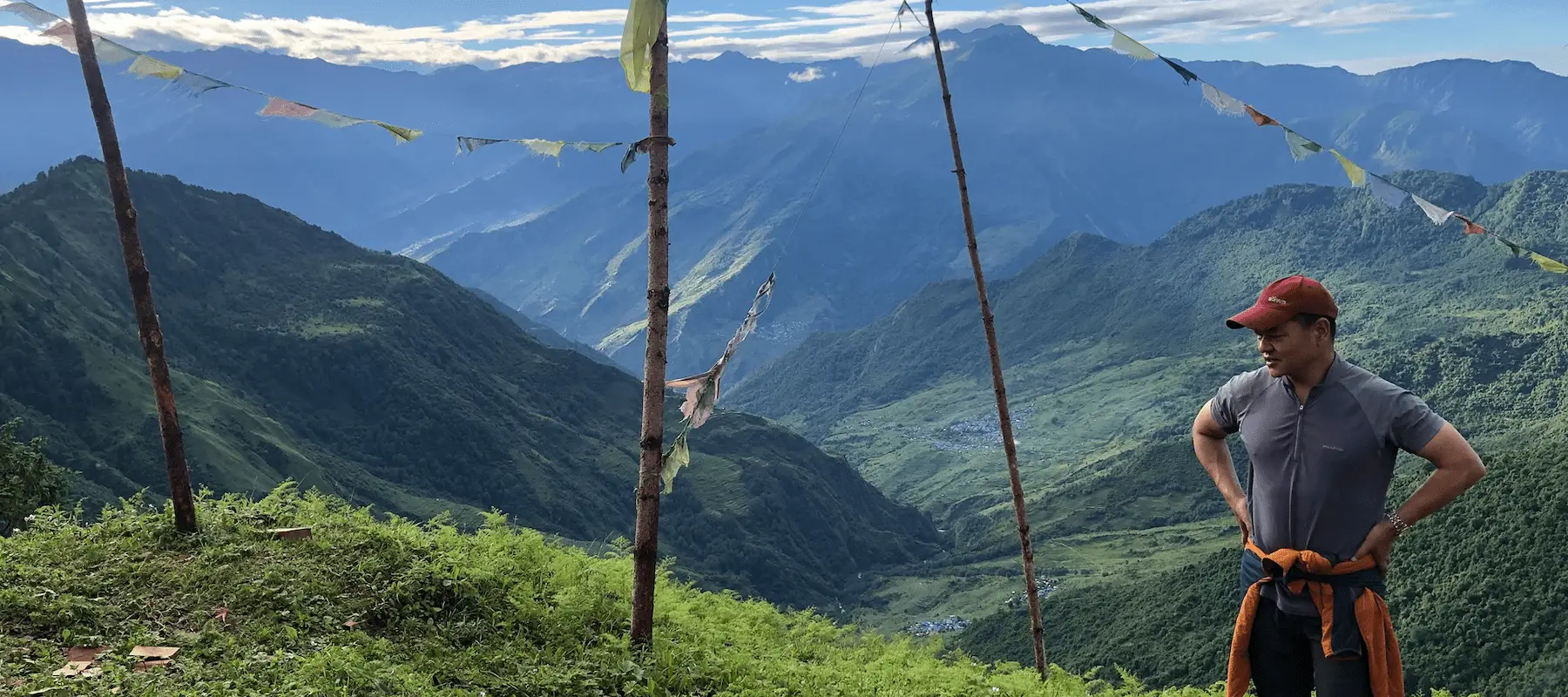
Magne Pass trek does not get the introduction it deserves. Most articles about the Ruby Valley region dedicate pages to Singla Pass and Pangsang Pass including their altitude, views, cultural weight and then mention Magne Goth almost as an afterthought. The third pass. The lower one. The exit.
That framing misses the point completely.
Magne Pass also known as Magne Goth Pass standing tall at 2,853 metres is not a lesser crossing. It is a different kind of crossing entirely and the one that takes everything the Ruby Valley has offered across days of high-altitude walking and brings it down through the densest, most biodiverse terrain on the entire route. Herder shelters used by Gurung and Tamang sheep and yak farmers in summer and left empty and ghostly in winter. A large boulder near the pass where ruby extraction has been documented. Views of Manaslu, Himalchuli, and Shringi opening to the west as you descend into the ancient kingdom of Gorkha.
And then, on the other side — the twin waterfalls of Ganga and Jamuna.
At Alliance Treks, we are the very first local trekking company from Ruby Valley. Our founder Kul Gurung was born here. The Magne Pass trek is the section of the route that most of our guides describe as the quietest and most unexpectedly moving, the part where the trek, having already given you high passes and mountain panoramas and sacred lakes, does something completely different. Slows down. Goes forest. Goes human.
This is everything about it.
Magne Pass (also written as Mangni Pass, Magne Goth Pass, or Myangal Bhanjyang on some maps) sits at 2,853 metres above sea level on the ridge between Khading Gaun and Dhunchet which marks the boundary between Dhading and Gorkha districts in central Nepal.
It is the second pass on the Ruby Valley Two Passes Trek which pairs it with Pangsang Pass as the two-pass combination that defines the standard extended Ruby Valley itinerary.
The pass sits in a landscape that is geographically lower than the Ruby Valley’s two higher crossings but ecologically richer. While Singla and Pangsang move through alpine terrain, open ridgeline, rocky ground, thin vegetation, Magne Pass Trek on the other side is embedded in dense Himalayan Forest. Bamboo, larch, rhododendron and blue pine. A sense of deep rural Nepal that the higher, more photographed passes don’t carry in the same way.
The first thing most trekkers notice about Magne Pass is the altitude — at 2,853 metres, it is considerably lower than Pangsang (3,850m) and Singla (4,250m). The temptation is to treat it as the easy part. This deserves a correction.
The Magne Pass Trek approach from Lapa Gaon involves a long, sustained climb from around 1,250 metres — a vertical gain of over 1,600 metres through forest and pasture before the pass itself. On a trek where accumulated fatigue from previous pass crossings is already present, this climb asks more of most trekkers than the altitude figure suggests.
The path goes through dense forest, where you might hear birds, monkeys, or see animal tracks. As you climb higher, the trees thin out and open pastures appear with herder shelters and stone fences. The higher you go, the wider the views get. Khading and the lower villages look smaller below.
The forest sections below the pass are the most physically enclosed stretches of the entire Ruby Valley Trekking route which is a marked contrast to the exposed ridgeline crossings at Singla and Pangsang. The trail narrows between stands of bamboo and rhododendron, stream crossings appear without warning, and the directional clarity that open alpine terrain provides is replaced by a denser, more immersive navigation challenge.
This is not a warning against Magne Pass. However, it is an argument for taking it seriously on its own terms rather than assuming the lower altitude makes it a formality.
The view from Magne Pass trek operates on a different axis from the northern panoramas at Pangsang. Where those two crossings look north toward the high Himalaya — Ganesh Himal dominant, Langtang and Manaslu in the supporting range — Magne Goth (Pass) opens to the west and south as you cross into Gorkha district.
From Magne Goth (Pass), Manaslu is the mountain most on view, with also views of Himalchuli and Shringi peaks.
Manaslu (8,163m) also known as Kutang is the eighth highest mountain in the world appears to the west from the pass in a presentation quite different from how it looks at Pangsang or Singla. Seen from Magne Pass Trek, Manaslu rises above the lower Gorkha ridgeline with the cumulative weight of everything that has happened on the trek behind you. Most trekkers who have been looking at Ganesh Himal for days find the sudden dominance of Manaslu from this pass genuinely surprising.
Himalchuli (7,893m) and Shringi Himal (7,187m) extend the western panorama — less familiar peaks than the standard Himalayan celebrities, which gives the view from Magne Goth a specificity that experienced trekkers often appreciate most.
Magne Pass Trek itself is a simple cluster of sheds and stone huts used by yak and sheep herders in summer. From here, you can see Ganesh Himal to the north and rolling hills to the south. It feels wild and untouched, very different from Pangsang Pass.
That phrase ” very different from Pangsang Pass” is the most useful single description of what Magne Pass Trek offers. The atmosphere is not dramatic in the way of a 4,000m ridge crossing. It is quieter than that. More inhabited in a seasonal, animal-husbandry sense. The herder shelters are empty in most trekking seasons, but the stone fences and worn tracks tell you exactly what this land is used for and by whom.
The approach to Magne Pass Trek moves through the most ecologically dense section of the Ruby Valley route — and for trekkers who love forests as much as ridgelines, it is the section they remember most.
The trail goes through high pasture, then enters forest with moss, trees and small streams. Along the way, you cross small passes and grazing areas such as Myangal Bhanjyang (2,975m) and Naubarn Kharka (2,750m). The trail moves through a mix of forest, open land, and viewpoints like Tinsure, where you can take one last wide view of the mountains.
Wildlife on the Magne Pass Trek:
The forested terrain between Lapa Gaon and the pass is active habitat for species that the higher, more exposed sections of the Ruby Valley route don’t support.
Wildlife found in the Magne Pass area includes musk deer, jharal (Himalayan blue sheep), wild boar, langur monkey, leopard, pheasant, and partridge.
Musk deer sightings are most common at dawn on the approach trail — the scent-marking animals prefer the forest edge where bamboo meets open pasture, exactly the terrain you walk through on the way to Magne Goth. Langur troops move through the upper forest canopy and are heard before they’re seen. Pheasant and partridge flush from the undergrowth at intervals throughout the day.
The biodiversity of this section makes it the argument for the Ruby Valley Passes Trek Valley that pure altitude seekers sometimes miss: the route is not only about what’s at the top of each pass. It’s also about what lives in the forest between them.
Crossing Magne Pass Trek means crossing into Gorkha district and this geographical transition carries a historical weight that changes how the descent feels once you know it.
Gorkha district is home to the Gurung people and has an amazing history. From here, Prithvi Narayan Shah (the last ruler of the Gorkha Kingdom) unified the various kingdoms into one Kingdom of Nepal in 1768. Prithvi Narayan Shah then became the first monarch of Nepal. From the same area, the men have a reputation of being loyal soldiers and have been recruited into the British and Indian armies, as well as the Nepal Army. Today many Gurkhas are also among the UN Peacekeeping Force.
The Gurkha story is inseparable from the landscape you descend into after Magne Pass Trek. The villages of Dhunchet, Katunje, and Manbu that appear on the descent are Gurung communities, the same ethnic community from which the British Army has recruited soldiers for over two centuries. Walking through these villages, past stone houses and terraced fields that look exactly as they would have looked when the first Gurkha recruits left for India, gives the trek a historical dimension that neither Singla nor Pangsang carries.
After crossing Magne Pass, the trail descends steeply to the Soti Khola and from there climbs to forested landscapes with beautiful mountain views of Manaslu Himal.
The most significant thing Magne Goth Pass does for the Ruby Valley route is unlock the Ganga and Jamuna waterfalls.
These twin cascades named after the two most sacred rivers in Hindu mythology fall in parallel from a cliff face above the lower valley, reached a day’s walk after the Magne Goth crossing. They are sacred to both Hindu and Buddhist communities of the region.
The twin waterfalls of Ganga and Jamuna are sacred to both Hindus and Buddhists. The falls are named after the holy rivers and are believed to be spiritually cleansing. You can feel the energy of nature and culture combined here.
After 10 to 14 days of high-altitude trekking — crossing passes, sleeping at altitude, camping in the cold and arriving at twin waterfalls in a warm lower valley with the smell of tropical vegetation and the sound of water falling continuously is a sensory reset that most trekkers describe as the emotional conclusion of the trek.
It is interesting that these names belong to Hindu twin goddesses and are usually given to twin girls — twins not being very usual in Nepal.
The Ganga and Jamuna falls would not be on the Ruby Valley itinerary without Magne Pass. They are what the third pass leads to and the reward that the lower crossing makes possible.
Accommodation at Magne Goth itself is basic even by Ruby Valley standards.
Magne Goth itself is a simple cluster of sheds and stone huts used by yak and sheep herders in summer. Depending on the season, you will stay in a basic herder’s hut, a tent, or a shelter.
In trekking season, some of these herder shelters can be used as very basic overnight stops. Alliance Treks carries tents for the Magne Goth camp as standard and the herder huts are backup rather than the plan. A night at Magne Goth, at a simple camp in a high pasture surrounded by the sound of wind and occasional distant sheep bells, is one of the most genuine wilderness nights on the entire Ruby Valley route.
Teahouse accommodation resumes at Lapa Gaon on the descent — the last teahouse/homestay before the pass on the southern approach and the first one you reach after crossing from the north.
| Season | Conditions | Verdict |
|---|---|---|
| October–November | Stable weather, crystal-clear skies, and the best mountain views from the pass. | ⭐⭐⭐⭐⭐ Ideal |
| March–May | Rhododendron forests in bloom with active spring wildlife and pleasant temperatures. | ⭐⭐⭐⭐⭐ Excellent |
| June–September (Monsoon) | Lush forests, slippery trails, and leeches below 2,500m. | ⭐⭐⭐ Possible with an experienced guide |
| December–February | Cold temperatures, possible snowfall on the pass, and empty seasonal herder shelters. | ⭐⭐⭐ Possible with an experienced guide |
Spring deserves a specific mention for Magne Pass Trek — the rhododendron forest on the approach is the most visually dramatic of any section of the Ruby Valley route in March and April, with bloom layers visible from the trail running from crimson through pink to white depending on species and elevation.
Magne Pass Trek is the section of the Ruby Valley route that most agencies treat as a logistical detail. We treat it as a destination in its own right — because the forest trek, the ruby boulder, the Gorkha cultural context, and the Ganga Jamuna falls that follow all deserve more than a paragraph.
Whether you’re planning the two passes trek with Pangsang and Magne or the full three passes trek, or you simply want to understand how Magne Pass Trek fits into your Ruby Valley Trek itinerary before committing, remember we are the team to ask.
Book Your Ruby Valley Trek with Alliance Treks →
Magne Goth Pass sits at 2,853 metres above sea level. Some sources list the altitude between 2,800m and 2,975m, reflecting different measurement points along the broad ridge.
Magne Pass lies between Khading and Dhunchet on the border of the Dhading and Gorkha districts in central Nepal. It is the southernmost of the three major passes in the Ruby Valley region.
Magne Pass is crossed on the Ruby Valley Two Passes Trek (Pangsang Pass + Magne Pass) and the Ruby Valley Three Passes Trek (Pangsang Pass + Timla Pass + Magne Pass). It is the final mountain pass on both itineraries.
From Magne Pass, trekkers can enjoy spectacular views of Manaslu (8,163m), Himalchuli (7,893m), Shringi Himal (7,187m), Ganesh Himal, and on clear days, Paldor Peak.
Basic seasonal herder shelters may be available during the trekking season, but camping is generally required. Standard trekking itineraries include tents, and comfortable teahouse accommodation resumes after descending to Lapa Gaon.
The forests around Magne Pass are home to musk deer, Himalayan blue sheep (jharal), wild boar, langur monkeys, leopards, Himalayan pheasants, and partridges. Early morning offers the best chance to spot wildlife, especially musk deer.
After crossing Magne Pass, the trail descends through the villages of Dhunchet, Katunje, Manbu, and Lapu Danda, then continues to the beautiful Ganga and Jamuna waterfalls before reaching Baseri and the road connection toward Gorkha or Arughat.
The best months are October to November for stable weather and crystal-clear mountain views. March to May is also an excellent time, with blooming rhododendron forests creating some of the most colorful scenery along the approach to the pass.
Alliance Treks & Expedition Pvt. Ltd. Once is not enough for naturally and culturally Himalayas