(Viber, Whatsapp, Cell) +977 9851022814

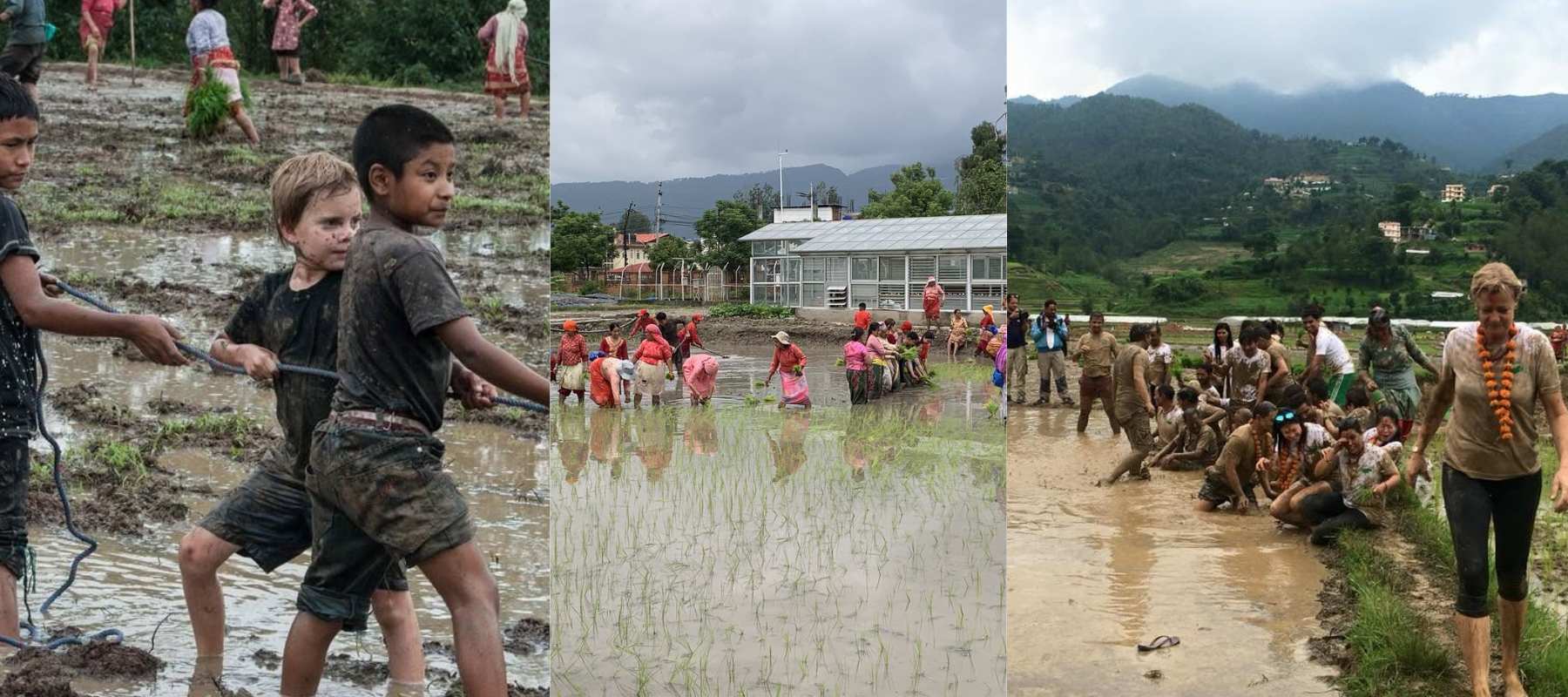
Dhan Ropai Festival also known as national paddy day marks the beginning of the rice-growing season and is celebrated with great enthusiasm across the country’s rural landscapes. There is a particular kind of joy that only comes from getting completely, unapologetically dirty with people who are laughing just as hard as you are. In Nepal, that joy has a name, a date, and thirty-four years of stories behind the company that’s about to invite you into it. Every year on Asadh 15 (29th June), almost the entire country pauses to do something most modern lives have forgotten how to do: plant rice together, by hand, in the mud, while singing.
We call it Dhan Ropai Festival (Diwas). You might also hear it called Ropai Diwas, Dhan Diwas, National Paddy Day, or simply Asadh Pandhra. Whatever name reaches you first, the feeling underneath it is the same — it’s the sound of an entire nation saying thank you to the soil that feeds it.
At Alliance Treks, we’ve spent over three decades walking these hills, sitting in these village courtyards, and eating dahi-chiura with farming families who’ve become more like relatives than hosts. And if there’s one day a year, we wish every traveler could experience Nepal through, it’s this one. Not a mountain summit. Not a viewpoint. Just a flooded rice field, a few dozen barefoot strangers-turned-friends, and a kind of happiness you can’t buy a ticket for — except, in a way, you can.
On paper, Dhan Ropai Festival is the official start of Nepal’s rice-planting season. The Nepal government declared Asadh 15 as National Paddy Day back in 2004, recognizing what farmers had already known for generations — that this date, falling right in the heart of monsoon season, is the most auspicious and agriculturally sound time to transplant young rice seedlings from the nursery beds into the flooded paddy fields.
But if you ask anyone who’s actually stood in that mud, they’ll tell you the calendar explanation barely scratches the surface.
Rice is not just a crop in Nepal. It’s the center of the table, the measure of a good harvest, the difference between a hard year and an easier one. Roughly two-thirds of the population still depends on agriculture, and rice alone makes up a significant share of the national economy. So when Asadh 15 arrives, it isn’t treated like a Tuesday with extra chores. It’s treated like a homecoming.
Families wake before the heat sets in. Men plough the fields and guide the oxen, churning the earth into that thick, slippery mud that will hold the new seedlings in place. Women carry bundles of rice saplings on their backs and begin the patient, rhythmic work of pressing each one into the soil, row by row, until the whole field is a soft green grid. And somewhere in the middle of all that labor, almost without anyone deciding it should happen — someone splashes someone else with mud. Then it’s chaos. Then it’s a festival.
People wear their traditional Nepali clothing into the fields — daura suruwal for the men, gunyo cholo for the women — fully expecting it to be covered in mud by noon and not minding one bit. Folk songs called Asare geet rise up from the fields, the kind of call-and-response melodies that have been passed down through generations of tired, happy farmers. When the planting slows down, everyone gathers for the day’s reward: dahi-chiura, curd and beaten rice, often with banana or mango on the side. It’s simple food. It’s also, somehow, one of the most satisfying meals you’ll ever eat with mud still drying on your ankles.
Ask a farmer in the Terai why Asadh 15 matters, and some will point you back to legend rather than logic. One story passed down through generations tells of King Suddhodana of Tilaurakot, in what is now Kapilvastu district, who is said to have once taken up a golden plough himself and planted the first rice of the season on this very day — a king, hands in the soil, leading by example rather than decree. Whether or not every detail of that story survived the centuries intact, it tells you something important about how Nepal sees this act of planting. It isn’t lowly work. It’s the work that everything else depends on, important enough that even royalty, in the old tales, rolled up their sleeves for it.
That reverence has outlasted kings and calendars. Long before the government made it official in 2004, rural communities were already marking Asadh 15 as one of their most meaningful days of the year — not because a ministry told them to, but because the rains had arrived, the fields were ready, and there was nothing more worth celebrating than the chance to grow food for the year ahead. The government’s recognition didn’t create the festival. It simply caught up to something farmers had been honoring all along.
There’s something quietly moving about that. So much of what gets called “tradition” in the world today was invented for tourism or nostalgia. Dhan Ropai Diwas wasn’t. It was alive in these fields long before anyone thought to write it down, and it will likely be alive long after we’re gone — because as long as people need rice, someone will need to plant it, and as long as someone plants it, there will be songs, mud, and laughter to go with the labor.
We’ve guided travelers through high passes at five in the morning, watched their faces when the sun finally clears a Himalayan ridge, and felt that quiet, awestruck silence settle over a group. Dhan Ropai Diwas in Nepal marks the beginning of the rice-growing season and is celebrated with great enthusiasm across the country’s rural landscapes. gives you something different. It’s loud. It’s communal. It’s the opposite of silence.
There’s an old Nepali belief that everyone should touch the mud at least once on this day, even if just symbolically — because the mud here isn’t dirt to be avoided. It’s seen as something close to sacred, the very thing that turns water and labor into food and life. When a farmer hands you a handful of seedlings and shows you how deep to press them, you’re not performing a cultural activity for a camera. You’re doing the same motion her grandmother did, and her grandmother’s grandmother before that. The continuity of it is humbling in a way that’s hard to explain until you’ve felt the cold mud close around your feet and looked up to see an entire field of people doing exactly the same thing, all at once, all together.
This is what we mean when we say a festival can have a human touch. Dhan Ropai Diwas isn’t a show staged for visitors. It’s real work, real food, real songs, real families — and for one day, real laughter shared between people who, an hour earlier, had never met.
We’ve designed our Dhan Ropai Diwas cultural experience specifically so that travelers aren’t just watching from the edge of the field — you’re in it, mud and all, alongside the local farmers who’ve welcomed our guests for years.
Here’s what a typical day with us looks like:
We keep our groups small on purpose. Dhan Ropai works best when it still feels like a village gathering, not a tour bus stop. You’ll leave with mud in places you didn’t know mud could reach, a stomach full of curd and beaten rice, and — we hear this from almost every guest — a strange, happy ache in your chest that’s hard to name. Some people call it joy. Some call it gratitude. We just call it Tuesday in rural Nepal during monsoon season, and we never get tired of sharing it.
Thirty-four years is a long time to be in any business, but it’s an especially long time to keep falling in love with the same hills, the same trails, the same handful of festivals that make Nepal feel less like a destination and more like a second home. We started Alliance Treks wanting to share mountains. Somewhere along the way, we realized the real heart of this country isn’t only found at altitude — it’s found at ground level, in flooded fields, in the hands of farmers who’ve never asked for recognition and who would be a little embarrassed to hear us call their daily work a “festival.”
But it is one. Asadh 15 is proof that joy doesn’t need a stage. It needs community, rhythm, a little bit of risk (you will fall in the mud at some point, we promise), and people willing to show up for each other year after year, harvest after harvest.
If you’re traveling through Nepal during monsoon season and looking for something, that mountains alone can’t give you, this is it. Not every memory from a trip needs a summit photo. Sometimes the best one is a photograph of you, knee-deep in a rice paddy, completely covered in mud, grinning like you haven’t grinned in years — surrounded by people who, by the end of the day, don’t feel like strangers anymore.
We’ve watched a lot of travelers leave a lot of places over the years. Most of the time, what people carry home are photographs — beautiful ones, often, but flat. A mountain captured at golden hour. A temple roofline against the sky. Dhan Ropai Diwas tends to leave people with something else, something that doesn’t fit as neatly into a photo album.
It’s usually a feeling more than an image. The specific warmth of a farmer’s hand steadying yours as she shows you, for the third time, the right angle to press a seedling into the mud, patient even though you’re clearly slower at this than her eight-year-old grandson. The unexpected vulnerability of being soaked in muddy water in front of people you met two hours ago, and realizing nobody is laughing at you — they’re laughing with you, because everyone gets splashed eventually, and that’s the entire point. The strange comfort of a meal as plain as curd and beaten rice tasting like one of the best things you’ve eaten all year, because of who you shared it with and where you were sitting when you ate it.
Guests have told us, sometimes a little sheepishly, that this single day in a rice paddy left a deeper mark than entire weeks spent trekking toward famous viewpoints. We don’t think that’s an exaggeration, and we don’t think it should be a surprise. Mountains are humbling because they’re vast and indifferent to you. Dhan Ropai in Nepal marks the beginning of the rice-growing season and is celebrated with great enthusiasm across the country’s rural landscapes. is moving for the opposite reason — because for one day, an entire community decides to be anything but indifferent to a stranger standing in their field, and chooses, instead, to hand you a seedling and say: here, plant this with us.
That’s not a tourist attraction. That’s an invitation. And we think invitations like that are worth crossing the world for.
Dhan Ropai Diwas falls on Asar 15 every year (late June in the Gregorian calendar), and the window to experience it properly is short — usually just a day or two around the official date, depending on the rains. If you’re already planning a Nepal trip for June or early July, we’d genuinely encourage you to build a day around this. It pairs beautifully with a short Kathmandu Valley cultural tour, and for trekkers heading toward the Everest or Annapurna regions afterward, it’s a gentle, joyful, grounding way to begin the journey — mud first, mountains after.
Reach out to our team and contact Alliance Treks, and we’ll help you find a village, a host family, and a date that works. We can’t promise you’ll stay clean. We can promise you’ll remember it.
Happy Asar 15, from all of us at Alliance Treks — may your year ahead be as full as the fields we’ll be planting together.
Alliance Treks & Expedition Pvt. Ltd. Once is not enough for naturally and culturally Himalayas