(Viber, Whatsapp, Cell) +977 9851022814

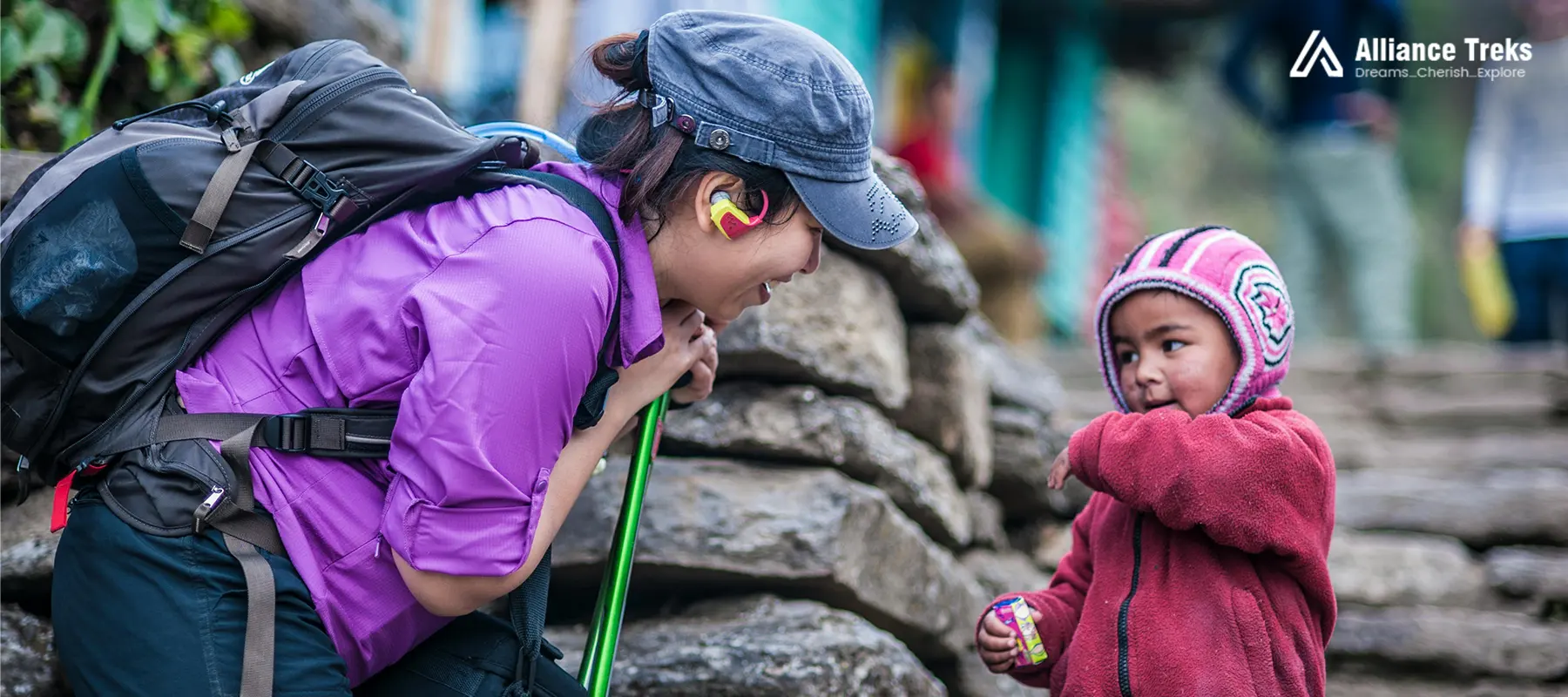
Nepal travel phrases are the single most underrated item on any packing list. Tourists spend weeks researching the right boots, the best sleeping bag, the perfect trekking pole length and then they land in Kathmandu and cannot say a single word to the person handing them tea. That is a missed opportunity. A massive one. Because in Nepal, more than almost anywhere else in the world, language is the fastest route to genuine human connection. And genuine human connection is the whole point of being here.
You do not need to become fluent. Nobody expects that. However, learning even ten or fifteen Nepal travel phrases before you arrive will completely change how locals respond to you. Shop owners will smile differently. Teahouse families will pull up an extra chair. Your guide, whether taking you on a Manaslu Circuit Trek or narrating the history of every monastery on the Annapurna Base Camp Trek — will grin at you with genuine delight the first time you nail a Nepali phrase without being prompted. Moreover, the mountains themselves feel more accessible when you can say something real to the people who live among them.
Alliance Treks has been taking tourists through Nepal for over 30 years. Consequently, our guides have heard every possible mispronunciation of every possible Nepali word. They find it charming every single time. So do not be embarrassed. Get the phrases wrong. Get corrected. Laugh about it. That, right there, is Nepal travel at its very best.
Nepal travel phrases open doors that money genuinely cannot. Furthermore, Nepal is not a country where throwing extra dollars at something makes it better. It is a country where warmth, humility and a genuine attempt at connection get you further than any budget upgrade ever could. A tourist who tries to speak Nepali even haltingly or even hilariously badly is treated fundamentally differently from one who communicates entirely through pointing and increasing volume.
Additionally, the effort itself is the message. Nepali people are extraordinarily gracious. They will not laugh at you for mispronouncing something. They will absolutely light up because you tried.
Therefore, think of this article not as a language lesson but as a relationship starter. These 35 Nepal travel phrases are the phrases our guides most wish their trekkers already knew before arriving. They are organised by situation so you can find what you need exactly when you need it. Carry this list. Practice in the shower. Butcher the pronunciations cheerfully. You will have the best trip of your life.
Alliance Treks tip: Write your five most-used phrases on a small card and keep it in your shirt pocket. Pulling it out to try a phrase in a teahouse is, apparently, the most charming thing a tourist can do. Our guides have witnessed this produce free extra dal bhat on three separate occasions.
Every list of Nepal travel phrases begins here and for genuinely good reason. “Namaste” (nah-mah-STAY) is not just a greeting. It is a philosophy compressed into three syllables. It translates loosely as “I bow to the divine in you” which sounds like a lot to pack into a hello, but that is Nepal. Furthermore, it is delivered with both palms pressed together at chest height and a slight bow of the head. Do the gesture. It matters as much as the word.
You will use Namaste approximately four hundred times per day in Nepal. Consequently, it is also the fastest way to tell if a tourist has done any homework before arriving because the ones who know it deliver it naturally, and the ones who do not either do nothing or shake hands, which is perfectly fine but notably less wonderful. Moreover, Namaste works in every situation: meeting someone for the first time, walking past a village elder on the trail, greeting your teahouse host at dinner, thanking your guide at the end of a long day. It is genuinely the Swiss Army knife of Nepal travel phrases.
Namaste with the palms-together gesture is called ‘Anjali mudra’ and it signals respect across South Asian cultures. In Nepal it also works as a goodbye. So if you learn nothing else from this entire article, learn Namaste. You are already winning.
These are the Nepal travel phrases that cover the first thirty minutes of any interaction. Furthermore, they are also the phrases that signal immediately to locals that you are the kind of tourist worth investing time in. Learn them phonetically. Practice the pronunciations.
| Nepali | Say It Like This | Meaning | Use It When… |
|---|---|---|---|
| Namaste | nah-mah-STAY | Hello / Goodbye / I respect you | Every single time you greet anyone. Always. |
| Dhanyabad | dhan-YAH-bad | Thank you | Someone helps you, feeds you, does anything kind |
| Tapai ko naam ke ho? | tah-PAI-ko naam ke ho | What is your name? | Meeting someone new on the trail or in a village |
| Mero naam ___ ho | may-ro naam ___ ho | My name is ___ | After they tell you theirs. Be ready. |
| Tapai lai kasto chha? | tah-PAI lai kas-to cha | How are you? | Any casual greeting after Namaste |
| Ramro chha | RAM-ro cha | Good / It is good | When the food is good, the view is good, life is good |
| Hudaina | hoo-DAI-na | No / It doesn’t work / Not okay | Politely declining something. Use gently. |
| Huncha | HUN-cha | Yes / Okay / It works | Agreeing to anything. Very versatile. |
A quick note on “Dhanyabad” — this is one of the Nepal travel phrases that trips people up because the ‘dh’ is aspirated, meaning there is a little puff of air after it. Think of it less like the English ‘d’ and more like a breathy version.
⚠️ Avoid saying ‘thank you’ in English as your default response in Nepal. It is perfectly understood, but Dhanyabad lands completely differently. One says you know the words. The other says you made the effort.
Food in Nepal deserves its own language entirely. Furthermore, dal bhat — lentil soup, rice, vegetable curry, and various rotating sides — is the national dish, the trekking fuel, and honestly one of the best things you will eat in your entire life. It also comes with unlimited refills if you know how to ask. Consequently, the phrase “Aru dinus” (more please) is, according to Paicha Lama, the Nepal travel phrase with the highest return on investment per syllable of any phrase on this list. Additionally, knowing food vocabulary makes teahouse mealtimes feel less like transactions and more like family dinners, which is exactly what they are.
| Nepali | Say It Like This | Meaning | Use It When… |
|---|---|---|---|
| Dal bhat power, 24 hour! | dal bhat POW-er, 24 hour | The trekker’s battle cry | Anytime, everywhere. Locals love it. Say it with conviction. |
| Aru dinus | ah-ROO dee-nus | More please / Give me more | When your dal bhat plate needs a refill. Which is always. |
| Khana khanu hunchha? | KAH-na kah-nu-hun-cha | Have you eaten? / Shall we eat? | A warm greeting used around mealtimes. Very endearing. |
| Mitho chha | MEE-tho cha | It is delicious | After your first bite of anything. Non-negotiable. |
| Paani | PAH-nee | Water | Ordering water, asking for water, desperately needing water |
| Chiya | CHEE-ya | Tea | Every morning, every afternoon, after every hard section of trail |
| Dudh chiya | DOODH chee-ya | Milk tea | When you want the full, warm, slightly sweet Nepali experience |
The phrase “Dal bhat power, 24 hour!” deserves special mention. It is not exactly a standard Nepal travel phrase. It was coined by trekkers but it has been fully adopted by the local trekking community and saying it in a teahouse dining room will produce immediate, genuine delight. Therefore, learn it, commit to it and deploy it loudly.
The dal bhat refill culture is real and wonderful. When your plate is running low, catch the host’s eye and say ‘Aru dinus’ with a small gesture toward your plate. You will be refilled immediately and for free. This is one of the greatest Nepal travel phrases in terms of direct caloric benefit.
Trekking vocabulary is where Nepal travel phrases move from charming to genuinely important. Furthermore, on a mountain trail, the ability to communicate something basic — I am tired, I have a headache, how far is it, I need to stop — in Nepali does something important: it keeps your guide in the loop faster than a translation delay allows. Moreover, Alliance Treks guides like Phircha are trained to watch for signs of altitude sickness even before you say anything, but confirming what you are feeling in clear terms always helps. Consequently, these phrases are the ones our team most wants trekkers to know before setting foot on any high-altitude route.
| Nepali | Say It Like This | Meaning | Use It When… |
|---|---|---|---|
| Kati taadhaa chha? | kah-TEE tah-daa cha | How far is it? | Every single time you wonder how much further. Which is often. |
| Bistaarai | bis-TAH-rai | Slowly / Take it easy | Your guide telling you to slow down. Also great for bargaining. |
| Thakyo | THAK-yo | I am tired | Honest self-reporting to your guide on a long day |
| Tauko dukhyo | TOW-ko dook-hyo | I have a headache | Important altitude symptom. Tell your guide immediately. |
| Ramrari bujhina | ram-RAH-ree boo-jee-na | I don’t understand | When you are lost in translation. Very useful. Very common. |
| Baato kaha chha? | BAH-to kah-HA cha | Where is the path / trail? | When the trail splits and you’re not sure which way |
| Eklai najanus | ek-LAI jah-nah- ja- nus | Please don’t go alone | Useful safety phrase if someone in your group wanders off |
| Dherai sundar chha | DHEH-rai sun-DAR cha | It is very beautiful | Looking at a mountain, a valley, a sunrise. Constantly useful. |
The phrase “Bistaarai” — slowly — is one of those Nepal travel phrases that works in both directions. Your guide will say it to you when you are pushing too hard on an ascent. You can say it back when you need a pace adjustment, or when you are trying to haggle for a souvenir, or when life in general feels like it is moving faster than your legs. Additionally, “Dherai sundar chha” — it is very beautiful — will become your most-used phrase above 3,500 metres. Use it freely and genuinely. The mountains in Nepal are, objectively, very beautiful, and saying so in Nepali to a local feels completely different from posting a caption in English.
Kathmandu’s Thamel district and the bazaars of Pokhara are joyful, chaotic, and absolutely loaded with opportunities to practice Nepal travel phrases in a low-stakes environment. Furthermore, bargaining is expected and entirely normal in market settings, it is a social ritual, not an adversarial event. The goal is not to win. The goal is to arrive at a number that both sides feel good about, while enjoying the conversation that gets you there. Moreover, attempting that conversation in Nepali is, according to our guide Ridhhe, the single fastest way to get a genuinely good price while also making a new friend.
| Nepali | Say It Like This | Meaning | Use It When… |
|---|---|---|---|
| Kati parchha? | kah-TEE par-cha | How much does it cost? | First thing to say before touching anything in a market |
| Mahango chha | mah-HAN-go cha | It is expensive | Your response to the first price. Always. Non-negotiable. |
| Sasto paarnus | sah-sto- paar-nus | Please make it cheaper | The polite ask. Works better than any aggressive tactic. |
| Ramro chha, kinchu | RAM-ro cha, KIN-chu | It’s good, I’ll buy it | Closing the deal once you’re happy with the price |
| Alikati | ah-lee-KAH-tee | A little / Just a bit | Aru alikati — just a little more. Use in every context. |
A word of honest advice here: use these Nepal travel phrases with warmth, not aggression. Furthermore, the vendors in Kathmandu and Pokhara hear every possible version of “it’s too expensive” every day. What stands out is genuine engagement — a smile, a laugh when you mispronounce something, a willingness to let the negotiation take three minutes instead of thirty seconds. Additionally, if someone gives you a price that is already very reasonable, accept it graciously. The point of bargaining in Nepal is connection, not conquest.
These Nepal travel phrases are not the fun ones. However, they are the important ones. Furthermore, in a genuine emergency — on a mountain trail or in a city street — being able to communicate the nature of the problem in Nepali will get you help faster than anything else. Moreover, all Alliance Treks guides carry full first aid kits and satellite phones on every remote trek, so in a guided situation your guide handles emergencies directly. Nevertheless, independent tourists and those exploring cities without a guide should absolutely know these phrases before they need them.
| Nepali | Say It Like This | Meaning | Use It When… |
|---|---|---|---|
| Sahayog garnuhos | sah-HYO gar-nu-hos | Please help me | The most important phrase on this list. Learn it first. |
| Doctor kaha chha? | DOK-tor kah-HA cha | Where is a doctor? | Medical emergency. Say it clearly and loudly if needed. |
| Aspatal kaha chha? | as-PAH-tal kah-HA cha | Where is the hospital? | More serious medical situation requiring facility care |
| Dukha bhayo | DOO-kha bha-yo | I am in pain / I am hurt | Communicating physical distress to a guide or local |
| Haraaye | ha-RAH-yay | I am lost | If you have wandered off the trail or out of an area |
| Prahari kaha chha? | prah-HAH-ree kah-HA cha | Where is the police? | If you need law enforcement assistance |
Altitude sickness is serious and moves fast. If you are on a high-altitude trek with Alliance Treks and feel a sudden severe headache, confusion, or cannot walk in a straight line, tell your guide immediately in any language. Do not wait to find the right Nepali phrase.
Numbers and directions are the Nepal travel phrases that nobody glamourises but everyone needs. Furthermore, knowing your numbers means you can check your bill, understand a quoted price, and count the kilometres to the next teahouse. Moreover, directions matter enormously on the trail — particularly when a fork appears and your guide is momentarily out of sight. Additionally, these words pop up constantly in everyday conversation and learning them dramatically increases your ability to navigate independently in cities like Kathmandu and Pokhara.
| Nepali | Say It Like This | Meaning | Use It When… |
|---|---|---|---|
| Ek, Dui, Teen | ek, doo-ee, teen | One, Two, Three | Counting things, prices, days, altitude gains |
| Char, Paanch | char, paanch | Four, Five | Continued counting. You’ll need these at markets. |
| Das | das | Ten | A useful anchor number for prices and distances |
| Saya | SAH-ya | One hundred | Prices in Nepal are often in hundreds of rupees |
| Daayaan | DAH-yaa | Right | Turn right. Go right. The trail is to the right. |
| Baayaan | BAH-yaa | Left | Turn left. The opposite of daayaan. Obviously. |
| Sidha janus | SID-ha jah-nus | Go straight | When the path continues directly ahead |
| Tala | TAH-la | Down / Below | The teahouse is down there. Your knees are going down there. |
| Maathi | MAH-thee | Up / Above | The pass is up there. The summit is up there. Keep going. |
The words “Tala” (down) and “Maathi” (up) will become deeply meaningful to you by about day four of any serious Nepal trek. Furthermore, everything on a mountain is either tala or maathi and your feelings about each direction will shift dramatically depending on whether your knees are working.
Technically, no; you can get by in English in major cities and on popular routes. However, learning basic phrases is about making a genuine connection rather than just getting by. Locals and guides respond much more warmly to the effort, turning a good trip into a great one.
Nepali is a phonetic language, meaning words are generally pronounced as they are spelled. Unlike Mandarin or Thai, it is not tonal, making it more accessible for English speakers. You can often learn the essential 35 phrases to a usable standard in just one afternoon.
While no standard phrases are offensive, you should avoid making negative comments about Nepal’s infrastructure or living conditions in any language. Keep your interactions positive and respectful, focusing on the country’s culture and natural beauty.
Absolutely. Alliance Treks guides enjoy helping trekkers practice, and long walking days provide plenty of opportunity for conversation. You can even ask your guide to write things down phonetically in a notebook to help you remember.
Keep a small card with your top ten phrases in an accessible pocket. You can also use offline modes on apps like Google Translate or refer to the route-specific phrase guide provided in the Alliance Treks pre-departure pack.
Nepal travel phrases are not about being impressive. They are about being present. They are about showing up in this extraordinary country with a little bit of effort and a lot of openness — and discovering that the people here will meet you more than halfway every single time. Furthermore, the mountains will be beautiful regardless of what language you speak. However, the stories you tell when you get home will be richer, funnier, and more human if you took the time to learn even ten words before you arrived.
Alliance Treks has been walking these trails and building these friendships for over 30 years. Our guides and the whole team are ready to show you Nepal in all its extraordinary depth. Moreover, they will absolutely teach you how to say Dhanyabad properly on day one. Consider it part of the service.
Plan your Nepal trip with Alliance Treks — Home – Alliance Treks and Expedition
Alliance Treks & Expedition Pvt. Ltd. Once is not enough for naturally and culturally Himalayas