(Viber, Whatsapp, Cell) +977 9851022814

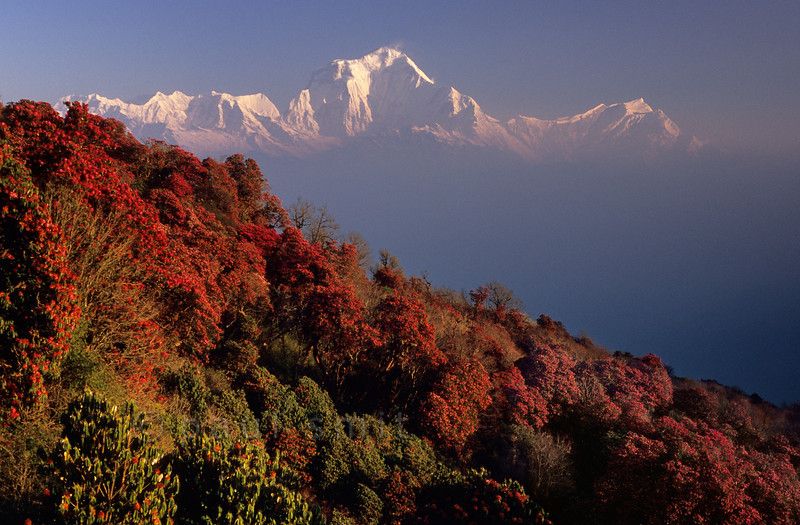
Most international travelers associate Nepal exclusively with grueling climbs and oxygen-depleted summits. However, the true soul of the Himalayas during spring exists three thousand meters below the peaks. In fact, the trend in 2026 shifts from “conquering” mountains to “connecting” with them. This is because March and April transform the mid-hills into a vertical botanical garden.
As a result of our 33 years as a legacy trekking company in Kathmandu, we have seen the crowded trails lose their charm. Consequently, we now advocate for a different approach. Specifically, you deserve a journey that balances visual splendor with cultural depth. Furthermore, this guide reveals how to navigate blooming rhododendron forests and ancient villages without the backpacker crowds. In addition, we promise a strategy to turn your walk into a profound cultural immersion. Therefore, we invite you to move past the postcards and step into the living heritage of the Annapurna and Langtang regions.
Spring in the Himalayas is a sensory revival. While the high-altitude passes remain locked in winter’s grip until late May, the mid-hills ignite with life as early as March. After three decades of observing these cycles, we identified a clear pattern: the “Spring Window” is getting earlier.
The Founder’s Perspective: “In the 1990s, we waited until mid-April for the full bloom. Today, however, the fragrance of the Daphne bholua (known locally in Nepal as Lokta) begins to drift through the forests of the Annapurna foothills by early March. Consequently, this early awakening provides a rare opportunity for trekkers to enjoy warm daytime temperatures. Moreover, it allows you to avoid the pre-monsoon haze that occasionally obscures the peaks in late May.”
Late February – March: Lower Foothills (1,500m – 2,500m). During this time, expect deep crimson Rhododendron arboreum.
April: The “Sweet Spot” (2,500m – 3,500m). Notably, this is the peak for pink blossoms and clear morning skies.
May: High Alpine (3,500m+). As the season ends, rarer species carpet the meadows near Kyanjin Gompa.
Many travelers default to Everest Base Camp (EBC) or the classic Annapurna Circuit. However, these routes often feature “conga lines” of trekkers that disrupt your tranquility. To solve this, we steer our clients toward the “Ridge Walks” of the Annapurna region.
Imagine standing on a ridge at 3,300 meters where the only sound is a distant yak bell. To your left, the Dhaulagiri massif glows orange in the sunrise. Meanwhile, to your right, the Annapurna range stands in silent majesty. Unlike the crowded viewpoint at Poon Hill, Mohare Danda offers a private audience with the giants.
By choosing these alternative ridges, you avoid the commercial “backpacker hubs.” Instead, you walk through pristine oak forests that feel like a private garden. Furthermore, the lack of crowds ensures that your photography remains unobstructed. Ultimately, your meditation remains personal and profound.
The rhododendron is the national flower of Nepal. In addition to its beauty, it is also the architect of the spring landscape. As you ascend, the forest composition changes dramatically.
Initially, at 2,000 meters, the trees are giants with gnarled trunks. Later, as you reach 3,000 meters, the colors soften into shades of salmon and creamy white. Because our guides have been with us for over twenty years, they can identify over 30 distinct species by name.
Furthermore, this floral diversity attracts incredible birdlife. For instance, in spring, the iridescent Himalayan Monal dances among the blossoms. Consequently, watching Nepal’s national bird take flight is a visual memory that no camera can fully capture.
A scenic walk loses its meaning without a human connection. Therefore, in the spring, the villages of the Gurung and Tamang people become the focus.
We have spent 33 years building relationships with specific families along these trails. Specifically, in villages like Ghandruk, we prioritize “Community Lodges.” Indeed, these are not merely hotels; they are the heart of the village.
When you sit by the hearth in a community lodge, you are talking to the family of your trekking guide. In 2026, these connections are more vital than ever. Because of your stay, you fund local initiatives such as solar power grids. Thus, you contribute to the resilience of mountain culture simply by being a guest.
Logistics should never overshadow your experience. Nevertheless, trekking in spring requires a specific strategy.
Layering is Essential: First, expect 20°C in the sun at noon. Then, prepare for -2°C at dawn. Therefore, we recommend merino wool layers.
The 2026 Guide Policy: Notably, the Nepal Tourism Board now requires all trekkers to have a licensed guide. As a result, our 1:2 guide-to-client ratio ensures your safety.
Hydration & Health: Finally, spring is dry. To address this, we provide daily health checks to ensure your body acclimates perfectly.
In an era of automated itineraries, our longevity is your safety net. In fact, our guides and office staffs are the children of the pioneers who started with us in 1993. This means we know which teahouse has the sunniest terrace in the afternoon. Moreover, we know which trail has the best-preserved monasteries.
Essentially, we don’t just book a trek; we architect an experience. We treat every client as a temporary member of our Kathmandu family. Whether it is arranging a private blessing or ensuring your favorite tea is available, the “personal touch” is our standard.
The snow is melting, and the rhododendrons are budding. Therefore, 2026 is the year to step away from the digital noise. Instead, step into the quiet rhythm of the Himalayan spring.
Ultimately, you don’t need to climb a mountain to be moved by one. Instead, the most profound journey is a slow walk through a blooming forest. So, we welcome you to join us where the stranger becomes a friend.
Are you ready to witness the Himalayas in bloom?
DM us today!!
Alliance Treks & Expedition Pvt. Ltd. Once is not enough for naturally and culturally Himalayas