(Viber, Whatsapp, Cell) +977 9851022814

“How difficult is Poon Hill Trek” is one of the most Googled questions about trekking in Nepal and the honest answer is more interesting than most websites give it credit for. Furthermore, the standard line is that Poon Hill is an easy to moderate beginner trek, which is technically true but slightly misleading. Moreover, what the standard line does not tell you is that day two — the climb from Tikhedhunga to Ghorepani via Ulleri — involves ascending more than 3,000 stone steps and nearly 1,300 metres of elevation gain in a single day. Additionally, the final summit push happens at 4am in the dark and cold. Consequently, Poon Hill is absolutely doable for beginners, but it earns that finish line. Nobody walks up and feels nothing.
Alliance Treks has been taking trekkers to Poon Hill for over 30 years. We have taken people of every fitness level, every age, and every level of previous experience up that hill and back down again. The ones who struggled most were not always the least fit — they were often the ones who arrived without accurate expectations. Consequently, this guide exists to give you accurate expectations. No padding, no selling, just the facts of what Poon Hill trek difficulty actually looks like on the ground.
If you are already thinking about booking, you can explore the Poon Hill trek packages from Alliance Treks directly. But read this first — it will make the experience significantly better.
Poon Hill trek difficulty sits at the easy to moderate end of the scale but moderate in Nepal and moderate in your local park are not the same thing. Furthermore, the route covers roughly 45 to 50 kilometres over four to six days, gaining a total of around 2,140 metres in elevation from its starting point at Nayapul at 1,070 metres to the Poon Hill summit at 3,210 metres. Moreover, the daily walking time ranges from four to six hours depending on your pace and the specific itinerary day. Additionally, about 60 percent of the trail is stone steps rather than gravel or dirt path — which is easier on the joints when going up but merciless on the knees on the way down. Consequently, Poon Hill trek difficulty is best described as a sustained moderate physical effort that genuinely rewards the preparation you put in before arriving.
The reason the trek works so well as a first Nepal trekking experience is that it never asks you to do anything extreme. Furthermore, the maximum altitude of 3,210 metres is well below the threshold where serious altitude sickness becomes a real concern. Moreover, teahouses are available at every overnight stop so there is no camping, no carrying a tent, and no cooking your own food. Additionally, the trail is clearly marked and well-trafficked enough that getting lost is genuinely unlikely. Poon Hill strips away many of the logistical challenges of harder Nepal treks while keeping the thing that makes Nepal trekking extraordinary: the mountains, the culture, and the physical satisfaction of a route that actually asks something of you.
Before going into the detail, here are the core facts about Poon Hill trek difficulty in one place:
| Category | Details |
|---|---|
| Total Distance | 45–50 km (full loop Nayapul to Nayapul) |
| Duration | 4–6 days (most commonly 5 days) |
| Maximum Altitude | 3,210m at Poon Hill viewpoint |
| Highest Overnight Stop | Ghorepani at 2,874m |
| Total Elevation Gain | Approximately 2,140m from Nayapul |
| Hardest Section | Tikhedhunga to Ulleri: 3,000–3,767 stone steps, approximately 510m elevation gain |
| Daily Walking Time | 4–6 hours on average |
| Trail Surface | About 60% stone steps, with the remainder being dirt and stone paths |
| Altitude Sickness Risk | Very low — unlikely at this elevation |
| Difficulty Grade | Moderate (beginner-friendly with preparation) |
| Permits Required | ACAP Permit + TIMS Card |
If there is one section of the Poon Hill trek that genuinely surprises people, it is the stone staircase from Tikhedhunga to Ulleri on day two. Furthermore, this is where the Poon Hill trek difficulty stops being theoretical and becomes very much physical. Moreover, the staircase rises approximately 510 metres over a relatively short horizontal distance — and it does so almost entirely via hand-cut stone steps that vary in height, width, and surface condition. Additionally, the step count is somewhere between 3,000 and 3,767 depending on which section of the route you take and who is counting. Consequently, calling it a staircase does not fully prepare you for the reality of it: it is more like someone stacked a small mountain with steps and told you to get on with it.
The interesting thing about the Ulleri staircase is that it is not technically difficult. Furthermore, it does not require any scrambling, rope work, or special footwear. Moreover, it is simply steep, relentless, and long — and it comes early on day two before your legs have had any chance to find their trekking rhythm. Additionally, local villagers pass you on this section with no apparent effort, often carrying loaded baskets and wearing sandals, which is both inspiring and slightly dispiriting depending on your mood. Consequently, the staircase is not something to dread, but it is something to respect.
After the staircase ends at Ulleri at 2,010 metres, the trail continues through rhododendron and oak forest all the way to Ghorepani. Furthermore, this forest section gains another 824 metres of elevation and takes three to four hours at a normal pace. Moreover, it is not as steep as the staircase but it is longer, and many trekkers find it mentally harder — the body is already tired from the steps and the end is not yet visible. Additionally, the forest is beautiful and the air gets noticeably cooler and cleaner as you climb, which genuinely helps. Consequently, day two of the Poon Hill trek is the hardest day of the route, and if you finish it, you have done the worst of it.
Understanding how the altitude changes each day is one of the most practical things you can do before any Nepal trek. Furthermore, it tells you where the effort concentrates, where the body gets a break, and where to expect the cold. Here is the complete altitude profile for the standard five-day Poon Hill circuit:
| Poon Hill Trek Fact | Details |
|---|---|
| Total Distance | 45–50 km (full loop Nayapul to Nayapul) |
| Duration | 4–6 days (most commonly 5 days) |
| Maximum Altitude | 3,210m at Poon Hill viewpoint |
| Highest Overnight Stop | Ghorepani at 2,874m |
| Total Elevation Gain | Approximately 2,140m from Nayapul |
| Hardest Section | Tikhedhunga to Ulleri: 3,000–3,767 stone steps with approximately 510m of elevation gain |
| Daily Walking Time | 4–6 hours on average |
| Trail Surface | Approximately 60% stone steps, with the remainder consisting of dirt and stone trails |
| Altitude Sickness Risk | Very low; unlikely at this elevation |
| Difficulty Grade | Moderate (beginner-friendly with basic preparation) |
| Permits Required | ACAP Permit and TIMS Card |
The word moderate gets thrown around a lot in Nepal trekking descriptions and it means different things to different people. Furthermore, in the context of Poon Hill trek difficulty, moderate means you need to be reasonably fit but you do not need to be athletic. Moreover, if you can walk for four to six hours on uneven terrain without stopping for extended rest, and your knees handle sustained downhill without giving you trouble, you will be comfortable on this route. Additionally, if you have not done much walking recently but are generally healthy and determined, you will also be fine — it will just feel harder on the first two days. Consequently, the honest answer to “is Poon Hill moderate?” is: moderate for someone who has put in a few weeks of preparation, and challenging for someone who has done nothing.
What moderate does not mean on this trek is easy. Furthermore, the stone steps of Ulleri will make your quads burn regardless of your fitness level. Moreover, the descent from Ghorepani through Tadapani to Ghandruk is long and knee-intensive and catches many people off guard after the physical focus on going up. Additionally, four to five hours of walking per day sounds gentle until you are doing it on uneven stone at altitude with a daypack. Consequently, Alliance Treks always advises trekkers to build their preparation around the actual demands of the route rather than the word moderate on a grade chart.
Note: The descent sections on Poon Hill trek are where most knee injuries occur. Furthermore, the stone steps that feel solid going up become slippery and uneven going down, particularly if there has been rain or morning frost. Trekking poles are not optional on this route — they reduce knee stress significantly on the long descents from Ghorepani to Tadapani and on the final day to Nayapul.
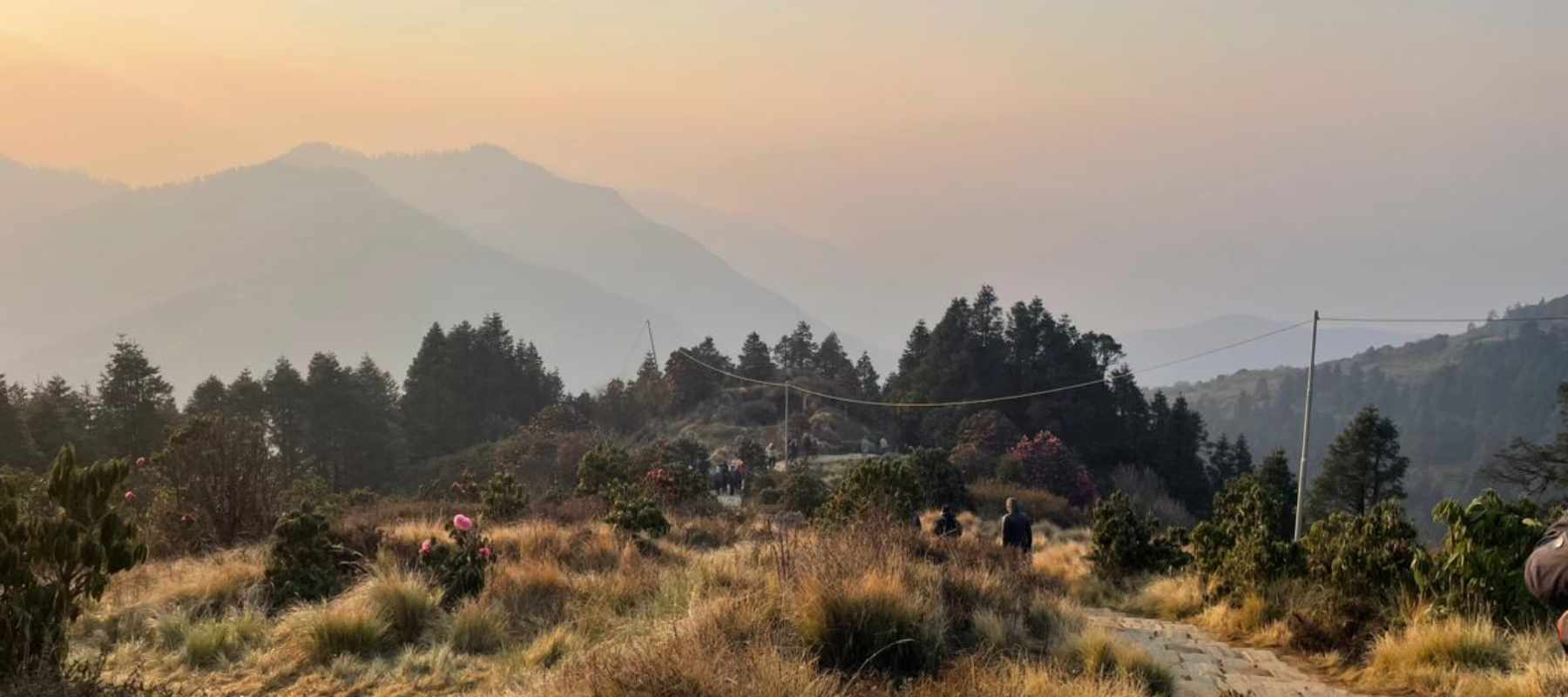
The Poon Hill summit hike is not technically difficult — it is a 45 to 60-minute walk from Ghorepani at 2,874 metres up to the viewpoint at 3,210 metres. Furthermore, the trail is clear, the distance is short, and the gradient is manageable. Moreover, you do it at 4am in the dark in temperatures that regularly drop below five degrees Celsius at this elevation, after your guide has knocked on your door and you have dragged yourself out of a warm sleeping bag into the cold mountain morning. Additionally, headlamps are required, the path is occupied by dozens of other trekkers in various stages of sleepiness, and the steps in this final section are just steep enough to remind your legs that yesterday was hard. Consequently, the difficulty of the Poon Hill sunrise hike is almost entirely psychological rather than physical.
What happens when you reach the top makes every bit of it completely irrelevant. Furthermore, the Poon Hill viewpoint at 3,210 metres offers one of the most spectacular sunrise panoramas in all of Nepal: Dhaulagiri at 8,167 metres to the west, the Annapurna massif across the north, Machhapuchhre — the perfect pyramid of Fish Tail — directly ahead, and Annapurna South rising dramatically to the east. Moreover, as the first light hits the upper snowfields, they turn from grey to gold to a vivid burning orange over the course of about twenty minutes. Additionally, this moment is why people put Poon Hill on their bucket list, and it delivers consistently and without apology. Consequently, the 4am alarm is the best alarm you will ever hear.
Altitude sickness on the Poon Hill trek is a very minor concern compared to most Nepal trekking routes. Furthermore, the maximum altitude of 3,210 metres at the Poon Hill viewpoint is well below the 3,500 to 4,000 metre range where acute mountain sickness typically becomes a significant risk. Moreover, you spend only one to two hours at 3,210 metres before descending, and your highest overnight is Ghorepani at 2,874 metres. Additionally, the gradual day-by-day altitude gain of the standard itinerary — never more than 1,300 metres in a single day — gives the body adequate time to adjust at each stage. Consequently, most healthy trekkers complete the Poon Hill route without any altitude-related symptoms beyond minor breathlessness on steep sections.
That said, altitude affects people differently and there is no absolute guarantee of a symptom-free experience at any elevation above sea level. Furthermore, if you arrive in Nepal and fly or drive directly to Pokhara before starting the trek, your body will have had minimal time to adjust to even the starting altitude of 820 metres in Pokhara. Moreover, drinking plenty of water, avoiding alcohol on the first night or two, and maintaining a steady rather than aggressive pace on day two will all reduce any risk further. Additionally, mild headache or breathlessness at Ghorepani in the evening of day two is normal and usually resolves after a night’s rest. Consequently, altitude sickness is not something to dismiss on Poon Hill, but it is something to be aware of rather than afraid of.
For a complete understanding of how altitude sickness works in Nepal — including what symptoms to watch for and what to do — read the Alliance Treks guide to altitude sickness in Nepal before your trek.
Poon Hill trek difficulty makes it suitable for a broader range of people than almost any other Nepal trek. Furthermore, the route is regularly completed by first-time trekkers with no previous hiking experience, by children as young as eight or nine with reasonable fitness, by older trekkers in their sixties and seventies, and by people returning to exercise after a period of inactivity. Moreover, it is one of the first routes Alliance Treks recommends for families with older children, for couples where one person is significantly more experienced than the other, and for anyone who wants a genuine taste of Himalayan trekking without committing to a two-week high-altitude expedition. Additionally, the teahouse infrastructure means that comfort is never more than a few hours away, which removes a lot of the anxiety that comes with longer, more remote routes. Consequently, if you can walk, you can do Poon Hill with the right preparation and the right guide.
There are a few specific groups who should think carefully before booking. Furthermore, anyone with existing knee problems should be aware that the descent sections — particularly the long downhill from Ghorepani to Ghandruk and the final day back to Nayapul — put significant repetitive stress on the knee joint over several hours. Moreover, very young children under the age of eight may find the day two staircase too demanding, particularly in the final hours approaching Ghorepani. Additionally, trekkers with significant cardiovascular or respiratory conditions should consult a doctor before any altitude trekking, even at moderate levels. Consequently, Poon Hill is widely accessible but not unconditionally so — honest self-assessment before booking is always more useful than a reassuring website.
The best way to understand Poon Hill trek difficulty is to place it in the context of the other routes in Nepal’s trekking network. Furthermore, Poon Hill sits firmly at the beginner end of the spectrum while still being a genuine mountain trek rather than a gentle nature walk. Moreover, the comparison below helps trekkers who have done Poon Hill plan their next challenge,or helps those planning their first trek understand where Poon Hill sits relative to the routes they may have heard about.
| Factor | Poon Hill Trek | Annapurna Circuit | Everest Base Camp |
|---|---|---|---|
| Max Altitude | 3,210m | 4,130m | 5,364m |
| Duration | 4–6 days | 7–10 days | 12–14 days |
| Daily Walking | 4–6 hours | 5–7 hours | 5–8 hours |
| Highest Pass | Poon Hill (3,210m) | Thorong La Pass (5,416m) | N/A – Point-to-Point Trek |
| Altitude Sickness Risk | Very Low | Moderate | High |
| Stone Steps | 3,000+ on Day 2 | Some Sections | Minimal |
| Suitable For | Beginners | Moderate Fitness | Strong Fitness Required |
| Best Next Step | Annapurna Base Camp | Manaslu Circuit | Already Advanced |
Trekkers who complete Poon Hill and want their next challenge often move to the Annapurna Base Camp trek as a natural progression — higher altitude, longer duration, and more demanding terrain, but built on the same Annapurna region foundations. Others choose the Langtang Valley trek for a different cultural and landscape experience at similar difficulty.
The preparation that makes the biggest difference on Poon Hill trek difficulty is not the most dramatic. Furthermore, you do not need to run marathons or spend six months in a gym. Moreover, what you do need is consistent, specific physical preparation in the four to six weeks before your trip. Additionally, the right gear matters almost as much as the fitness — worn out footwear and the wrong clothing will make a manageable trek miserable. Consequently, the following preparation framework is what Alliance Treks recommends to every client booked onto the Poon Hill route.
Poon Hill trek difficulty is classified as moderate and is suitable for beginners with a reasonable level of fitness and some preparation. Furthermore, the maximum altitude of 3,210 metres is well below serious altitude risk territory, the teahouse infrastructure keeps logistical demands low, and the trail is clearly marked throughout. Moreover, the hardest section — the Ulleri staircase on day two — is demanding but not technical. Consequently, most first-time trekkers complete Poon Hill successfully and come back wanting to do something harder.
The Ulleri staircase from Tikhedhunga to Ulleri contains between 3,000 and 3,767 stone steps depending on the specific route variant and counting method. Furthermore, this section alone gains approximately 510 metres of elevation and takes two to three hours at a normal trekking pace. Moreover, additional stone steps appear throughout the route, and approximately 60 percent of the entire Poon Hill trail surface is stone steps of varying gradient. Consequently, knee preparation and trekking poles are both strongly recommended.
Yes, a three-day version of the Poon Hill trek is possible but it is significantly more demanding than the standard four to five day itinerary. Furthermore, the compressed schedule means longer daily walking hours and less recovery time between the hardest sections. Moreover, for first-time trekkers, Alliance Treks recommends a minimum of four days and ideally five, which allows for a more comfortable pace and a rest stop in Ghandruk on the return leg. Consequently, the three-day option works well for experienced trekkers who want a quick Himalayan adventure, but it is not the ideal format for maximising enjoyment of the route.
Spring from March to May and autumn from September to November are both excellent seasons for the Poon Hill trek. Furthermore, spring offers the added spectacle of rhododendrons in full bloom along the forest sections of the route. Moreover, autumn provides the clearest mountain views of the year with consistently dry conditions and crisp mornings. Consequently, both seasons are ideal, and the choice comes down to whether you prefer colourful forests or crystal-clear Himalayan panoramas.
Since April 2023, Nepal requires foreign trekkers on many multi-day trekking routes to trek with a licensed guide arranged through a registered trekking company. Furthermore, a guide provides cultural insight, handles accommodation logistics, monitors your wellbeing, and helps ensure a smoother trekking experience. Consequently, trekking with a guide is both practical and, in many cases, required.
Poon Hill trek difficulty is real but it is the right kind of real. Furthermore, it asks enough of you to make the summit feel earned, the sunrise feel deserved, and the return to Pokhara feel like a genuine achievement. Moreover, it does all of this within a format that is genuinely accessible to most reasonably healthy people who have put in a few weeks of honest preparation. Additionally, the mountain views, the rhododendron forests, the stone villages of Ulleri and Ghandruk, and the moment the Annapurna range ignites at dawn from 3,210 metres are exactly what they are described as: some of the finest walking experiences available anywhere in the world. Consequently, if you are reading this and wondering whether you can do it, the answer is almost certainly yes. Go find out.
Book your Poon Hill trek with Alliance Treks .
Alliance Treks & Expedition Pvt. Ltd. Once is not enough for naturally and culturally Himalayas