(Viber, Whatsapp, Cell) +977 9851022814

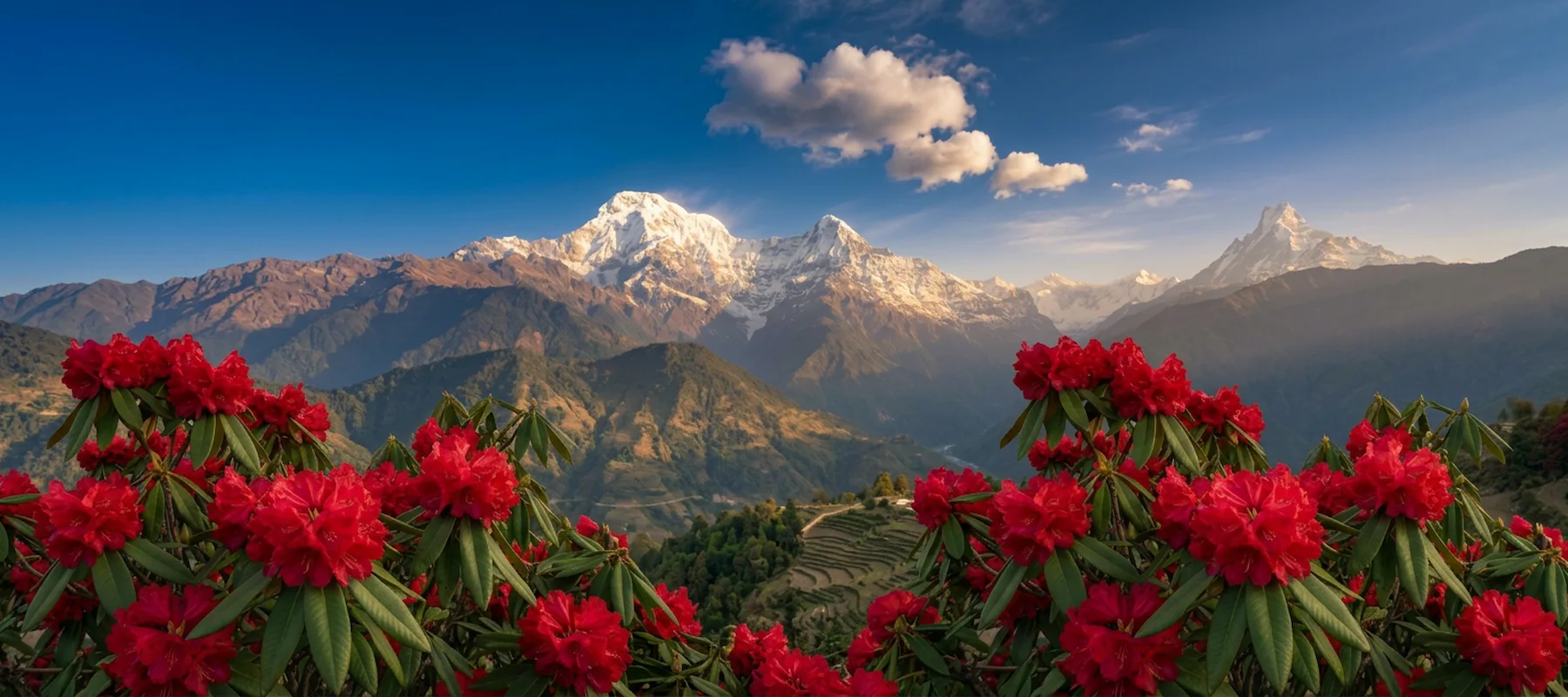
The Himalayas in spring are a Study in Contradictions. While the valleys below bake in the pre-monsoon heat, the high-mountain trails change in ways that feel like a seasonal glitch – where vibrant blooms are suddenly dusted by a heavy, sculptural spring snow.
Now imagine walking on a white snow carpet. Blood red rhododendrons cover the whole forest. Snow powder glitters. This is the “Powder & Petals” phenomenon. It is a brief, ethereal moment. Winter’s stubborn tail brushes against spring’s vibrant awakening.
Unlike the crisp, dry clarity of autumn, spring in the Himalayas offers a scenery overload. It is one of the perfect seasons for those who crave drama over predictability. While autumn is a “perfect” postcard, spring is a living, breathing painting.
Many travelers think spring means “warmth”, but in the high-altitude Himalayas, spring is a battleground between air masses. It is the time of the Pre-Monsoon season, when moisture-laden air from the Bay of Bengal hits the cold wall of the high peaks.
The result isn’t just rain– it’s a surreal, sticky snow that slings to everything where it touches. Unlike January’s dry, wind-blown powder, spring snow feels heavy and sculptural. It shapes the scenic view around the mountain. It coats the branches of blooming trees, creating a surrealist landscape where fire-red blossoms are encased in the ice. It is the only time of year you can experience the absolute silence of a blizzard and the fragrant humidity of a jungle in a single day’s trek.
In March, the mountains are still shaking off winter. The air is crisp, and the snow line remains low during this month. By May, the heat in Kathmandu is intense, but this creates the convection necessary for afternoon thunderstorms in the mountains. In May, you might trek in a T-shirt and shorts at noon and be caught in a white-out by 3:00 PM.
There is a distinct “thermal boundary” in the Himalayan spring. Because the air is warmer, it holds more moisture.
As this air rises (orographic lift), it cools rapidly. Below 3,000m, this falls as life-giving rain for the terraced farms. Above 4,000m, however, that same moisture crystallizes into massive, wet snowflakes that can dump six inches of powder in an hour, only to melt by the next morning’s sun.
| Month | Climate Character | Trail Conditions |
|---|---|---|
| March | Shaking off winter, crisp and dry | The snow line is low; rhododendrons begin to bud. |
| April | The peak of “Powder & Petals”. | Maximum bloom; frequently afternoon “flurries” |
| May | Humid, hazy, and electric. | T-shirts at noon; heavy convection snow at 3:00 PM |
To experience the “Powder & Petals” window, one must prepare for a daily cycle weather in winter:
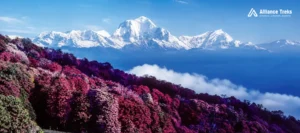
While the snow paints the canvas in the mountain, the Rhododendron (locally known as Lali Gurans) provides the red fire glimpses, adding beauty to Spring Snow. This is the National Flower of Nepal, and in spring, it turns the whole mountainside into an attractive gradient of red, pink, and white. The best treks to view the magic of “Petals & Powder” are Pikey Peak Trek and Poon Hill Trek.
At last, Spring in the Himalayas isn’t just about the stability; it’s about the spectacle. It’s the only time on the mountain that feels truly alive.
It feels like heaven, and photos or videos can’t capture it. You need to visit once to feel this delightful scenic view created by nature. To see nature’s beauty, you’ll need a guide to join you. If you like this article, know more about Soulful Spring Walks.
Book your tour now with us.
“Power the snow and petal the flowers.”
It is a rare seasonal window in spring where winter’s late snow (powder) settles on blooming rhododendron forests (petals). This creates a stunning contrast of fire-red flowers encased in white, glittering ice.
Yes! Spring (March to May) is one of the best trekking seasons. It offers warmer temperatures than winter, vibrant wildlife, and the unique chance to see the national flower, the Rhododendron, in full bloom against snowy peaks.
Yes. While valleys stay warm, high altitudes (above 4,000m) often experience “convection snow” in the afternoons. This spring snow is typically wet and heavy, creating sculptural landscapes that usually melt by the next morning.
April is the peak month for rhododendrons. The “Red Blood” varieties bloom first at lower elevations (2,000m) in March, while pastel pink and white shrubs peak at higher altitudes (above 3,000m) throughout April and early May.
Spring follows a predictable daily cycle: clear, sunny mornings with high UV intensity; building clouds and humidity by midday; and occasional afternoon snow or rain showers. Evenings usually clear up to reveal bright, starry skies.
Because spring is a “study in contradictions,” you need layers. Pack lightweight trekking shirts for sunny mid-days, but keep a high-quality down jacket and waterproof shell ready for sudden afternoon temperature drops and snow flurries.
Alliance Treks & Expedition Pvt. Ltd. Once is not enough for naturally and culturally Himalayas