(Viber, Whatsapp, Cell) +977 9851022814

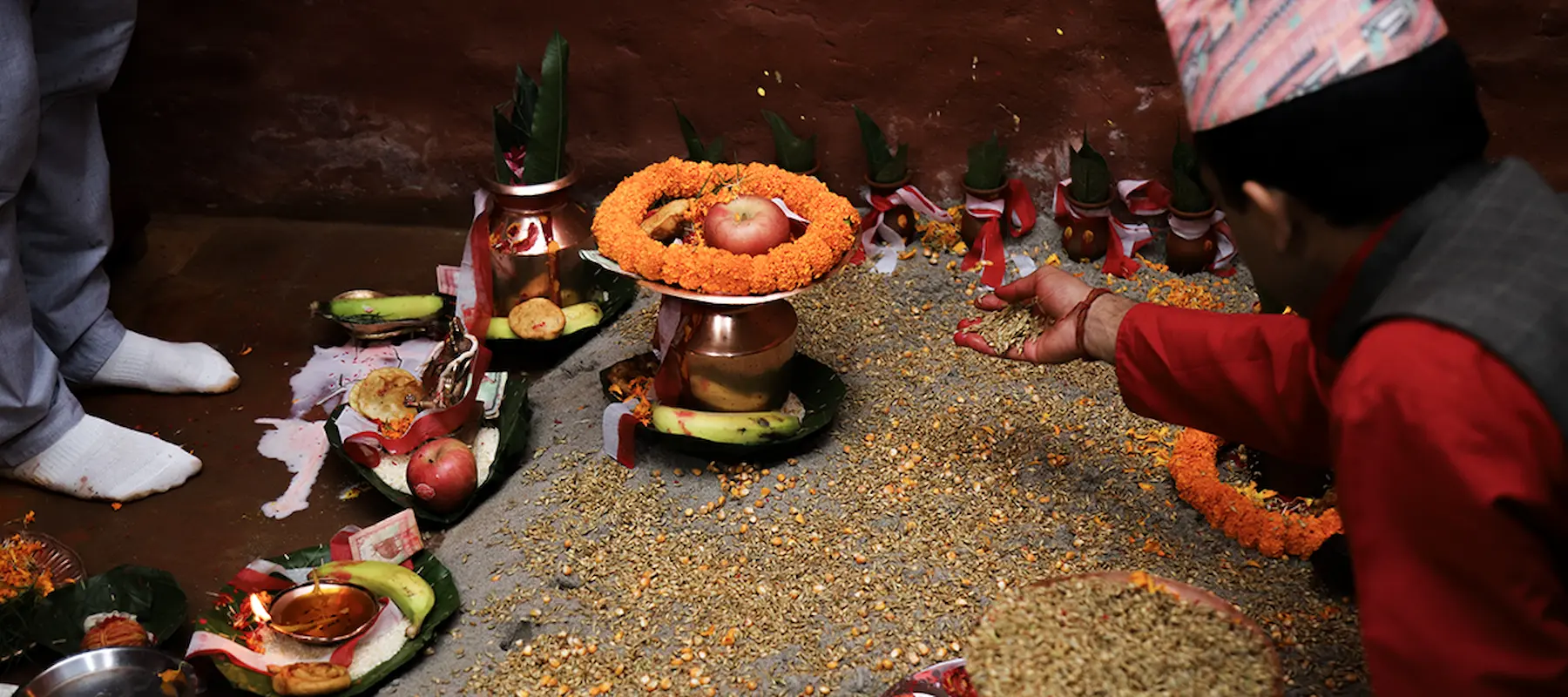
Ghatasthapana 2026 falls on Sunday, October 11, 2026 (Asoj 25, 2083 BS). Nepal’s national calendar committee, the Nepal Panchang Nirnayak Vikas Samiti, has set the auspicious time (sait) at 11:47 AM. Ghatasthapana is the first day of Bada Dashain. Families install a sacred pot (ghata or kalash) in the puja room and sow barley seeds that grow into jamara, the yellow shoots used as a blessing on Vijaya Dashami, which falls on October 21.
This guide covers what Ghatasthapana means, the official 2026 time and why it falls at midday this year, how families perform the ritual step by step, how to grow jamara, how the day compares with Navratri’s Kalash Sthapana in India, and what visitors to Nepal should expect.
| Detail | Information |
|---|---|
| Date | Sunday, October 11, 2026 |
| Nepali date | Asoj 25, 2083 BS |
| Tithi | Ashwin Shukla Pratipada, the first day of the bright fortnight |
| Official sait (Nepal) | 11:47 AM, set by the Nepal Panchang Nirnayak Vikas Samiti |
| What it starts | Bada Dashain (15 days) and Navaratri (nine nights) |
| Goddess worshipped on Day 1 | Shailaputri |
| Public holiday in Nepal | Yes |
| Vijaya Dashami (Tika day) | Wednesday, October 21, 2026 |
| Next Ghatasthapana (expected) | Thursday, September 30, 2027 |
The word comes from Sanskrit. Ghata means pot or vessel, and sthapana means installing or establishing. Ghatasthapana literally means “installing the sacred pot.”
On this day the pot is filled with clean water and placed in a clean, prepared spot. The Goddess Durga, in her form as Shakti, is invited to dwell in it. For nine days the pot becomes the centre of daily worship. Beside it, barley seeds are sown in sand or soil, and the shoots that grow by Vijaya Dashami are called jamara.
In Nepal, the ritual is often described as jamara rakhne, “placing the jamara,” because the barley bed is as important as the pot. In India, the same day is usually called Kalash Sthapana and begins Sharad Navratri.
The official sait for Ghatasthapana in Nepal is 11:47 AM on Sunday, October 11, 2026. The Nepal Panchang Nirnayak Vikas Samiti announced it as part of the Dashain 2083 calendar, and Nepali news outlets repeated it on the morning of the festival.
Two astrological factors, Chitra Nakshatra and Vaidhriti Yoga, are in effect for most of October 11. Because the early-morning window can’t avoid them, the committee picked a midday sait, reported as being based on the Abhijit muhurat, the traditional fallback. The committee also advised families to perform the pacifying rites (shanti) for Chitra Nakshatra and Vaidhriti Yoga before installing the kalash. Ask your family priest (purohit) how your household should do this.
October 11. Some social media posts claimed that jamara should be sown only on Asoj 26 (October 12). The committee rejected that claim and asked people to perform Ghatasthapana on Asoj 25. The reason is the tithi: Pratipada begins on the night of October 10 and ends on the evening of October 11, at roughly 9:30 to 9:45 PM depending on location, so it is in effect for the whole day.
The committee’s time is the one it calls best (uttam). It also noted that families may complete the ritual according to their own kul parampara (family tradition) and their local panchang. If you can’t be home at 11:47 AM, speak to your family priest or the elders who usually lead the ritual.
| Place | Time given | Source type |
|---|---|---|
| Nepal (official) | 11:47 AM | Nepal Panchang Nirnayak Vikas Samiti |
| Kathmandu, Abhijit muhurat | About 11:27 AM to 12:14 PM | Panchang websites |
| Biratnagar, Nepal | Morning window about 5:53 to 9:46 AM; Abhijit about 11:19 AM to 12:06 PM | Drik Panchang |
| New Delhi, India | Morning window: about 6:19 to 10:12 AM; Abhijit: about 11:44 AM to 12:31 PM | Panchang websites |
Times differ because of local sunrise, Nepal’s time zone (UTC+5:45, fifteen minutes ahead of India), and different calendar calculations. Nepal publishes one national sait. Indian panchangs usually give a window for each city, so use the one that applies to where you live.
Customs vary by family, caste, and region, so treat this as a general outline rather than a rule.
| Step | What happens | Why |
|---|---|---|
| 1. Prepare | Wake early, bathe, finish daily rites and wear clean clothes | Purity before the ritual |
| 2. Ready the puja space | Clean the puja room or Dashain ghar, traditionally plastering the floor with cow dung or clay | Creates a purified space for the Goddess |
| 3. Bring soil | Fetch clean sand or soil, traditionally from a river bank or a clean spot | The seedbed for the jamara |
| 4. Sow the barley | Spread the soil in a tray or wide pot, scatter barley (jau) seeds and sprinkle water. Some families add other grains | Barley shoots are considered dear to Durga |
| 5. Install the kalash | At the sait, set a pot of clean water on or beside the seedbed and invoke Durga. Many families begin with a prayer to Ganesh | The pot becomes the seat of the Goddess |
| 6. Worship | Light a lamp and offer flowers, rice, vermilion and incense. Prayers and recitations follow family tradition | Formally begins Navaratri |
| 7. Daily care | Water the jamara every morning and evening and offer daily puja to the forms of Durga | Keeps the shoots growing and the worship continuous |
| 8. Final use | On Vijaya Dashami the jamara is placed behind the ear or in the hair as part of tika. After Kojagrat Purnima it is immersed in a clean place | Receives and then returns the Goddess’s blessing |
Some families also keep a lamp burning through the nine days. The Dashain ghar is often kept private during this time.
| Item | Purpose |
|---|---|
| Clean sand or soil | The seedbed |
| Barley (jau) seeds | Grows into jamara |
| Tray, wide clay pot or leaf plates | Holds the seedbed |
| Kalash (copper, brass or clay pot) with clean water | The Goddess’s seat |
| Cow dung (traditional) | Purifies the floor |
| Rice (akshata), vermilion, flowers | Offerings |
| Ghee or oil lamp and incense | Light and fragrance |
| Mango leaves, coconut and red cloth or thread | Commonly used to decorate the kalash, varies by family |
Jamara grows for about nine days, and families like it to look full and golden by Dashami. These are gardening tips, not ritual rules, so follow your family’s customs where they differ.
| Problem | Likely cause | What to try |
|---|---|---|
| Seeds not sprouting | Old seed, soil too dry or too cold | Use fresh barley, keep the soil lightly moist and the room mild, not near a heater |
| Shoots green rather than yellow | Too much light | Many families keep jamara in a dim spot, which gives the traditional yellow colour. Green shoots are fine too |
| White mould on the soil | Too much water, poor airflow | Water lightly, improve ventilation and remove the affected patch |
| Patchy or thin growth | Seeds too sparse or too crowded | Sow in a single, even layer |
| Limp, falling shoots | Overwatering or crowding | Reduce water and thin out if needed |
Living abroad or in an apartment? A shallow tray, clean soil or sand, and barley from a grocery or health-food store are enough. Keep the tray out of direct sun and away from heaters.
Religious. Ghatasthapana invites the Goddess into the home to begin nine nights of worship. Navaratri honours Durga’s victory over the buffalo demon Mahishasura. A parallel tradition links the season to Lord Rama’s worship of Durga before his battle with Ravana. Both stories are remembered on Vijaya Dashami.
Agricultural. The festival falls after the monsoon and before the main harvest. Sowing barley is an old way to give thanks to the earth and pray for a good crop, and many families read the health of the jamara as a sign for the year.
Social. In Nepal, Ghatasthapana signals that Dashain has arrived. Families begin travelling home, markets fill up, and the countdown to receiving tika and jamara from elders begins.
Historical. Dashain rituals have long been tied to the old palaces. Jamara is traditionally also sown at the Dashain ghar at Hanuman Dhoka in Kathmandu, and the Fulpati procession brings sacred flowers and plants to the city on the seventh day.
| Aspect | Nepal (Ghatasthapana) | India (Kalash Sthapana, Sharad Navratri) |
|---|---|---|
| Starts | Bada Dashain, a 15-day festival | Sharad Navratri, nine nights, ending with Dussehra |
| Time | One national sait, 11:47 AM in 2026 | A muhurat window per city; Delhi’s morning window is roughly 6:19 to 10:12 AM |
| Focus | Jamara (barley shoots) and the Dashain ghar | Kalash, often with an unbroken lamp (akhand jyot) and fasting |
| Public holiday | Yes | Varies by state |
| Climax | Vijaya Dashami with tika and jamara, October 21 | Dussehra, listed on October 20 in many Indian calendars |
| Ravana effigies | Not a Dashain custom | Common at Dussehra |
These dates follow the Nepal Panchang Nirnayak Vikas Samiti’s calendar as reported by Nepali media.
| Nepali date | English date | Event |
|---|---|---|
| Asoj 25 | Sunday, Oct 11 | Ghatasthapana, sait 11:47 AM |
| Asoj 31 | Saturday, Oct 17 | Fulpati |
| Kartik 1 | Sunday, Oct 18 | Maha Ashtami (the Ashtami tithi continues on Oct 19) |
| Kartik 3 | Tuesday, Oct 20 | Maha Navami |
| Kartik 4 | Wednesday, Oct 21 | Vijaya Dashami: Devi visarjan 8:49 AM, tika sait 10:26 AM, facing west |
| Kartik 8 | Sunday, Oct 25 | Kojagrat vrata and evening Mahalakshmi puja, which close the 15 days |
| Kartik 9 | Monday, Oct 26 | Kojagrat Purnima |
Ghatasthapana is a public holiday in Nepal. The longer Dashain holiday block starts around Fulpati, so confirm the latest government notice if you plan to visit offices or banks.
Ghatasthapana is mainly a quiet family ritual in the home, not a street festival, so don’t expect a big public procession. A few practical points:
Ghatasthapana is on Sunday, October 11, 2026 (Asoj 25, 2083 BS), the first day of Bada Dashain.
The official sait is 11:47 AM on October 11, set by the Nepal Panchang Nirnayak Vikas Samiti.
Chitra Nakshatra and Vaidhriti Yoga are in effect for most of the day, so the committee chose a midday sait instead of an early-morning one and advised families to perform the related shanti rites first.
October 11. Pratipada tithi is in effect throughout that day, and the committee rejected claims that jamara should be sown on October 12.
It means “installing the pot.” A kalash is set up to invite the Goddess Durga, and barley is sown beside it to grow into jamara.
Jamara are the yellow barley shoots grown for nine days from seeds sown on Ghatasthapana. They are worn behind the ear or in the hair with tika on Vijaya Dashami.
The committee’s time is the best one, but families may complete the ritual according to their own family tradition and local panchang. Ask your priest or elders.
Yes. Government offices are closed, and many schools and businesses close or run short hours.
Vijaya Dashami and the main tika day fall 10 days later, on Wednesday, October 21, 2026, with the tika sait at 10:26 AM.
They are the same day but celebrated differently. Nepal’s version centres on jamara and the Dashain ghar and uses one national sait, while Indian Navratri observance often involves fasting, an unbroken lamp, and city-wise muhurat windows.
It is expected on Thursday, September 30, 2027, but confirm with the Nepal Panchang Nirnayak Vikas Samiti closer to the date.
It is a private family ritual, so visitors usually see it only if invited. Ask permission before photographing the kalash or jamara.
Ghatasthapana is small in scale and large in meaning. A pot of water, a tray of soil and a handful of barley seeds start a 15-day festival that brings families home and sets Nepal’s calendar for the weeks ahead. In 2026 the date is Sunday, October 11, and the official time is 11:47 AM. After that, the jamara grows quietly beside the kalash until Vijaya Dashami on October 21.
Dashain falls in Nepal’s clearest trekking season. Alliance Treks & Expedition Pvt. Ltd. runs guided departures on the Annapurna Base Camp Trek, Ghorepani Poon Hill, Mardi Himal Trek and Everest Base Camp, and can advise on festival timing for your dates.
Alliance Treks & Expedition Pvt. Ltd. Once is not enough for naturally and culturally Himalayas