(Viber, Whatsapp, Cell) +977 9851022814

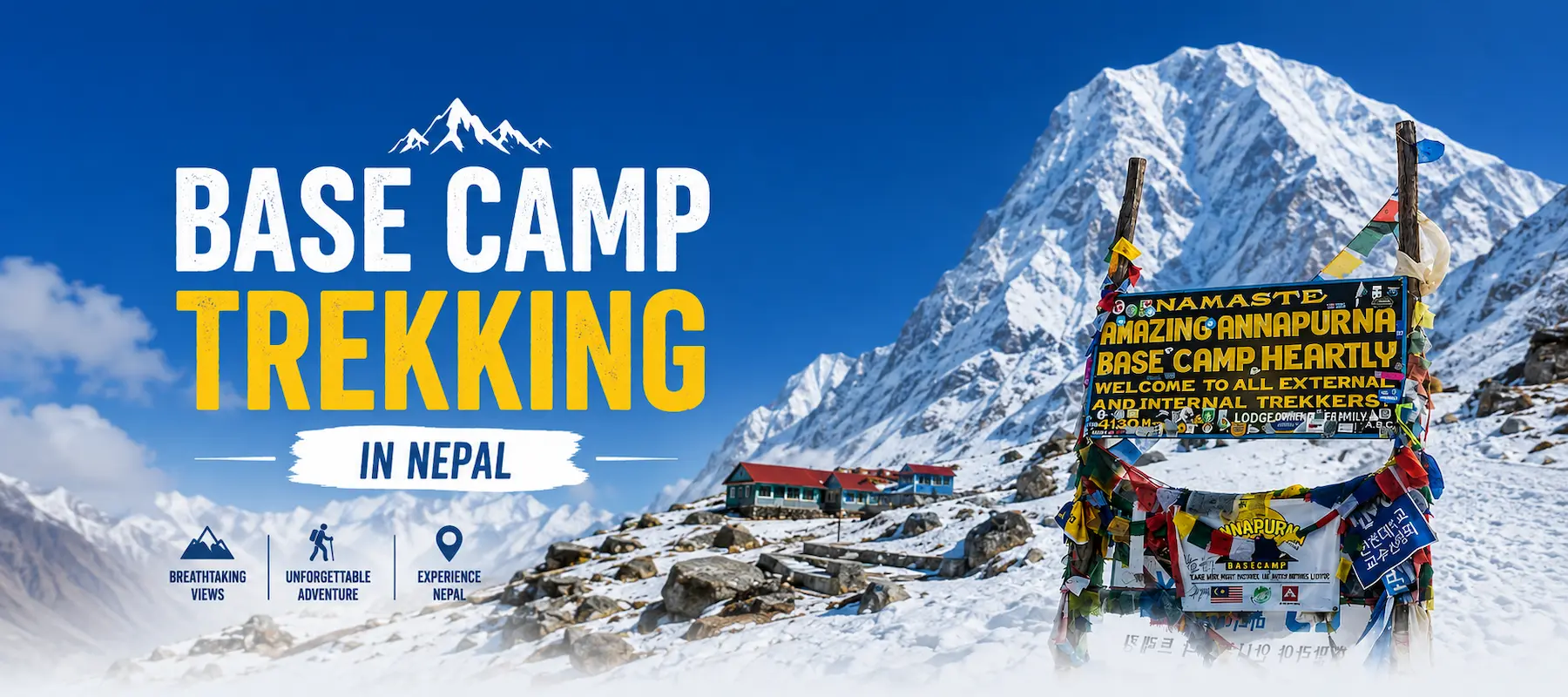
Base camp trekking in Nepal means hiking to a high altitude at the foot of a major Himalayan mountain. The base camp is the last stop before technically climbing begins. Nepal is home to eight of the world’s fourteen peaks above 8,000 meters, and trekking to their base camps (Everest, Annapurna I, Manaslu, Kanchenjunga, Makalu, Lhotse, Cho Oyu and Dhaulagiri I among them) ranges from as short as 5 days to as long as 22 days, depending on the route and altitude.
This guide answers the questions most first-time trekkers ask before booking: what a base camp actually is, why it matters so much to mountaineers, which base camps in Nepal are worth trekking to, and exactly how many days each one takes to reach.
A base camp is the final camp mountaineers set up before attempting to summit a mountain. It’s usually located at the point where standard hiking trails end & technical climbing begins, which includes walking to the foot of the mountain to experience the view and atmosphere climbers see right before their ascent, without attempting the summit itself.
For trekkers who aren’t climbing the mountain itself, “Base Camping Trekking in Nepal” simply means hiking to this same staging point – walking to the foot of the mountain to experience the view and atmosphere climbers see right before their ascent, without attempting the summit itself.
Base camps aren’t just resting points; they serve several essential functions and have significance for both climbers and trekkers.
For Mountaineers:
For trekkers:
In short, base camps matter because they sit at the exact intersection of accessibility and extremity — close enough to reach on foot, but positioned at the true edge of where the Himalayas become a technical climbing environment.
Nepal offers several major base camp treks, each built around a different 8,000-meter giant or a signature stretch of the Himalayan skyline. Here’s a closer look at the seven that draw the most attention from trekkers every year and reason why around 1.16 million tourists visit Nepal in 2025.
This is the World famous Base Camp, No trek in the world carries the same name recognition as the walk to the foot of Mount Everest (8,849 m). The journey begins with a short mountain flight into Lukla before winding through the Khumbu region’s Sherpa strongholds — Namche Bazaar, Tengboche, and Dingboche — each one adding another layer of altitude, monastery culture, and mountain scenery. By the time trekkers reach the Khumbu Glacier and the base camp itself, they’ve walked through a living museum of mountaineering history, past memorials to climbers who attempted the summit before them. Roughly 35,000-40,000 people visits to Everest Base Camp each year.
Tucked inside a natural bowl formed by Annapurna I, Machapuchare, and Hiunchuli, this base camp feels less like a single viewpoint and more like standing inside an amphitheater carved out of ice and rock. The trail climbs steadily through subtropical forest, rhododendron groves, and traditional Gurung settlements before the terrain opens up into high alpine grassland. Because the distances are shorter and the elevation gain more forgiving than routes like Everest or Manaslu, it’s often the first serious base camp trek many travelers attempt. Over 50,000 travelers both international and domestic travelers visit the base camp of Annapurna I each year.
Sitting beneath the eighth-highest mountain on the planet, Manaslu Base Camp trades crowds for solitude. The region only opened to trekkers relatively recently and still requires a restricted-area permit, which naturally limits foot traffic compared to Everest or Annapurna. What travelers get in return is a raw, less commercialized trail through Gurung and Tibetan-influenced villages, dense forest, and glacier-fed valleys that feel considerably wilder than Nepal’s more mainstream routes.
Tucked into the far eastern corner of Nepal near the Sikkim border, Kanchenjunga is home to the world’s third-highest peak and one of the country’s most untouched trekking regions. Because the approach is long and logistically demanding, only a small fraction of Nepal’s trekkers ever make it here — which is exactly the appeal for those chasing a genuinely remote Himalayan experience, far from teahouse crowds and well-trodden trails.
The route to the base of Makalu, the world’s fifth-highest mountain, cuts through the Makalu Barun National Park, one of the most biologically diverse protected areas in Nepal. Dense rhododendron forest gradually gives way to alpine meadow and glacial moraine, and the trail’s technical, less-maintained sections make this one of the more physically demanding base camp journeys in the country — better suited to trekkers with prior high-altitude mileage under their boots.
Circling the world’s seventh-highest peak, this route is as much a mountaineering-style expedition as it is a trek. It typically involves crossing the French Pass and Dhampus Pass, two high-altitude sections that demand solid acclimatization and genuine trekking experience. The reward is a raw, dramatic landscape of glaciers and rock walls that sees far fewer visitors than Nepal’s more established circuits.
One of the newer additions to Nepal’s base camp lineup, Mardi Himal has quickly become a favorite for travelers who want a genuine high-altitude payoff without a multi-week commitment. The trail climbs through forested ridgelines before breaking into open alpine terrain with close, almost intimate views of Machapuchare’s fishtail summit — a perspective few other treks in the region can match in such a short window of time.
Trek duration depends on the route, altitude, and how many acclimatization days are built into the itinerary. Here’s a general breakdown for base camp trekking in Nepal:
| Base Camp | Altitude | Typical Duration | Difficulty |
|---|---|---|---|
| Mardi Himal Base Camp | ~4,500 m | 5–7 days | Easy to Moderate |
| Annapurna Base Camp | 4,130 m | 7–12 days | Moderate |
| Everest Base Camp | 5,364 m | 12–15 days | Moderate to Strenuous |
| Manaslu Base Camp / Circuit | 5,215 m | 14–18 days | Strenuous |
| Dhaulagiri Base Camp | ~4,750 m | 14–18 days | Strenuous |
| Makalu Base Camp | ~4,870 m | 18–22 days | Very Strenuous |
| Kanchenjunga Base Camp | ~5,000 m | 18–22 days | Very Strenuous |
With several options for base camp trekking in Nepal, the right pick usually comes down to these listed factors you can consider:
Mardi Himal Base Camp is generally considered the easiest, taking around 5 to 7 days with a moderate difficulty level suited to trekkers with basic fitness.
Everest Base Camp is the most popular, with roughly 70,000 trekkers attempting the route each year, followed closely by Annapurna Base Camp.
Yes. Most base camp treks require a TIMS card and a region-specific permit, such as the Sagarmatha National Park permit for Everest or the Annapurna Conservation Area Permit for Annapurna. Restricted regions like Manaslu and Kanchenjunga require additional special permits.
Yes, particularly on routes like Annapurna Base Camp or Mardi Himal Base Camp, which don’t require technical climbing skills — just reasonable fitness and gradual acclimatization.
Most base camps in Nepal sit between 4,100 and 5,400 meters, well below the summits themselves but high enough to require careful altitude acclimatization.
Ready to plan your base camp trek in Nepal? Alliance Treks & Expedition Pvt. Ltd. can help you choose the right route and handle permits, guides, and logistics:
Phone / WhatsApp: +977 9851022814 | +977 9841451681
Office Phone: +977 01 5326667 / 01-5320317
Address: JP Marg, Thamel, Kathmandu, Nepal
Website: www.alliancetreks.com
Alliance Treks & Expedition Pvt. Ltd. Once is not enough for naturally and culturally Himalayas