(Viber, Whatsapp, Cell) +977 9851022814

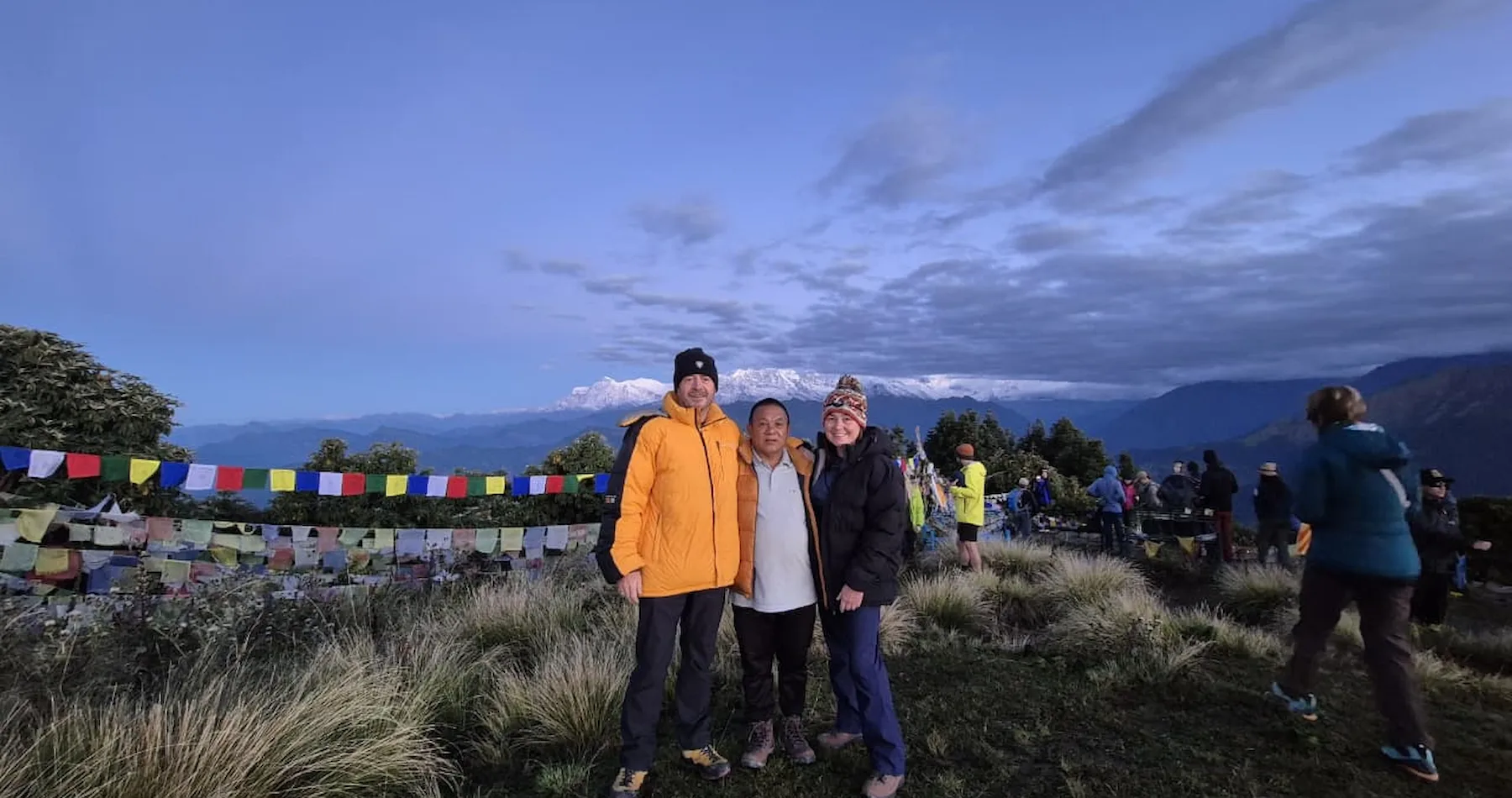
In 34 years as a guide, I’ve witnessed thousands of sunrises and sunsets across the Himalayan range. What makes Nepal’s golden hours truly special isn’t just the mountains—it’s the combination of geography, weather patterns, and light quality that creates moments of pure magic.
Best Places in Nepal for Sunrise & Sunset are unique geography that concentrates 8 of the world’s 14 highest mountains within 300 kilometers. This means from a single viewpoint, you might see peaks ranging from 6,000m to 8,849m illuminating sequentially in golden hour light. Compare this to other mountain regions—the Rockies, the Alps, even Patagonia—and Nepal’s sunrise/sunset experiences are incomparable.
The reason is simple: nowhere else can you stand at 3,000-4,000 meters elevation and have multiple 8,000m+ peaks visible within your frame. Nowhere else does the light dance across such a concentrated range of extreme altitude in such a short time window. Additionally, Nepal’s autumn weather (September-November) creates a high-pressure system that produces crystal-clear morning skies with minimal cloud cover and pollution. Meanwhile, spring (March to May) adds warmth and sometimes flowers to the golden hour experience. Winter offers the clearest, sharpest air of the entire year—perfect for technical photography.
Best For: Sunrise, photography, and beginners.
Duration from Kathmandu: 1.5 days (fly to Pokhara + trek)
Accessibility: Easy trek (well-maintained trail)
Cost: USD $300-400 (3-day trek package)
Crowds: Very high (hundreds nightly).
Poon Hill is Nepal’s most famous sunrise location for good reason. Standing at 3,210 meters, it offers a 360-degree panorama of the Annapurna range. At dawn, Annapurna I (8,091m), Annapurna South (7,219m), Machhapuchhre (6,997m), and Dhaulagiri I (8,167m) light up sequentially—first dark silhouettes, then orange glow, then golden illumination within 30 minutes.
The experience requires early wake-up (3:00-4:00 AM to secure a good spot among hundreds of trekkers), but the reward is incomparable. Even with crowds, watching these massive peaks transform from darkness to brilliant white-gold is life-changing.
Photography Tips: Bring a wide-angle lens (14-24mm) for a full panorama. Use ISO 400-800, f/4-f/8 aperture, 1/50-1/125s shutter. Arrive 30 minutes early to scout composition. Best light: 6:20-6:40 AM.
Trek Link: Ghorepani Poon Hill Trek
Best For: Sunset, romance, reflection photography
Duration from Kathmandu: 1 hour flight to Pokhara
Accessibility: Lakeside—no hiking needed
Cost: USD $0-100 (optional boat rental)
Crowds: Moderate (popular tourist spot)
Phewa Lake is Nepal’s second-largest lake, positioned with Annapurna range reflected in still water. Unlike mountain-focused viewpoints, Phewa’s magic is the mirror effect—mountains appear twice, once above and once reflected below. Sunset creates golden light rippling across water, painting the entire landscape in warm colors.
This is the only Nepal location where water reflections are the primary feature rather than just background. For couples, this is romantic. For photographers, the symmetry enables powerful compositional opportunities. Rent a boat one hour before sunset and drift on the lake as light transforms the sky through orange, pink, purple, and blue.
Photography Tips: 24-50mm lens works best. Use ISO 100-400, f/4-f/8 aperture. Shoot from boat for different angles. Best time: 5:30-6:30 PM (15 minutes before sunset produces best reflections).
Best For Couples?: Absolutely. Many lakeside restaurants offer romantic sunset dinners with mountain views.
Best For: Everest views, Sherpa culture, trekkers
Duration from Kathmandu: 2 days (fly to Lukla + trek)
Accessibility: Moderate trek (5 hours at altitude)
Cost: USD $1,200-1,600 (3-day trip)
Crowds: High (gateway to Everest Base Camp)
Namche Bazaar is the heart of the Everest region—and a stunning sunrise location if you’re already trekking there. At 3,440m, this Sherpa trading town offers sunrise views of Ama Dablam (6,812m), Everest (8,849m in distance), and surrounding peaks.
The unique aspect: Namche isn’t just a viewpoint. It’s a living town. Sunrise includes monastery bells ringing, prayer flags fluttering, Sherpa villages awakening. You’re not just photographing mountains—you’re witnessing a culture’s morning rituals.
Photography Tips: 24-35mm lens. ISO 800-1,200, f/5.6-f/8 aperture. Best from monastery area or town hilltop. Best time: 5:50-6:30 AM (Everest often clouds over after 6:45).
Trek Link: Everest Base Camp Trek
Best For: Quick trips, sunset, families
Duration from Kathmandu: 1 hour flight to Pokhara + 30 min drive + 2 hour trek
Accessibility: Easy (moderate walk from parking)
Cost: USD $50-150 (transportation only)
Crowds: Moderate (fewer than Poon Hill)
Sarangkot is Nepal’s most accessible high-altitude viewpoint. At only 1,600m, there’s zero altitude sickness risk. From the overlook, you see Pokhara city in the foreground, Phewa Lake below, and the Annapurna/Dhaulagiri range in the distance. Sunset here is actually better than sunrise—the city lights below combined with mountain glow above create a dramatic layered composition.
The view is less dramatic than 4,000m+ locations, but the accessibility makes it ideal for travelers with limited time or those sensitive to altitude. You can literally drive within 20 minutes of Kathmandu and reach a decent mountain viewpoint.
Photography Tips: 50-70mm lens for compressed perspective. ISO 200-400, f/5.6-f/11 aperture. Include city lights for a unique foreground. Best time: 5:30-6:15 PM sunset (better than sunrise).
Best For: Meditation, spiritual experience, peace Duration from Kathmandu: 1.5 hours drive Accessibility: Very easy (30-minute gentle walk) Cost: USD $80-150 (transportation + accommodation) Crowds: Very low (few tourists)
Nagi Gompa is a Buddhist monastery perched on a hillside overlooking valleys. Unlike mountain-focused viewpoints, Nagi’s magic is spiritual. At sunset (6:00 PM), monastery bells ring, monks chant prayers, prayer flags flutter in the evening wind, and golden light illuminates the monastery walls.
This location is for travelers seeking peace rather than dramatic mountain views. The experience is intimate—you’re not photographing a landscape; you’re witnessing a spiritual practice. Sunset here teaches presence. Many visitors report profound meditation experiences.
Photography Tips: 24-35mm lens for monastery + landscape. ISO 1,600-3,200, f/2.8-f/5.6 aperture (low light, protected valley). Respect monks’ prayer time—photograph ethically. Best time: 5:45-6:15 PM.
Best For: Scale, photographing all peaks, and experienced photographers.
Duration from Kathmandu: 2-hour drive
Accessibility: Easy (paved road to top)
Cost: USD $100-150 (transportation + accommodation)
Crowds: Low (not widely known)
Daman Hill is the only location in Nepal where you can see all major peaks simultaneously. From the observation tower at 2,322m, on clear days, you can see Everest (north), Makalu (east), Kanchenjunga (southeast), and Annapurna (west). It’s a 360-degree panorama unlike anywhere else.
The challenge: these peaks are 100+ km away, so they’re small in frame. This requires a telephoto lens and pristine, clear air. But when conditions align—typically in October or February—the scale is mind-blowing. You’re looking at half of Nepal’s tallest mountains simultaneously.
Photography Tips: 70-200mm telephoto lens essential. ISO 400-800, f/5.6-f/11 aperture. Shoot panoramic (multiple shots stitched together). Best time: 6:00-7:00 AM sunrise (air is clearest early morning).
Best For: Easy access to mountains, cloud inversion effects.
Duration from Kathmandu: 1.5-hour drive
Accessibility: No hiking (accessible town)
Cost: USD $150-300 (overnight stay + transportation).
Crowds: Moderate (day-trip destination)
Nagarkot is Nepal’s most accessible mountain town—literally drivable from Kathmandu. The unique feature here is cloud inversion: you stand at 2,175m while clouds sit at 1,500m below you. Mountains peek through a sea of clouds, creating a dramatic layered composition.
This effect is common in winter/spring mornings when warm valley air meets cool mountain air. The visual impact is otherworldly—like standing above the clouds themselves.
Photography Tips: 50-135mm lens. ISO 400-800, f/5.6-f/11 aperture. Shoot the cloud inversion effect directly. Best time: 5:45-6:30 AM (before clouds burn off).
Best For: Culture, history, architecture
Duration from Kathmandu: 45-minute drive
Accessibility: Very easy (no hiking, just city walking)
Cost: USD $60-120 (day trip)
Crowds: Low (not a typical tourist destination)
Dhulikhel is an ancient Newari trading city on the historic trade route. Sunrise here isn’t about mountains—it’s about watching a historic city awaken. Golden light illuminates centuries-old temples, stone-carved architecture, and traditional buildings as markets open and monks begin morning prayers.
This experience appeals to those interested in culture more than landscape. You’re witnessing living history—the same routines performed for hundreds of years, now bathed in golden morning light.
Photography Tips: 35-50mm lens (street photography). ISO 400-800, f/5.6-f/8 aperture. Capture people, temple details, cultural moments. Best time: 6:00-7:00 AM (golden light on buildings).
Best For: History, architecture, authentic experience
Duration from Kathmandu: 2.5 hours drive
Accessibility: Very easy (village walking)
Cost: USD $80-150 (day trip or overnight)
Crowds: Very low (few tourists)
Bandipur is an 18th-century Newari trading town preserved in time. There’s no modern infrastructure visible—no cars, no electricity lines, just traditional stone buildings and narrow streets. Sunrise here feels like stepping back 200 years.
Walk the village streets before sunrise, position yourself at an elevated point, and watch the golden light illuminate ancient architecture. The experience is like photography in a different era.
Photography Tips: 35-50mm lens (architecture). ISO 400-800, f/4-f/8 aperture. Capture building details, street scenes, and morning activity. Best time: 5:45-7:00 AM (golden light on buildings).
Best For: Heritage, pilgrimage, spiritual atmosphere
Duration from Kathmandu: 1-hour drive + 30-minute hike
Accessibility: Easy (gentle trail)
Cost: USD $60-120 (transportation + accommodation)
Crowds: Very low (not on typical tourist circuit)
Changu Narayan is a UNESCO World Heritage temple complex dating to the 7th century. Sunset here combines heritage architecture with spiritual practice. Local pilgrims participate in evening prayers as golden light illuminates ancient stone carvings.
This location blends history, spirituality, and photography into a single experience. You’re not just photographing a sunset—you’re witnessing centuries-old traditions continuing in modern day.
Photography Tips: 24-50mm lens. ISO 1,600-3,200, f/2.8-f/5.6 aperture (temple interiors dim). Photograph respectfully—this is an active worship site. Best time: 5:15-6:15 PM sunset.
| Month | Sunrise Time | Sunset Time | Best For | Rating |
|---|---|---|---|---|
| Sept | 5:45 AM | 5:30 PM | Clear skies, fewer crowds | ⭐⭐⭐⭐⭐ |
| Oct | 6:00 AM | 5:15 PM | Best overall, but crowded | ⭐⭐⭐⭐⭐ |
| Nov | 6:15 AM | 5:00 PM | Good weather, declining crowds | ⭐⭐⭐⭐ |
| Dec | 6:45 AM | 4:45 PM | Clear but cold | ⭐⭐⭐ |
| Jan | 7:00 AM | 4:50 PM | Extreme cold, clearest air | ⭐⭐⭐ |
| Feb | 6:30 AM | 5:15 PM | Clearest views, solitude | ⭐⭐⭐⭐ |
| Mar | 6:00 AM | 6:00 PM | Warming, good views | ⭐⭐⭐⭐ |
| Apr | 5:45 AM | 6:15 PM | Warmest, rhododendrons | ⭐⭐⭐⭐⭐ |
| May | 5:30 AM | 6:45 PM | Increasing rain, avoid | ❌ |
| June–Aug | 5:30 AM | 7:15 PM | Monsoon rain, avoid | ❌ |
Poon Hill (3,210m) is the best overall choice because of its clear mountain views and accessibility. Daman Hill is ideal for a 360-degree mountain panorama, while Phewa Lake is excellent for sunset photography with reflections. Sarangkot is a convenient option, especially for travelers staying in Pokhara.
No. Everest is visible from selected locations such as Namche Bazaar, Daman Hill, and Nagarkot under clear conditions. Most other locations primarily offer views of the Annapurna and surrounding Himalayan ranges. Namche Bazaar provides one of the most reliable mainstream trekking views of Everest.
Nagi Gompa, Dhulikhel, and Nagarkot are among the easiest options to reach from Kathmandu without a long trek. Sarangkot is also highly accessible from Pokhara and requires only a short walk to reach the viewpoint.
Phewa Lake is ideal for romantic sunset photography because of its water reflections. Sarangkot offers mountain glow, while Nagi Gompa provides a more spiritual atmosphere. Changu Narayan is particularly appealing for photographers interested in temple architecture and golden-hour light.
Costs vary significantly depending on the destination and whether an overnight stay or trek is required. Day trips to Nagi Gompa or Dhulikhel may cost around US$50–100, while Nagarkot and Bandipur can cost US$100–200. Sarangkot trips from Pokhara may cost US$100–150, while Poon Hill and Namche Bazaar require longer trekking packages.
No. A smartphone with good low-light performance can capture excellent sunrise and sunset photographs. Composition, timing, lighting, and location are often more important than expensive equipment. A professional camera simply provides greater control over exposure, lenses, and image quality.
Try to reach your viewpoint at least 30 minutes before sunrise so you have enough time to set up and capture changing light. Sunrise times vary by season, generally becoming earlier in spring and later during winter.
Use a layering system with a moisture-wicking base layer, fleece or insulation layer, and windproof outer layer. Bring gloves, a hat, and warmer clothing for high-altitude viewpoints such as Poon Hill and Namche Bazaar, where temperatures can be significantly colder before sunrise.
Yes, established trails such as those to Poon Hill, Sarangkot, and Daman Hill can be accessed independently. However, a guide can provide additional safety, route knowledge, cultural information, and assistance at locations where local customs or altitude may be a concern.
Don’t assume the photography opportunity is lost. Clouds can create dramatic, layered, and moody photographs. If your schedule allows, you can also wait for another morning or choose an alternative viewpoint with potentially better conditions.
Sarangkot, Phewa Lake, and Daman Hill are among the most family-friendly options because they involve little or no demanding hiking. Nagi Gompa is also accessible with a short gentle walk. Namche Bazaar is less suitable for young children because of its elevation at around 3,440m.
Alliance Treks & Expedition Pvt. Ltd. Once is not enough for naturally and culturally Himalayas