(Viber, Whatsapp, Cell) +977 9851022814

The cost of Everest Base Camp Trek typically ranges from $1,095 to $1,500 per person for a standard 12-day guided package including Lukla flights, permits, and a guide. Alliance Treks & Expedition, for example, prices its 12-day EBC package from $1,095 per person for groups of 11 or more, with round-trip Lukla airfare, park fees, and breakfast included. Solo trekkers pay closer to $1,400+ per person, since flight and guide costs aren’t split across a group.
This guide breaks the full cost of Everest Base Camp Trek into its individual parts — permits, guide and porter fees, food, accommodation, flights, and extras so you know exactly what you’re paying for before you book.
| Cost Category | Typical Price Range | Usually Included in Packages? |
|---|---|---|
| Sagarmatha National Park Permit | $30–$35 per person | Yes |
| Khumbu Rural Municipality Fee | $20 per person | Yes |
| Kathmandu–Lukla Flight (round trip) | $340–$400 | Yes |
| Guide (per day) | Bundled into package rate | Yes |
| Porter (per day) | $18–$25 per day | Often optional/extra |
| Breakfast | Bundled into package rate | Yes |
| Lunch & Dinner | $11–$15 per meal | Usually excluded |
| Teahouse Accommodation | Bundled into package rate | Yes (twin-sharing) |
| Hot Shower / Charging | $3–$6 per use | No |
| Travel Insurance (high-altitude cover) | $100–$200 (full trip) | No |
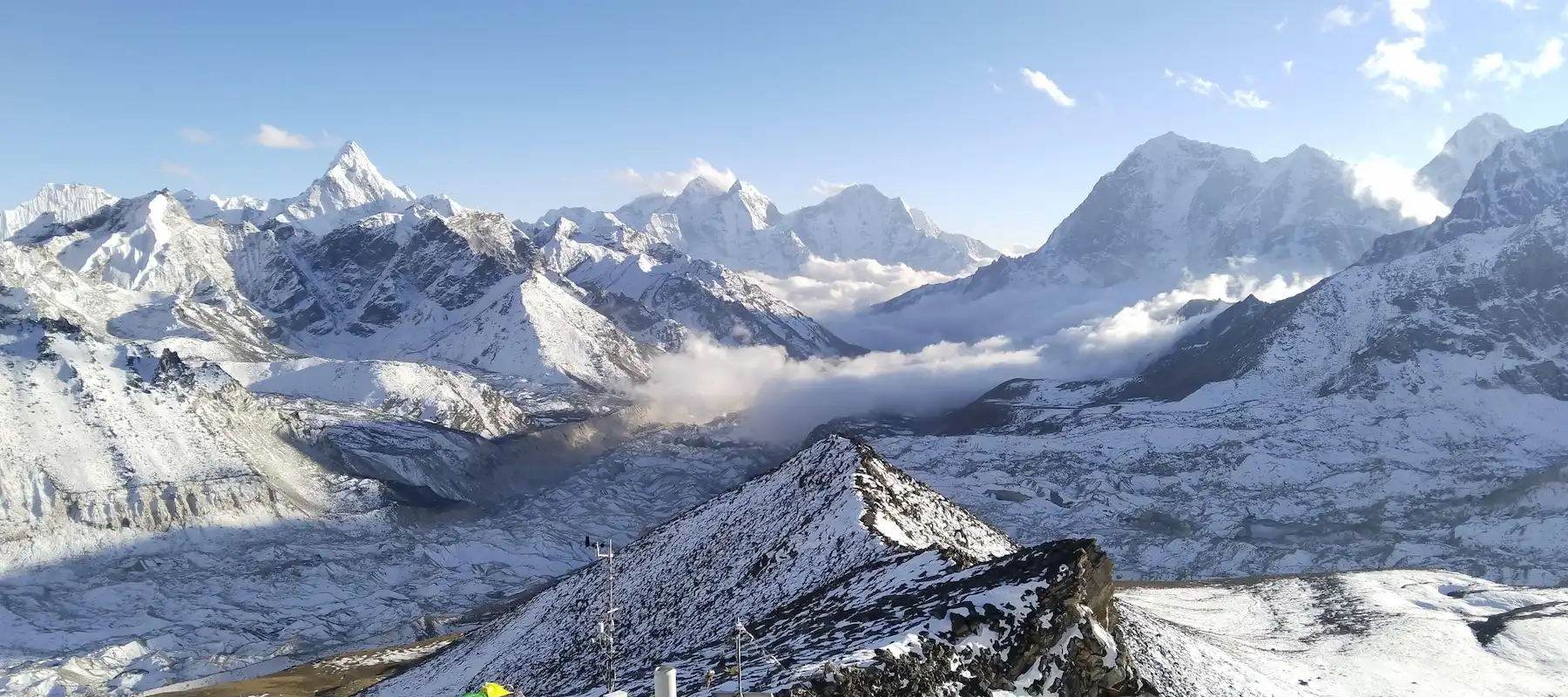
The Everest Base Camp Trek climbs through the Khumbu region to the foot of the world’s highest mountain at 5,364 meters, with most itineraries also including a sunrise hike to Kala Patthar (5,545 m) for the best panoramic views of Everest itself. The journey typically runs 12 days round trip, beginning with a mountain flight into Lukla and passing through Namche Bazaar, Tengboche, and Dingboche before reaching Gorakshep, the final stop before base camp. Everest Base Camp elevation is 5,364 meters (17,598 feet) above sea level on the southern side in Nepal.
Unlike the Annapurna Base Camp Trek, which is reachable by road, the Everest route depends entirely on a short domestic flight to Lukla, which is one reason the cost of Everest Base Camp Trek tends to run noticeably higher than comparable treks elsewhere in Nepal.
For a standard 12-day guided package departing from Kathmandu, expect to pay $1,095 to $1,500 per person, depending on group size and season. Unlike road-accessible treks, this figure almost always includes the Lukla flight, since there’s no practical way to reach the trailhead without it.
Group size affects the price more than most first-time trekkers expect, mainly because flight seats and guide costs are shared across the group:
| Group Size | Approx. Price Per Person |
|---|---|
| Solo trekker | $1,400–$1,500+ |
| 2–5 people | $1,125 |
| 6–10 people | $1,110 |
| 11+ people | $1,095 |
Fixed departure dates with guaranteed group sizes often come at a further discounted rate — Alliance Treks, for instance, lists several 2026 guaranteed departures priced around $1,125, down from a standard rate of $1,200 for smaller private bookings. Booking onto an existing fixed date is usually the easiest way to bring your per-person cost down without needing to organize your own group.
Check Out Here: Everest Base Camp Trek
Trekkers need two permits to enter the Khumbu region: the Sagarmatha National Park entry permit, generally around $30–$35, and the Khumbu Pasang Lhamu Rural Municipality fee, typically around $20. Unlike the Everest region’s old TIMS requirement, both of these are usually checked at physical checkposts along the trail rather than issued centrally, and most guided packages handle the paperwork and payment as part of the base price.
A licensed guide is effectively mandatory for the Everest Base Camp Trek, both for safety at altitude and for navigating flight schedules that can shift with mountain weather. Guided packages typically bundle the guide’s daily wage, insurance, meals, and accommodation into the base price. Porters are usually a separate line item:
| Service | Typical Daily Rate |
|---|---|
| Guide | Included in most package prices |
| Porter | $18–$25 per day |
Most porters on this route carry gear for two trekkers, so splitting the cost with a trekking partner is common practice.
Breakfast is generally included in guided packages, while lunch and dinner are paid for directly at teahouses, priced from each lodge’s printed menu. Prices increase steadily with altitude, since everything above Lukla arrives either by porter or yak train:
| Trail Section | Typical Meal Price (Lunch/Dinner) |
|---|---|
| Phakding / Namche Bazaar | $8–$11 per meal |
| Tengboche / Dingboche | $10–$13 per meal |
| Lobuche / Gorakshep | $13–$18 per meal |
As a rough planning figure, budget around $11 for lunch and $15 for dinner per day at higher elevations, which is the standard rate most Everest-region agencies quote when excluding meals from a package price.
Accommodation is entirely teahouse-based along the standard route, with no camping required. Namche Bazaar has the widest range of lodges and the most competitive pricing; rooms become simpler and pricier the closer you get to Gorakshep, where supply is limited, and demand is constant during peak season:
| Region | Cost Per Night |
|---|---|
| Phakding to Namche Bazaar | $5–$10 |
| Tengboche to Dingboche | $8–$15 |
| Lobuche to Gorakshep | $15–$25 |
Most guided packages include twin-sharing teahouse rooms in the base cost.
| Route | Transport Type | Estimated Cost |
|---|---|---|
| Kathmandu to Lukla (round trip) | Domestic flight | $340–$400, usually included in package |
| Kathmandu to Ramechhap (peak season) | Private drive | 4–5 hrs, sometimes included |
| Ramechhap to Lukla | Domestic flight | Shorter flight, replaces direct Kathmandu route in peak months |
| Kathmandu airport transfers | Private vehicle | Usually included in package |
During the busiest trekking months (March–May and September–November), Lukla flights commonly depart from Ramechhap airport rather than Kathmandu, adding a road transfer to the schedule. This shift happens due to air traffic congestion at Kathmandu’s main airport during peak season and isn’t something individual trekkers can control — it’s worth confirming with your agency which routing applies to your travel dates.
| Mistake | Why It Costs You |
|---|---|
| Not budgeting for flight delays | Lukla flights are frequently delayed by weather, and missed connections can mean unplanned nights and meals |
| Skipping high-altitude travel insurance | One of the riskiest costs to cut given the trek’s altitude and remoteness |
| Underestimating meal costs at altitude | Lunch and dinner prices roughly double between Lukla and Gorakshep |
| Assuming Kathmandu–Lukla flights are guaranteed as booked | Peak-season flights often reroute through Ramechhap, changing your schedule |
| Ignoring group size discounts | Solo trekkers can pay 25–30% more per person than a full group |
| Not accounting for porter costs upfront | An unplanned extra $18–$25 per day adds up quickly over 12 days |
A standard 12-day guided package from Kathmandu typically costs $1,095 to $1,500 per person, depending on group size and season, and usually includes round-trip Lukla flights.
Yes, in almost all guided packages. Since there’s no practical road access to the Khumbu region, the round-trip Kathmandu–Lukla flight is typically bundled into the base price.
Breakfast is usually included. Lunch and dinner are generally excluded and paid for directly at teahouses, with prices rising the higher you climb.
The cost of Everest Base Camp Trek is higher mainly because of the required Lukla flight, higher permit fees, and steeper on-trail prices at extreme altitude, none of which apply to the road-accessible Annapurna route.
Usually not. Porters are typically offered as an optional add-on at a daily rate, separate from the base package price.
Alliance Treks & Expedition Pvt. Ltd. runs a 12-day Everest Base Camp Trek from Kathmandu starting at $1,095 per person for groups of 11+, including round-trip Lukla flights, Sagarmatha National Park and municipality fees, guide, breakfast, and a returnable sleeping bag/down jacket kit.
Alliance Treks & Expedition Pvt. Ltd. Once is not enough for naturally and culturally Himalayas