(Viber, Whatsapp, Cell) +977 9851022814

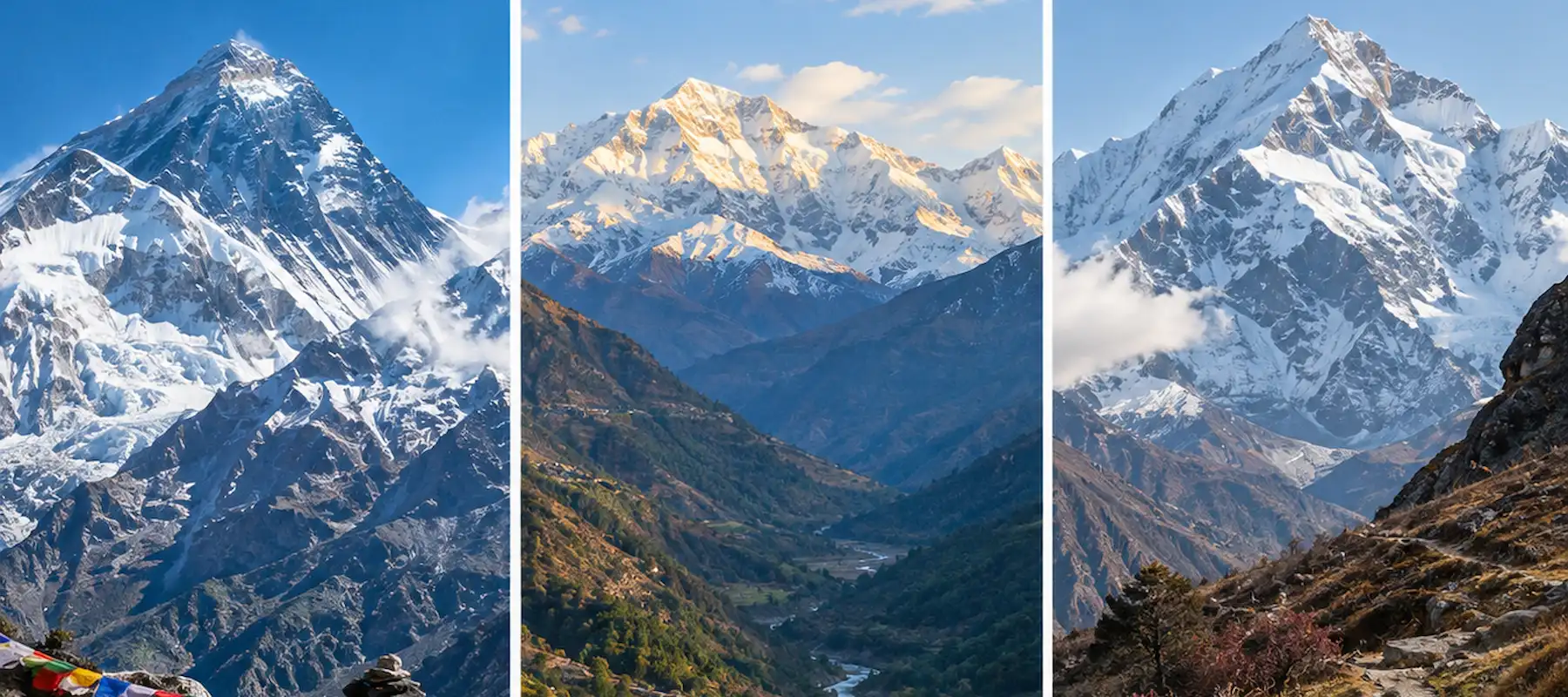
Choose Everest Base Camp if you want the famous name, close views of the world’s highest mountains and Sherpa culture, and you can handle crowds and a longer approach. Choose the Annapurna Circuit if you want the most varied scenery, flexible trip lengths, and the lowest cost. Choose the Manaslu Circuit if you want quiet trails, a wilder feel and a real sense of remoteness, and you are happy with a stricter permit system. All three take roughly two weeks, and all three involve sleeping at 4,400 m or higher. None is a “beginner” trek in the easy sense.
| Aspect | Everest Base Camp (EBC) | Annapurna Circuit | Manaslu Circuit |
|---|---|---|---|
| Typical length | 12 to 16 days (from Kathmandu) | 12 to 21 days (flexible) | 12 to 16 days |
| Highest point | Kala Patthar ~5,545 m (Base Camp ~5,364 m) | Thorong La 5,416 m | Larkya La ~5,106 m |
| Highest sleeping point | Gorak Shep ~5,164 m | Thorong Phedi / High Camp ~4,800 m | Dharamsala (Larkya Phedi) ~4,460 m |
| Style | Out-and-back along one valley | A-to-B loop over a pass | A-to-B loop over a pass |
| Difficulty | Moderate to challenging | Moderate to challenging | Challenging |
| Crowds | Highest | Moderate, busy in the lower sections | Lowest of the three |
| Guide requirement | Disputed: see permits section | Disputed: see permits section | Mandatory (restricted area) |
| Permit cost (foreigners) | ~USD 40 to 50 | ACAP NPR 3,000 | ~USD 220 or more in autumn |
| Typical guided package | ~USD 1,250 to 1,800 | ~USD 900 to 1,500 | ~USD 1,200 to 1,800 |
| Best months | Oct to Nov, Mar to May | Oct to Nov, Mar to May | Sep to Nov, Mar to May |
| Signature moment | Sunrise from Kala Patthar | Crossing Thorong La | Crossing Larkya La |
| Strongest culture | Sherpa villages, monasteries | Gurung, Thakali, Manangi, Tibetan-influenced | Tibetan-Buddhist valleys near the Tibet border |
A comparison is only useful if it uses the same yardsticks for each trek. We looked at the things that decide whether a trip goes well:
Then we turned that into a simple decision guide at the end so you do not have to read all of it to choose.
What It Is
The Everest Base Camp trek follows the Dudh Koshi and Imja valleys through Sherpa country to the foot of the Khumbu Icefall. Most people fly into Lukla, walk up through Phakding, Namche Bazaar, Tengboche, Dingboche and Lobuche, reach Gorak Shep, and visit Base Camp at about 5,364 m. The real viewpoint is Kala Patthar at about 5,545 m, where Everest finally shows itself properly.
What Makes It Special
The Honest Downsides
Cost and Logistics
Guided packages from licensed Nepali agencies commonly range from about USD 1,250 to 1,800 per person for 12 to 16 days, with luxury or helicopter options costing much more. Flights between Kathmandu or Ramechhap and Lukla are often USD 180 to 240 each way for foreign nationals and are frequently the single biggest cost line. Teahouse prices rise with altitude. Rooms in lower villages cost around USD 7 to 15, and above Dingboche they cost around USD 15 to 25, usually with cheaper rates if you eat at the lodge.
Best For
First-time Himalayan trekkers who have time, a healthy budget, and a strong emotional pull toward Everest; trekkers who want reliable lodges and a well-supported route; people who value a name they can tell friends about.
What It Is
The Annapurna Circuit loops around the Annapurna massif, climbing from subtropical foothills through pine and rhododendron forest into the dry, Tibetan-style Manang valley, crossing Thorong La at 5,416 m, and dropping into the Kali Gandaki gorge, one of the deepest valleys on Earth. A standard route runs from Besisahar or Jagat to Muktinath, then continues to Tatopani, Ghorepani and Nayapul, with an optional Poon Hill sunrise at the end.
What Makes It Special
The Honest Downsides
Cost and Logistics
Guided packages usually fall between about USD 900 and 1,500 for 12 to 20 days, depending on how much driving is included and the comfort level. Permit costs are low. The ACAP is NPR 3,000 for most foreign nationals and NPR 1,000 for SAARC nationals. There is no flight on the standard route. You travel by road from Kathmandu or Pokhara, which also lowers the cost and removes the Lukla weather risk.
Best For
Trekkers who want variety and flexibility; people with 10 to 18 days; budget-conscious travellers; those who value a mix of culture, scenery and a big pass crossing without the Everest premium.
What It Is
The Manaslu Circuit circles Manaslu (8,163 m), the eighth-highest mountain in the world. Starting at Soti Khola or Machha Khola, the trail follows the Budhi Gandaki river upstream through deep gorges and terraced villages, then enters Tibetan-Buddhist valleys at Namrung, Lho and Samagaun, climbs to Samdo and Dharamsala, crosses Larkya La at about 5,106 m, and descends to Bimthang and Dharapani.
What Makes It Special
The Honest Downsides
Cost and Logistics
A licensed-agency package commonly costs about USD 1,200 to 1,800. The permit line is the biggest difference: for foreigners, the Manaslu Restricted Area Permit is USD 100 for the first seven days (September to November) and USD 75 for the first seven days (December to August), plus USD 15 or USD 10 respectively for each additional day. Add the Manaslu Conservation Area Permit (NPR 3,000), the Annapurna Conservation Area Permit (NPR 3,000, because the trek ends in the ACAP area), and a local municipality fee (about NPR 1,000). For a 12-day autumn trip, that works out to roughly USD 220 or more in permits alone. Licensed guides typically cost about USD 25 to 35 per day.
Best For
Experienced walkers who want solitude, a rugged feel and cultural depth; second-time Nepal trekkers who have done EBC or ABC; anyone who has been put off by crowds on the more famous routes.
Scenery
Difficulty
All three are demanding because of altitude, not technical skill. None requires ropes or crampons in normal conditions, but each has long days and cold, thin air.
Our ranking by overall challenge, easiest to hardest: Everest Base Camp, then the Annapurna Circuit, then the Manaslu Circuit. The Annapurna Circuit moves down a step if your itinerary uses jeeps on the lower sections, and up a step if you walk the whole route, so the order depends on how you plan it.
Crowds
Everest Base Camp is the busiest, especially at Namche, Dingboche and Lobuche in October and April. The Annapurna Circuit is busy in the lower sections and calmer once you pass Manang. The Manaslu Circuit is the quietest of the three, though autumn weeks are no longer empty.
Culture
EBC is the best for Sherpa culture and mountaineering history. The Annapurna Circuit offers the widest cultural spread. Manaslu offers the most intact Tibetan-Buddhist village life, especially above Lho.
Cost
On a typical guided package, the Annapurna Circuit is cheapest, Manaslu falls in the middle (permits push it up), and Everest Base Camp is the most expensive once flights are included. Independent daily budgets are similar across all three: expect roughly USD 25 to 50 per day for food and lodging, plus guide and porter costs where you hire them.
Logistics and Risk
| Aspect | Everest Base Camp | Annapurna Circuit | Manaslu Circuit |
|---|---|---|---|
| Main permits | Sagarmatha National Park permit and Khumbu Pasang Lhamu Rural Municipality permit | ACAP | Manaslu Restricted Area Permit (RAP), MCAP, ACAP, local municipality fee |
| Approx. cost (foreigner) | ~USD 40 to 50 combined | NPR 3,000 (SAARC: NPR 1,000) | RAP USD 100 / USD 75 first 7 days + per-day extras; MCAP NPR 3,000; ACAP NPR 3,000; local fee ~NPR 1,000 |
| TIMS card | Reported as not required on the standard route | Described as optional or included by agencies; sources differ | Commonly bundled by the agency |
| Guide | Sources differ. Some operators say a licensed guide is now expected for foreign trekkers; others report independent trekking is still legal | Sources differ, same as EBC | Mandatory; permit issued only via a registered agency |
| Where to get permits | Checkposts and municipal offices on the route, or through your agency | NTNC offices in Kathmandu or Pokhara, or online | Through a registered agency only; cannot be self-issued |
A practical rule: Whatever rule is in force on your travel dates, the safest path for all three is to book through a licensed Nepali agency, ask them to confirm each permit in writing, and carry paper copies. A guide earns their fee on all three treks through route-finding, acclimatisation decisions, emergency response and teahouse bookings in busy weeks.
For a clearer picture of conservation-area rules, see our guide to the Annapurna Conservation Area.
| Season | Everest Base Camp | Annapurna Circuit | Manaslu Circuit |
|---|---|---|---|
| Autumn (Sep to Nov) | October and November are best: clean, clear skies, busiest | October to early November is best; teahouses fill quickly | September to November: stable weather; busiest period; higher permit rate |
| Winter (Dec to Feb) | Very cold, quiet, clear days; high lodges may close | Possible but riskiest; Thorong La may be snow-blocked | Heavy snow can close Larkya La; not recommended for most |
| Spring (Mar to May) | Warmer days, rhododendrons lower down, afternoon cloud builds | Rhododendron blooms, longer days, clouds in May | Good weather and flowers; popular alternative to autumn |
| Monsoon (Jun to Aug) | Wet lower trail, flight delays, cloudy views | Better rain shadow beyond Chame, but wet, leech-prone lower sections | Landslide risk and poor views; not recommended |
Pick Everest Base Camp if you…
Pick the Annapurna Circuit if you…
Pick the Manaslu Circuit if you…
Short on time (under 10 days)? None of the three is ideal. Consider the Annapurna Base Camp Trek or the Mardi Himal Trek instead.
First time in the Himalaya? Consider starting with a shorter trek to test your response to altitude, then graduate to one of the Big Three. If you go straight to one, the standard Everest Base Camp trek and a well-paced Annapurna Circuit offer the strongest support on the trail.
Everest Base Camp: 14 Days (Kathmandu to Kathmandu)
| Day | Route | Sleeping altitude |
|---|---|---|
| 1 | Arrive Kathmandu | 1,400 m |
| 2 | Fly to Lukla, trek to Phakding | ~2,610 m |
| 3 | Phakding to Namche Bazaar | ~3,440 m |
| 4 | Acclimatisation day in Namche | ~3,440 m |
| 5 | Namche to Tengboche | ~3,860 m |
| 6 | Tengboche to Dingboche | ~4,410 m |
| 7 | Acclimatisation day in Dingboche | ~4,410 m |
| 8 | Dingboche to Lobuche | ~4,940 m |
| 9 | Lobuche to Gorak Shep, Base Camp visit | ~5,164 m |
| 10 | Kala Patthar sunrise, descend to Pheriche or Pangboche | ~4,200 to 3,930 m |
| 11 | Descend to Namche | ~3,440 m |
| 12 | Namche to Lukla | ~2,860 m |
| 13 | Fly to Kathmandu | 1,400 m |
| 14 | Spare / departure day |
Annapurna Circuit: 15 Days (Kathmandu to Kathmandu)
| Day | Route | Sleeping altitude |
|---|---|---|
| 1 | Drive Kathmandu to Jagat | ~1,100 m |
| 2 | Jagat to Dharapani | ~1,950 m |
| 3 | Dharapani to Chame | ~2,650 m |
| 4 | Chame to Pisang | ~3,250 m |
| 5 | Pisang to Ngawal | ~3,650 m |
| 6 | Ngawal to Manang | ~3,519 m |
| 7 | Acclimatisation day in Manang | ~3,519 m |
| 8 | Manang to Yak Kharka | ~4,200 m |
| 9 | Yak Kharka to Thorong Phedi / High Camp | ~4,800 m |
| 10 | Cross Thorong La to Muktinath | ~3,800 m |
| 11 | Muktinath to Kagbeni | ~2,800 m |
| 12 | Drive to Tatopani | ~1,120 m |
| 13 | Tatopani to Ghorepani | ~2,860 m |
| 14 | Poon Hill sunrise, to Nayapul, drive to Pokhara | ~820 m |
| 15 | Drive Pokhara to Kathmandu | 1,400 m |
Manaslu Circuit: 14 Days (Kathmandu to Kathmandu)
| Day | Route | Sleeping altitude |
|---|---|---|
| 1 | Drive Kathmandu to Soti Khola | ~700 m |
| 2 | Soti Khola to Machha Khola | ~870 m |
| 3 | Machha Khola to Jagat | ~1,340 m |
| 4 | Jagat to Deng | ~1,860 m |
| 5 | Deng to Namrung | ~2,630 m |
| 6 | Namrung to Samagaun (via Lho) | ~3,530 m |
| 7 | Acclimatisation day in Samagaun | ~3,530 m |
| 8 | Samagaun to Samdo | ~3,860 m |
| 9 | Samdo to Dharamsala (Larkya Phedi) | ~4,460 m |
| 10 | Cross Larkya La to Bimthang | ~3,590 m |
| 11 | Bimthang to Dharapani | ~1,860 m |
| 12 | Drive Dharapani to Kathmandu or Pokhara | |
| 13 | Spare / weather buffer day | |
| 14 | Departure |
Altitude affects fit and unfit trekkers alike. On all three treks you will sleep above 3,500 m, and on all three you will spend nights close to or above 4,400 m.
Know the signs.
Follow these rules.
Packing Essentials (All Three Treks)
For the Manaslu Circuit and Annapurna Circuit, add microspikes in colder months, and consider gaiters for snow near the passes.
There is no single best trek. Everest Base Camp is best for iconic views and Sherpa culture, the Annapurna Circuit is best for variety and value, and the Manaslu Circuit is best for solitude and remoteness. Match the trek to your time, budget and tolerance for crowds.
The Manaslu Circuit is usually considered harder overall because of longer walking days, rougher lower trails, fewer facilities and greater remoteness. Everest Base Camp reaches the higher sleeping altitude, so altitude risk is higher there. Difficulty depends on your fitness and how well you acclimatise.
None of the three is easy. For a first Himalayan trek, Everest Base Camp or a well-paced Annapurna Circuit is more practical because of better lodge infrastructure. If you want something shorter and lower, start with the Annapurna Base Camp or Mardi Himal trek.
Everest Base Camp takes 12 to 16 days including flights from Kathmandu. The Annapurna Circuit takes 12 to 21 days depending on how much you walk and drive. The Manaslu Circuit takes 12 to 16 days.
Usually yes, mainly because of the Restricted Area Permit, mandatory guide and the longer, more remote logistics. A licensed-agency Manaslu package commonly costs about USD 1,200 to 1,800, compared with about USD 900 to 1,500 for the Annapurna Circuit.
For the Manaslu Circuit, yes: a licensed guide and an agency-issued permit are required. For Everest Base Camp and the Annapurna Circuit, operators describe the current rules differently, so confirm with a licensed agency. In practice, a guide is strongly recommended on all three.
A Manaslu Restricted Area Permit (USD 100 for the first 7 days in September to November, USD 75 for December to August, with extra-day fees), the Manaslu Conservation Area Permit, the Annapurna Conservation Area Permit, and a local municipality fee, all arranged through a registered agency.
Everest Base Camp reaches about 5,364 m at Base Camp and about 5,545 m at Kala Patthar. The Annapurna Circuit crosses Thorong La at 5,416 m. The Manaslu Circuit crosses Larkya La at about 5,106 m.
October and November, and March to May, are best for all three. September is also good for Manaslu. The monsoon (June to August) and deep winter bring weather and trail challenges.
It has changed. Jeep roads now reach Manang and Muktinath, and many itineraries use vehicles. You can still walk most of the route on alternative trails and side paths, or choose itineraries designed for walking. Ask your operator how much of the trek is on foot.
Everest Base Camp has the most dramatic close-up peaks, the Annapurna Circuit has the widest range of mountain scenery, and the Manaslu Circuit has the most uncluttered views around a single giant peak.
Yes, but it needs 3 or more weeks and careful planning. Common combinations include Manaslu with the Annapurna Circuit, or Everest Base Camp with Gokyo Lakes or the Three High Passes.
When you look at Everest Base Camp vs Annapurna Circuit vs Manaslu Circuit, the best answer is the one that fits your priorities. If the name Everest is your dream, go to Everest. If you want one trip that shows you the whole of Nepal’s mountain landscape without the biggest price tag, the Annapurna Circuit is hard to beat. If you want quiet trails and a wilder feel and are prepared for more logistics, Manaslu is the reward.
Whichever you choose, give yourself enough days, respect the altitude, book through a licensed agency that confirms permits in writing, and travel with a guide who knows the route.
Ready to plan? Explore the Everest Base Camp trek, the Annapurna Circuit trek, or the Manaslu Circuit trek, or talk to our local team for a custom itinerary and current permit advice.
Alliance Treks & Expedition Pvt. Ltd. Once is not enough for naturally and culturally Himalayas