(Viber, Whatsapp, Cell) +977 9851022814

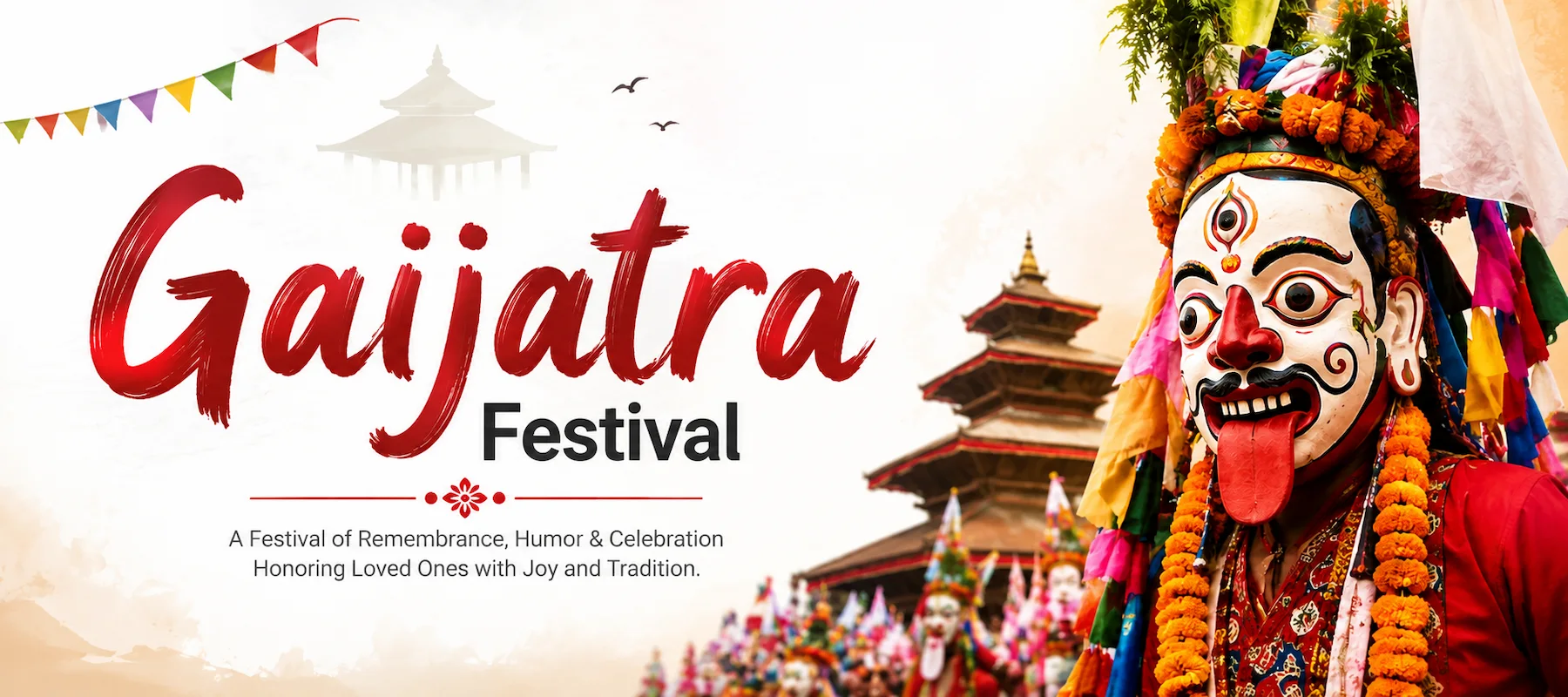
One of the most unique and culturally significant festivals of Nepal is Gaijatra, mainly celebrated in Bhadra month, August-September. The term Gaijatra means “cow procession,” with “Gai” (cow) first and “Jatra” (procession or festival) second.
Gaijatra is quite different from the other festivals that have been created to celebrate and enjoy. It’s a celebration of the dead, remembrance, and bravery in the aftermath of death. One of the most distinctive aspects of the festival is the use of humor, satire, and public engagement to deal with grief, a very Nepali way of doing this.
Although Gaijatra is celebrated in different ways by people of different ethnic groups such as Tamang, Magar and others, it is especially significant for the Newaris of Kathmandu Valley. The festival has been longstanding and has been passed on through centuries.
The uniqueness of Gaijatra lies in the way it is celebrated: rather than the time of sorrow, it is a time of celebration, with public processions, costumes, jokes, and satirical performances. Families who have lost loved ones march in a procession, sometimes carrying cow effigies, to publicly identify and experience loss in an unusual but psychologically healthy manner.
The history, cultural significance, traditions, celebration sites and ways how visitors can genuinely experience Gaijatra in Nepal are covered in this comprehensive guide.
| Aspect | Details |
|---|---|
| Festival Name | Gaijatra (गाइजात्रा) |
| Meaning | “Cow Procession” (Gai = Cow, Jatra = Procession/Festival) |
| Common Name | Festival of Cows |
| Celebration Month | Bhadra (August-September in the English calendar) |
| Exact Date | 14th & 15th of Bhadra month (varies yearly) |
| Duration | 2 days typically |
| Primary Celebration | Kathmandu Valley (Kathmandu, Bhaktapur, Panauti) |
| Other Locations | Throughout Nepal (celebrated differently by various communities) |
| Main Theme | Courage, mourning, honoring deceased, coming-of-age |
| Key Activity | Cow processions through streets with people in costumes |
| Religious Aspect | Hindu festival (Newari, Tamang, Magar traditions) |
| Public Holiday | Yes (national holiday in Nepal) |
| Unique Feature | Only major festival where people joke about death and loss |
Gaijatra is an ancient celebration and has been part of Nepali culture for centuries. The most popular legend surrounding Gaijatra is of a Newari king and his mother’s demise.
The Classical Legend:
Historical sources report of a death of a Newari king’s mother in Bhadra month. The king was sorely grieved by his mother’s death because of his excessive grief, his advisor and family were worried about his mental condition and the security of the kingdom.
To help the king process his grief, the advisors suggested creating a festival where mourning could be expressed publicly and collectively—transforming private sorrow into communal acknowledgment. They suggested parading in the streets carrying an effigy of the cow, creating an event that acknowledged death while simultaneously introducing levity and humor.
The king did this and started the first Gaijatra procession. The procession, miraculously (or according to legend), helped the king to accept his loss, to work through his grief and to return to normal functioning. Such was the psychological impact of the festival that it was made a yearly event.
Historical Significance:
This legend reflects a profound understanding of grief psychology—the idea that shared mourning, public acknowledgment, and community participation help individuals process loss more effectively than private grief.
Evolution Through Centuries
Over centuries, Gaijatra evolved from a royal practice into a widespread public festival celebrated by common people throughout the Kathmandu Valley.
Medieval Period Development:
In the medieval period (12th to 18th Century), Gaijatra became a part of the tradition of the Newari society. These rules, traditions and customs evolved during the festival and continued over generations.
Gaijatra Calendar Dates
Gaijatra is celebrated on a fixed date in the Nepali lunar calendar, though the English calendar date changes yearly.
Nepali Calendar:
English Calendar Conversion:
2026 Gaijatra Dates:
Gaijatra’s Deep Cultural Meaning
Gaijatra transcends a simple cultural celebration—it represents core Nepali values and philosophies about life, death, grief, and courage.
Gaijatra’s primary function is honoring family members who died in the preceding year. Families who experienced loss lead processions, bringing the deceased’s memory into public consciousness.
How this works:
Spiritual meaning: According to Nepali Hindu belief, cows are sacred animals connected to the divine. Parading with cow effigies helps guide the deceased’s soul toward spiritual peace and liberation (mukti).
The festival explicitly celebrates courage—specifically, the courage to face loss and continue living. Families displaying their grief publicly demonstrate strength and resilience.
Gaijatra teaches:
Social message: By making grief public and social rather than private and hidden, Gaijatra creates a culture where emotional expression is valued.
Unlike many cultures that avoid discussing death, Gaijatra directly confronts mortality through celebration and humor. The festival embodies an acceptance that death is natural, inevitable, and part of life.
Philosophy:
Psychological benefit: Research in modern psychology shows that cultures embracing death’s reality (rather than denying it) have lower anxiety and depression rates. Gaijatra embodies this principle.
For young people, particularly Newari youth, Gaijatra serves as a coming-of-age ritual. Participating in processions and public ceremonies marks transition to adulthood and full community membership.
Significance:
A uniquely powerful aspect of Gaijatra is its license for satire and social criticism. During Gaijatra, people traditionally create jokes, satirical performances, and humorous commentary on social issues and public figures.
Why this matters:
Historical function: In earlier eras when free speech was limited, Gaijatra provided one opportunity for public commentary without severe consequences.
At its core, Gaijatra is a communal ritual. Collective participation in mourning creates healing that isolated grief cannot achieve.
Community aspects:
Primary Gaijatra Celebration Locations
While Gaijatra is celebrated throughout Nepal, certain locations are particularly significant for authentic experiences.
Kathmandu is the epicenter of Gaijatra celebrations, particularly in the Kathmandu Valley.
Key Kathmandu locations:
Durbar Square, Kathmandu:
Freak Street (Jochhen Tole):
Asan Market & Surroundings:
Thamel Area:
Pashupatinath Temple Area:
Bhaktapur, one of Kathmandu Valley’s three ancient cities, celebrates Gaijatra with a strong traditional focus.
Bhaktapur characteristics:
Why visit Bhaktapur for Gaijatra:
Panauti is a smaller historic town in Kavre District (about 40km from Kathmandu).
Panauti characteristics:
Why visit Panauti:
Gaijatra is celebrated beyond Kathmandu Valley by various ethnic groups.
Janakpur (Eastern Nepal):
Pokhara (Western Nepal):
Answer: “Gaijatra” literally means “cow procession.” “Gai” is Nepali for “cow,” and “Jatra” means “procession” or “festival.” The festival is also commonly called the “Festival of Cows” in English. The name reflects the festival’s central element—processions featuring cows or cow effigies through Kathmandu’s streets.
Answer: Cows hold profound religious and cultural significance in Nepali Hindu tradition. During Gaijatra, cow processions symbolically help guide deceased souls toward spiritual peace and liberation. The cow’s sacredness connects the festival’s mourning traditions with its deeper spiritual purpose.
Answer: No. Gaijatra originated in Newari communities and remains strongest in the Kathmandu Valley, but other Nepali communities also celebrate it in their own ways. The most widely recognized celebrations take place in Kathmandu, Bhaktapur, and other Valley communities.
Answer: No. While Gaijatra has Hindu religious roots and includes temple rituals, its themes of honoring the deceased, processing grief, courage, and community can be appreciated by people of all backgrounds. Visitors can observe and participate respectfully where appropriate.
Answer: Gaijatra is celebrated according to the Nepali lunar calendar, generally falling in Bhadra, which corresponds roughly to August or September. The exact English-calendar date changes every year.
Answer: Gaijatra uniquely uses humor and satire as a way of coping with grief. Rather than avoiding the subject of death, the festival creates a culturally accepted space for people to confront loss through laughter, satire, and public expression. Humor and sincere mourning coexist as part of the tradition.
Answer: Tourists are welcome to observe Gaijatra celebrations and may participate when invited by local communities. Visitors should always follow local guidance, respect private mourning, and avoid forcing participation in rituals or family processions.
Answer: Modest and respectful clothing is recommended, particularly when visiting temples or joining cultural events. Long pants or skirts and clothing that covers the shoulders are generally appropriate. Visitors should also be prepared to remove shoes when entering certain religious spaces.
Answer: Yes, Gaijatra is generally safe for visitors. Large processions can create crowded streets, so standard precautions such as keeping valuables secure, staying aware of your surroundings, and following local instructions are recommended.
Answer: Gaijatra is distinct because it combines mourning, remembrance, courage, processions, humor, and social satire. While festivals such as Dashain and Tihar primarily emphasize religious celebration and family traditions, Gaijatra provides a unique cultural space for communities to acknowledge death and process grief.
Answer: Gaijatra has both historical and legendary origins connected with the Newar communities of the Kathmandu Valley and traditions from the Malla period. Its exact origin has evolved through centuries, but the festival has long served as a community tradition for honoring those who have died.
Answer: Gaijatra has traditionally provided a culturally accepted opportunity for humor, satire, and social commentary. Performers and communities use comedy to discuss social issues, challenge norms, and reflect on contemporary events.
Answer: Cow effigies are used when live cows are not part of a procession. They carry symbolic meaning connected with the sacred role of cows in Hindu tradition and the belief that cows can help guide departed souls on their spiritual journey.
Answer: Modernization has changed some forms of celebration through social media, photography, and contemporary costumes, but core traditions continue. Processions, remembrance of the deceased, prayers, communal gatherings, and social satire remain central to the festival.
Answer: Yes. The largest and most elaborate celebrations take place in the Kathmandu Valley, including Kathmandu, Bhaktapur, and Panauti, but smaller local celebrations can also be found elsewhere in Nepal. Kathmandu Valley is the best choice for visitors wanting to experience major processions and the festival’s distinctive traditions.
Gaijatra represents a uniquely Nepali approach to grief, loss, and human resilience. Far from being merely a festival of curiosity or tourist attraction, Gaijatra embodies profound psychological and spiritual insights about processing loss, accepting mortality, and finding courage to continue living after experiencing death.
The Festival of Cows, celebrated during Bhadra month in Kathmandu Valley, teaches that grief is not shameful but should be publicly acknowledged. That loss is universal and connects entire communities. That humor and joy can coexist with mourning. That courage means facing death’s reality rather than denying it. These lessons, preserved through centuries of tradition, remain profoundly relevant in modern times.
Gaijatra’s evolution from royal practice to popular festival to UNESCO consideration demonstrates how traditions can adapt to modern contexts while maintaining essential meaning. The festival permits satire, embraces humor, honors ancestors, celebrates courage, and builds community—all simultaneously. This complexity makes Gaijatra not just culturally significant but psychologically innovative.
For visitors, Gaijatra offers rare opportunity to witness authentic cultural practice focused on acknowledging life’s most difficult aspects while celebrating human resilience. The festival invites participation not as passive observers but as community members, if respectfully engaged. Whether you’re photographing processions in Durbar Square, sharing meals with bereaved families, laughing at satirical performances, or reflecting in temples, Gaijatra offers profound cultural and personal experience.
The future of Gaijatra depends on younger generations maintaining traditions while adapting to modern contexts. UNESCO recognition, increased tourism, and cultural documentation ensure Gaijatra won’t disappear. Yet the festival’s true preservation lies in continued local participation—families leading processions, communities gathering annually, people processing grief collectively rather than in isolation.
Gaijatra teaches that acknowledging death paradoxically affirms life. By confronting loss directly, laughing at our shared mortality, and celebrating courage, Gaijatra helps people live more fully. This essential wisdom ensures that Gaijatra will remain central to Nepali culture for generations to come.
Alliance Treks & Expedition Pvt. Ltd. Once is not enough for naturally and culturally Himalayas