(Viber, Whatsapp, Cell) +977 9851022814

The essentials
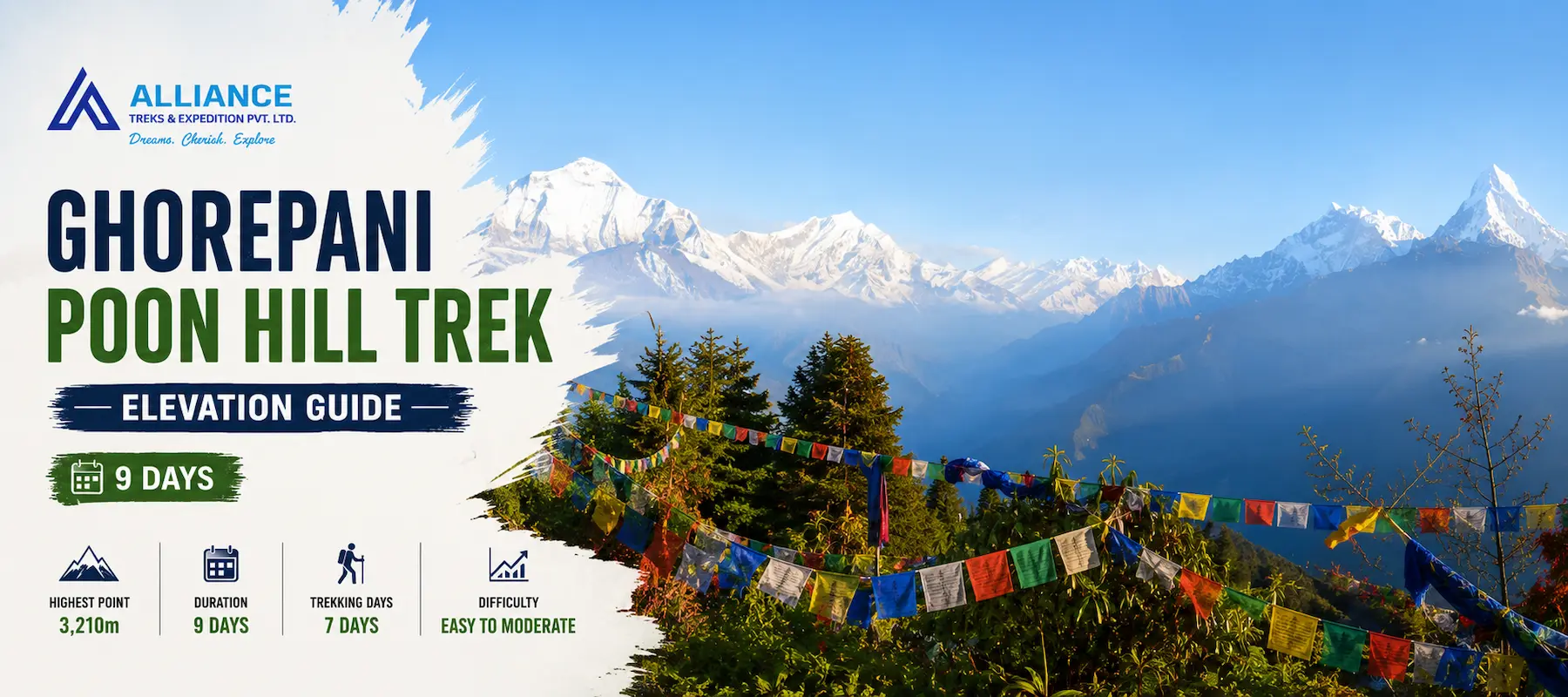
Highest point: Poon Hill at 3,210m (10,531 feet)
Duration: 9 days total, with 4 days of trekking
Starting elevation: Pokhara at 915m (3,001 feet)
Lowest point on trek: Tikhedhunga at 1,480m (4,856 feet)
Maximum elevation gain in one day: Day 5 (Tikhedhunga to Ghorepani): 1,373m gain
Acclimatization required: Minimal—only 2-3 hours extra sleep needed
Altitude sickness risk: 2-5% (extremely rare—one of Nepal’s lowest-risk treks)
Sunrise time requirement: Wake at 3:00 AM, trek 45 minutes, arrive at 5:30 AM for sunrise
Key advantage: At 3,210m, you’re high enough for spectacular Himalayan views but low enough that altitude sickness is almost non-existent
Unique factor: Poon Hill sunrise is the primary highlight—not the elevation itself, but the morning views
Ghorepani Poon Hill is the ideal first Himalayan trek because of its elevation profile. It is good for beginners and for travelers with limited time in Nepal.
First: Poon Hill is low enough for beginners. At 3,210m, you’re above most clouds (unobstructed views) but below the altitude where serious sickness occurs. Compare:
Second: Only 4 trekking days. You reach Poon Hill in just 2 days of actual hiking (Day 4-5), then descend over 2 days (Day 6-7). This compressed timeline means:
Third: The route is gentle. Unlike steeper treks, Ghorepani uses switchbacks and gradual ascents:
Fourth: Acclimatization is automatic. You don’t need a dedicated acclimatization day because:
Fifth: Descent is rapid recovery. After Poon Hill sunrise, you descend immediately:
By Day 8, all altitude stress is gone. Your body feels normal again.
Here’s the complete elevation breakdown:
| Day | From | To | Elevation | Daily Gain/Loss | Cumulative From Sea Level | Activity |
| 1 | Tribhuvan Airport | Kathmandu | 1,350m | N/A | 1,350m | Arrival, city prep |
| 2 | Kathmandu | Kathmandu | 1,350m | 0m | 1,350m | City sightseeing |
| 3 | Kathmandu | Pokhara | 915m | -435m | 915m | Drive only |
| 4 | Pokhara (915m) | Tikhedhunga | 1,480m | +565m | 1,480m | Trek start |
| 5 | Tikhedhunga | Ghorepani | 2,853m | +1,373m | 2,853m | STEEPEST DAY |
| 6 | Ghorepani (2,853m) | Poon Hill Sunrise (3,210m) | 3,210m | +357m | 3,210m | HIGHEST POINT |
| 6 | Poon Hill | Tadopani | 2,650m | -560m | 2,650m | Descent after sunrise |
| 7 | Tadopani | Kimche | 1,350m | -1,300m | 1,350m | Major descent |
| 8 | Kimche | Pokhara | 915m | -435m | 915m | Drive return |
| 9 | Pokhara | Kathmandu | 1,350m | +435m | 1,350m | Drive & departure |
Key observations:
Poon Hill is not a mountain to climb. It’s a viewpoint located at 3,210m (10,531 feet) where you watch the sunrise illuminate the Himalayan range.
A hillside viewpoint in the Annapurna foothills, the highest point on the Ghorepani Poon Hill trek route. The name “Poon” comes from a local Gurung word referring to a type of forest. “Hill” is simply the English term for an elevated location.
Elevation context:
At 3,210m, Poon Hill sits at a moderate altitude:
Day 6 involves:
3:00 AM wake-up at Ghorepani (2,853m)
The night before you sleep at Ghorepani, the next morning you wake up in pitch darkness. Guide arranges hot tea (necessary for warmth). It’s quick to prepare, no breakfast yet.
3:30 AM start of hike
You start your hike on a hill going up in pitch darkness. You can only use your headlamp as your light. The trail is well marked but gets rather rough towards the end. The temperature is cold (about 0°C).
4:45-5:30 AM arrival at Poon Hill
The area at the top is achieved gradually. There are other trekkers there, too (This is Poon Hill, so there will be 20-50 people on high season mornings).
The sky is still dark. A faint view of mountains. All are silent, all are trembling in the cold dark.
5:45 AM first light
The eastern sky starts to glow, but very faintly at first. It is faintly orange in color.
6:00-6:15 AM the transformation
The first rays of the sun reached the highest summits. Annapurna I (8,091m) is first lit up – golden light falling on its peak. Then Annapurna South (7219m) then Dhaulagiri (8167m).
The light spreads rapidly. It takes just 15 minutes for the whole Himalayan range to turn into a golden orange, something that is indescribable. Within 30 minutes, the sky changes from orange to pink, to a stunning blue.
The Moment of Sunrise: This sunrise is life changing for every trekker, no matter their condition, or their experience on the mountain. It’s not about elevation or physical achievement. It’s the ability to see the most spectacular light show in nature, from the best seat in the house.
At 3,210m, you’re:
Temperature and conditions:
Most successful Poon Hill experiences involve:
The rhododendron forests which cover the path to Ghorepani Poon Hill are its most distinctive characteristic.
What are rhododendrons at Ghorepani’s elevation?
Rhododendrons are flowering shrubs that grow best at moderate altitudes (1,500-3,500 m). At Ghorepani’s elevations:
Spring rhododendrons (March-May):
During the spring season, at the altitude of Ghorepan, the rhododendron forests go wild with colour:
Slightly reduced in the spring (more clouds as monsoon approaches at this elevation), but more than made up for by the beauty of the rhododendron.
Autumn forests (September-November):
In autumn, there are no rhododendrons, but the forests are green and luxuriant. From Poon Hill is clear (less pre-monsoon moisture).
Winter forests (December-February):
Rhododendrons are bare, but their red bark can be seen in the winter. Views from Poon Hill are frequently very clear (cold air is dry air).
How altitude affects rhododendron ecology
At Ghorepani’s 1,500-3,210m range:
Why this matters for elevation experience:
Rhododendron forests provide:
What can you expect at varying heights along the trek to Ghorepan?
At 1,350m (Kathmandu/Pokhara):
Normal. There are no altitude effects. Energy is high. Sleep is perfect. Breathing is normal.
At 1,480m (Tikhedhunga, Day 4):
Still normal. A marginal rise from Pokhara but insignificant. Some people may experience an increased breath rate on uphills. Sleep is normal. Appetite is normal.
At 2,650m-2,853m (Ghorepani, Day 5 afternoon):
Real altitude now. The altitude is definitely apparent:
There may be some mild disruptions in sleep (waking once or twice at night). There may be a slight decrease in appetite. Possibly a mild headache (this is little known at this elevation, although possible).
It is at 2,853m that most trekkers have no altitude sickness. Maybe 10-15% trekkers will experience mild symptoms (slight headache, mild fatigue).
At 3,210m (Poon Hill, Day 6 morning):
Peak elevation. You’ve been ascending for 2 days. You are acclimatised. You feel:
Most trekkers feel strong at: 3210m because of:
At 3210m, the problem of altitude sickness may only affect 2-5% of trekkers (50% of Everest BC and 40% at Manaslu). Those who do get it have mild symptoms, such as a slight headache and slight nausea.
At Tadopani (2650m) by afternoon (Day 6):
Descent has already begun. It is apparent that your body feels much better:
Day 4: Tikhedhunga (+565m)
The hike from Pokhara to Tikhedhunga is of easy standard with a gain of 565m and a duration of 3-4 hrs.
This elevation gain is barely noticeable. The hike is easy. Rhododendron forests start to appear. Today is a warm-up day both physically and mentally.
Day 5: Ghorepani (+1,373m) – STEEPEST DAY
Starting elevation: 1480m (Tikhedhunga) Ending elevation: 2853m (Ghorepani) Difficulty: moderate to challenging (one of the higher elevation changes during a Nepal trek) Time: 7-8 hours
The Day 5 is all about the physical. You are advancing at a good rate in terms of altitude! But:
Day 5, which is the most challenging of the trip, is still doable for most trekkers. By night in Ghorepani, you’re fed up but content.
Day 6 morning: Poon Hill (+357m)
The trail is steep and short, lasting only 45 minutes to 1 hour, and starts at 2,853m (Ghorepan) and culminates at 3,210m (Poon Hill).
The last leg of the walk to Poon Hill is the steepest stretch of the walk (steep in the final 100m). But:
Day 6 afternoon: Tadopani (-560m)
Starting elevation: 2,853m (Ghorepani, after returning from Poon Hill) Ending elevation: 2,650m (Tadopani) Loss: 203m (wait—this isn’t matching the elevation)
In fact, when looking at the itinerary in more detail:
So Day 6 afternoon is only a 203m descent from Ghorepani to Tadopani after the sunrise. This is a very gentle descent—almost staying at the same elevation.
Day 7: Kimche major descent (-1,300m)
Distance: 5-6km (total) or 2km in and out of the village; depending on your goals this can be extended or shortened as desired.
The rapid descent is Day 7! Oxygen is plentiful in the afternoons. Energy returns. It’s over with the high altitudes. By Day 7, most trekkers are feeling relief, and their energy is renewed.
Ghorepani Poon Hill requires almost no special acclimatization because the elevation gain is gentle and the final elevation is low.
How acclimatization happens naturally:
Result: After Day 6 sunrise, your body has adapted to 3,210m. There is no specific acclimatization day required.
Compare with other treks:
Altitude Sickness: Uncommon at Ghorepani’s Heights
3210m is extremely high, and therefore very rare to suffer from altitude sickness there.
Altitude sickness statistics:
Only a small number of trekkers (about 5-10%) will have any symptoms of altitude sickness at Ghorepani’s max height of 3,210m, and even these will only be mild symptoms.
The reasons for the low rates at Ghorepani:
Symptoms (rare):
A few hikers get altitude sickness at Ghorepani, and have said:
Extremely sick (very uncommon at Ghorepani):
High Altitude Cerebral Edema (HACE) or High Altitude Pulmonary Edema (HAPE) at 3210m is very rare. Over 34 years, I have led 300+ Ghorepani treks, without ever having had serious problems with altitude sickness.
Prevention:
At the elevation of Ghorepan, the prevention is easy:
Take a gentle descent to Tadopani or Tikhedhunga if mild symptoms are experienced at Ghorepani (very rare). Symptoms clear up in 2-3 hours. The trek continues the next day with no problems.
Comparing Ghorepani Poon Hill’s elevation to other popular Nepal treks:
| Trek | Max Elevation | Days to Max | Altitude Sickness Risk | Best For |
| Ghorepani Poon Hill | 3,210m | 2 days | 5–10% (mild) | Beginners, first-time trekkers |
| Annapurna Base Camp | 4,130m | 6 days | 20–25% | Experienced beginners |
| Upper Mustang | 3,810m | 8 days | 15–20% | Intermediate trekkers |
| Everest Base Camp | 5,364m | 6 days | 50–60% | Experienced trekkers |
| Manaslu Circuit | 5,160m | 11 days | 45–50% | Experienced trekkers |
| Kanchenjunga Circuit | 5,143m | 12 days | 40–45% | Experienced remote trekkers |
Ghorepani’s unique position:
| Factor | Ghorepani Poon Hill | Annapurna Base Camp |
| Max Elevation | 3,210m | 4,130m |
| Days Trekking | 4 days | 6 days |
| Altitude Sickness Risk | 5–10% | 20–25% |
| Difficulty | Easy–Moderate | Moderate–Challenging |
| Daily Hiking Time | 5–8 hours | 5–8 hours |
| Best For | Beginners and first-time trekkers | Intermediate trekkers |
| Sunrise Views | Excellent | Excellent |
Ghorepani is beginner-friendly. Annapurna Base Camp Trek is more challenging.
Poon Hill stands at 3,210m (10,531 feet) above sea level. For comparison, Denver, USA sits at about 5,280 feet, making Poon Hill nearly twice as high and one of Nepal’s most accessible high-altitude viewpoints.
No. Sunrise visibility depends entirely on mountain weather. During the best trekking seasons, there is roughly an 80% chance of clear sunrise views, while clouds may obscure the panorama on other days.
Yes. The Poon Hill Trek is one of Nepal’s best beginner-friendly treks. At 3,210m, with a gradual ascent over two trekking days and no technical climbing, it is ideal for first-time Himalayan trekkers.
Generally, no. Most healthy trekkers do not require altitude medication at 3,210m. Staying hydrated, walking at a steady pace, and getting adequate rest are usually sufficient. If you have previous altitude-related issues, consult your doctor before the trek.
The hike from Ghorepani (2,853m) to Poon Hill (3,210m) typically takes 45 minutes to 1 hour. Most trekkers start before dawn to reach the viewpoint in time for sunrise.
Yes, but the risk is low. Mild altitude symptoms affect approximately 5–10% of trekkers, while serious altitude sickness is extremely rare at 3,210m. Most visitors complete the trek without any altitude-related problems.
Autumn (September–November) offers the clearest skies and best mountain views, making it the most popular season. Spring (March–May) is equally beautiful thanks to blooming rhododendron forests. Winter is quieter but colder, while the monsoon season has frequent clouds and rain.
No. The standard Poon Hill itinerary requires at least 4–5 trekking days, allowing time for the gradual ascent, the sunrise hike, and the descent. Attempting to rush the trek into two days is not recommended and reduces the overall experience.
The elevation of Ghorepani Poon Hill Trek is 3210m, which is an ideal starting point for trekking in the Himalayas.
It’s tall enough to see 50+ Himalayan peaks: 3,210m is tall enough for a spectacle. You live at a high altitude. You achieve something authentic. It’s at a safe height: Altitude sickness is uncommon. Acclimatization is automatic. This is natural and adapts within 2 days without any special medication or struggle.
It’s designed to be successful: The 2-day ascent, sunrise at Poon Hill, and the quick descent, is a natural arc of emotions: Challenge, reward, recovery. It’s the ideal first Himalayan trek: You prove to yourself that you can climb to 10,500 feet. Here you can see the landscape of the Himalayas. You live in the mountains. Then you safely descend, knowing you can tackle more difficult hikes if you’re feeling up to it.
The elevation of 3210m is not random. It is designed just right to be high enough to inspire wonder, low enough to be safe, just right to be humanly achievable.
Alliance Treks & Expedition Pvt. Ltd. Once is not enough for naturally and culturally Himalayas