(Viber, Whatsapp, Cell) +977 9851022814

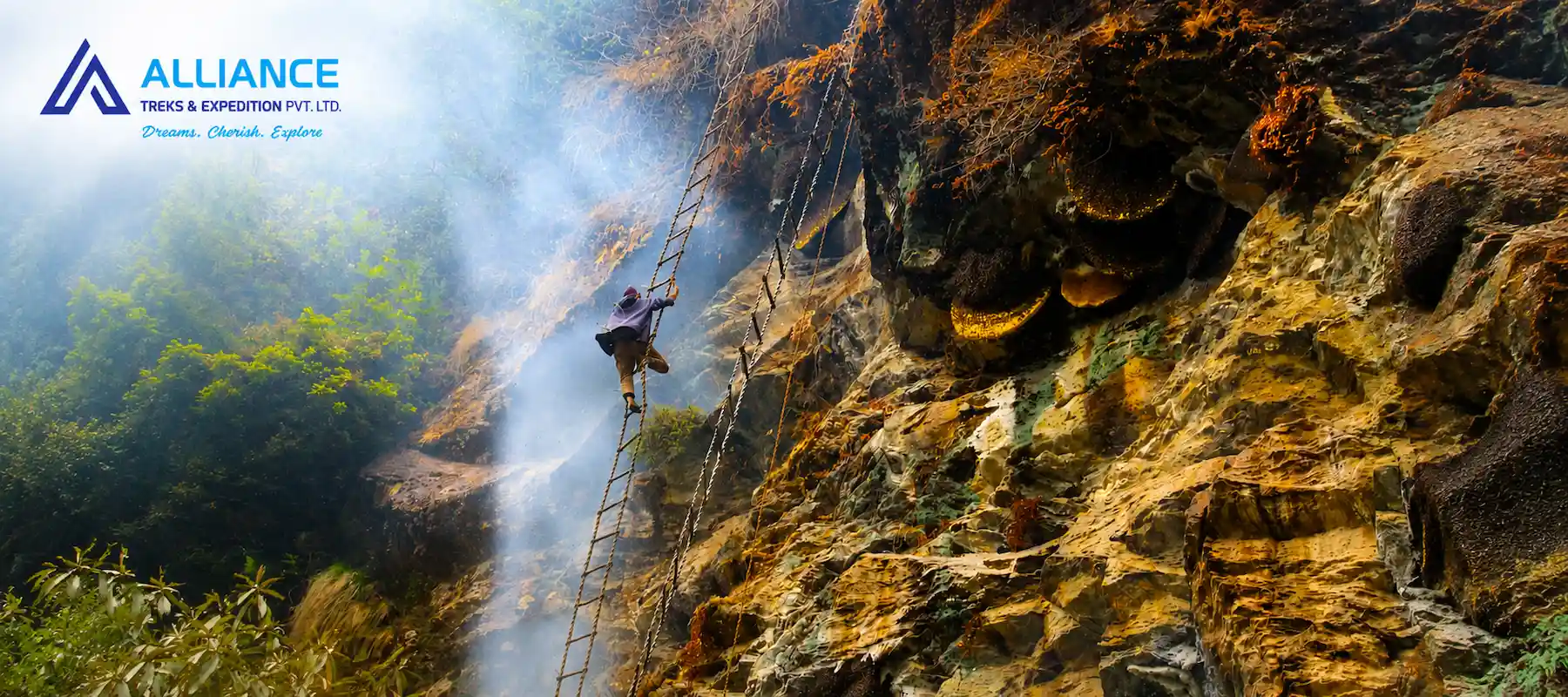
Honey hunting in Nepal is an age-old tradition where Gurung and Magar people hang from the handmade rope ladders over 300 metres high from sheer cliffs to collect wild honeycomb made by the largest honeybee, Apis laboriosa. Conducted twice a year (spring and autumn), this ritual results in ‘mad honey’ – a rare reddish honey that contains grayanotoxins derived from the nectar of rhododendrons and produces mild psychoactive effects when consumed in excess.
Anyone who has seen a man in a cloud of smoke hanging off a cliff face with bees about the size of thumbs has seen a honey hunter! This is no show-action travel. It’s a way of life, a tradition of faith, and a way of life that is now a way of life threatened.
Hunting is the act of collecting the wild honeycomb from its natural location without using a managed comb, rather than from a managed comb or apiary. In Nepal, that involves scaling exposed rock faces in the mid-hill areas of the mountains to get to the nests constructed by the Himalayan giant honeybee.
There are no boxes, no smokers that are convenient to use, and no safety harnesses in the traditional way of beekeeping. They use bamboo ladders stacked up with hemp lines, hemp lines woven by hand, long bamboo poles (tangos) to loosen the comb, and baskets to collect the falling honeycomb.
The tradition is mainly practiced by the indigenous Gurung (also known as Tamu) and Magar ethnic groups of the mid-hill districts of central and western Nepal. The Gurung migration from the north is said to have taken place many centuries ago by oral tradition, and in writing, there is little documentation available, and dates remain uncertain among the historians.
Hunting of honey is usually a collective activity of the villagers and is handed down by apprenticeship. It takes years for a young guy to learn how to handle a rope ladder, how to help, and how to gain the trust of the group before he is given permission to climb down the cliff himself. It is getting phased out in some of the villages. The younger generations are migrating to the urban areas and overseas to the job markets, while some of the most seasoned ones are now in their 60s and 70s, having practiced hunting for decades.
Honey hunting takes place across the mid-hill regions of central and western Nepal, generally at elevations between 1,000 and 2,500 meters. The most well-known hunting grounds include:
| Region | Known For |
|---|---|
| Lamjung District | Dense forest cliffs, strong Gurung presence, and widely recognized as the heartland of traditional honey hunting. |
| Ghalegaon (Kaski District) | A traditional Gurung village that offers visitors the opportunity to experience honey hunting through responsible community tourism. |
| Nyadi River Gorge (Central Nepal) | Known for some of Nepal’s largest recorded cliff bee nesting sites, attracting researchers and adventurers. |
| Annapurna Foothills | Combines spectacular mountain scenery with traditional honey hunting areas located near popular trekking routes. |
Not every nest is hunted. Some sites are considered too dangerous or too sacred to touch, and local hunters will deliberately leave certain colonies undisturbed for years.
The queen of all things traditional is one species: Apis laboriosa, the world’s largest honeybee from the Himalayas. A worker bee can reach a length of about a human thumb, while the colonies erect crescent-shaped combs that can extend more than a metre and a half across, hidden beneath a rock overhang where predators can’t get to them.
The honey’s unusual and sometimes objectionable chemical characteristics are derived from the blossoms of rhododendron that these bees forage in the spring.
A traditional hunt is more of a three-day trek than a quick kill. This is a summary of how it works:
The whole ritual to the end of the harvest takes up a full day at each cliff face and the hunt can be performed over two or three days with several sites to be targeted.
The red and bitter-tasting honey that the giant bees of the Himalayas make from the nectar of rhododendrons is known as “mad honey.” The nectar contains naturally occurring substances, called grayanotoxins, that cause temporary, mild intoxication in small quantities and disrupt sodium channels in the body.
The effects are not fun at higher doses: Dizziness, nausea, heavy sweating, lowered heart rate, lowered blood pressure, and rare, severe instances of heart problems that need medical attention. There’s a bizarre history of mad honey in military history, too: Reports from ancient Greece recount how the honey from the area was used to stun invaders during the war.
Small amounts are used locally as folk medicine for diseases such as high blood pressure, joint pain, digestive ailments, etc., but not as medicine, as it is traditional medicine. If you want to try mad honey, do so like you would with anything that might affect your mind: only take a small sample, be aware of its origin, and don’t mix it with alcohol, blood pressure, or heart medication.
Honey hunting is facing a number of forces that are threatening its survival:
Many conservation and cultural heritage organizations have started documenting the practice and promoting community-based sustainable tourism models, which welcome guests to the hunt instead of selling honey that is not limited.
Yes, in specific villages that have opened the tradition to visitors, most notably around Ghalegaon and parts of Lamjung District. A few things to know if you’re considering it:
If you wanted to see the honey hunting expedition, Alliance Treks can organize this expedition for you.
Honey hunting in Nepal is an ancient tradition in which Gurung and Magar communities climb steep Himalayan cliffs using handmade rope ladders to harvest wild honeycombs built by the Himalayan giant honeybee (Apis laboriosa).
Mad honey gets its name from the natural grayanotoxins found in rhododendron nectar. When consumed in larger quantities, these compounds can produce temporary psychoactive effects such as dizziness, lightheadedness, and mild intoxication.
Honey hunting is considered one of Nepal’s most dangerous traditional activities. Hunters descend cliffs over 300 feet high using handmade rope ladders while facing thousands of aggressive giant honeybees and the constant risk of falling.
Traditional honey hunting usually takes place twice each year—during spring (April to May) and autumn (October to November)—when the honeycombs are fully developed and ready for harvest.
The primary producer of mad honey is Apis laboriosa, the Himalayan giant honeybee and the world’s largest honeybee species. In some regions, honey from the related Apis dorsata is also harvested.
Lamjung District and the Gurung village of Ghalegaon in Kaski District are among the best-known places to witness honey hunting. Community-based tours may allow visitors to observe the tradition responsibly during the harvest season.
When consumed in small, carefully sourced amounts, mad honey is traditionally considered safe by local communities. However, larger quantities may cause nausea, low blood pressure, dizziness, and heart rhythm problems. People taking heart or blood pressure medications should avoid it, and medical attention should be sought if serious symptoms occur.
Alliance Treks & Expedition Pvt. Ltd. Once is not enough for naturally and culturally Himalayas