(Viber, Whatsapp, Cell) +977 9851022814

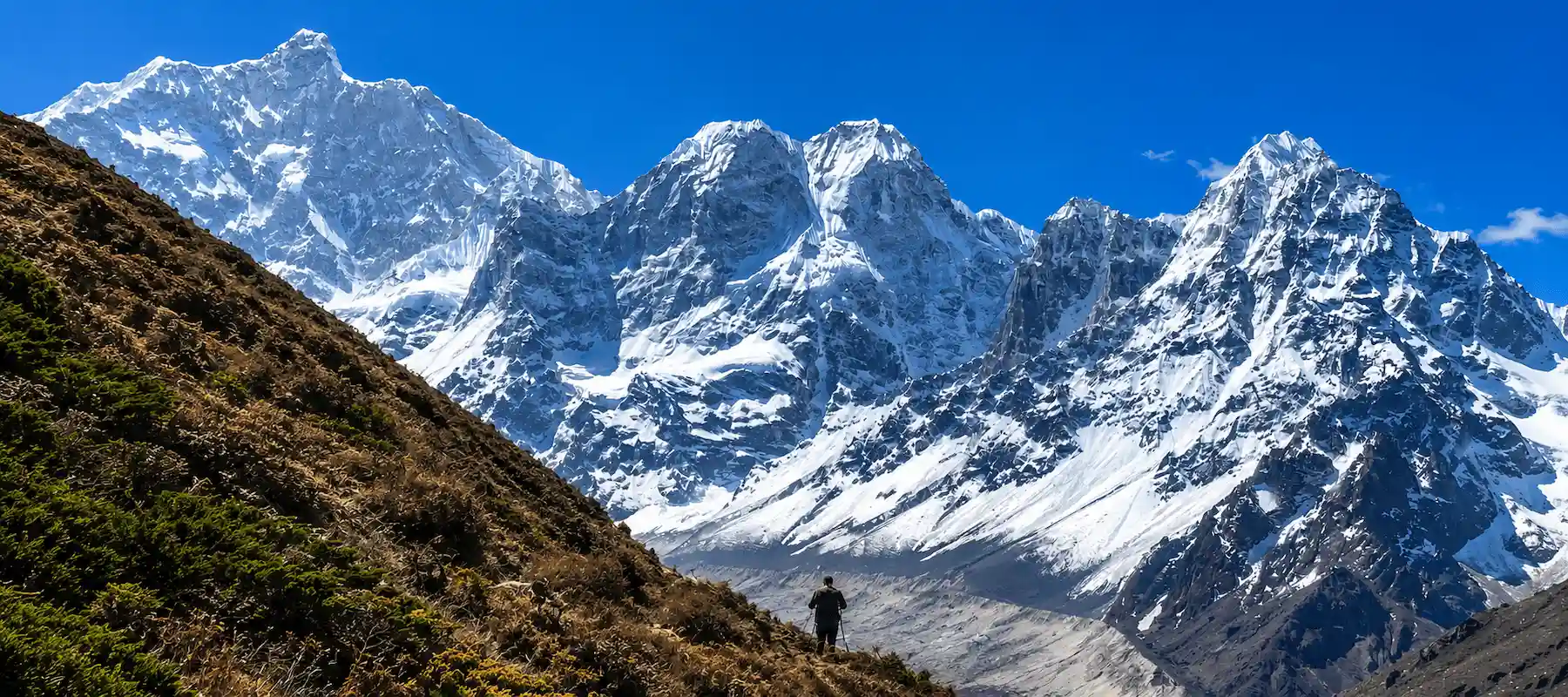
The Kanchenjunga Circuit Trek is Nepal’s answer to a question serious trekkers eventually ask: what does the Himalayas look like without the crowds? Tucked into the far eastern corner of the country, this 21-day journey circles Mount Kanchenjunga — at 8,586 meters, the third-highest mountain on Earth — visiting both its North and South Base Camps in a single trip, something very few treks anywhere allow.
Unlike Everest or Annapurna, where teahouses line up every few hundred meters, Kanchenjunga remains a restricted area requiring a special permit and a licensed guide, and trail traffic here is a fraction of Nepal’s headline routes. That isolation has preserved something increasingly rare: an intact Limbu cultural landscape, one of the country’s richest pockets of biodiversity, and views of both Kanchenjunga and, from certain ridges, Everest itself in the same panorama.
This guide covers every stop along the trail, the wildlife and vegetation across its dramatic elevation range, the Limbu communities who call this valley home, food and lodging, altitude planning across two base camp excursions, the best photography spots, essential gear, required permits, and honest answers to what trekkers ask most before booking.
| Detail | Information |
|---|---|
| Duration | 21 days (Kathmandu to Kathmandu) |
| Max altitude | 5,143 m (Kanchenjunga North Base Camp / Pang Pema) |
| Kanchenjunga height | 8,586 m (world’s 3rd highest) |
| Starting/ending point | Kathmandu (via Birtamode and Taplejung) |
| Trip grade | Moderate to challenging |
| Accommodation | Teahouse/local lodge, some basic |
| Best seasons | March–May, September–November |
| Permits required | Kanchenjunga Restricted Area Permit, KCAP, TIMS |
| Licensed guide | Mandatory (restricted area) |
| Ethnic community | Limbu, with Sherpa influence in higher villages |
| Key highlight | Visiting both North and South Base Camps in one trek |
Birtamode and Taplejung — The Long Approach
Getting to the trailhead is itself a two-day journey: a full day’s drive from Kathmandu to the lowland town of Birtamode near the Indian border, followed by a second long drive up into the hills to Taplejung, the district headquarters and gateway to the Kanchenjunga region. This overland approach, rather than a short mountain flight, is part of what keeps the region so lightly visited compared to Everest or Annapurna.
Sekathum (1,660 m) — Into the Valley
The trek proper begins with a descent into the Tamor River valley, crossing suspension bridges and passing through lower, forested terrain toward Sekathum, a small settlement marking the true start of the trekking trail into Kanchenjunga Conservation Area.
Amjilosa (2,510 m) — The Steep Climb Begins
The trail turns noticeably steeper here, climbing through dense subtropical and lower temperate forest. Amjilosa is a modest trail-stop village, the last easily accessible point before the route commits to the higher valley.
Gyabla (2,730 m) — Into the Forest Zone
A shorter day continues climbing through increasingly dense rhododendron and oak forest, with the air noticeably cooling and mountain views beginning to open between the trees. Gyabla is a quiet Sherpa-influenced settlement providing a comfortable overnight stop.
Ghunsa (3,475 m) — The Region’s Cultural Hub
Ghunsa is the most significant settlement in the upper Kanchenjunga valley — a substantial Tibetan-influenced village with a monastery, several teahouses, and a small school. It also hosts the trek’s first acclimatization day, giving trekkers a chance to explore the village, visit the local gompa, and take a short acclimatization hike before pushing higher.
Khambachen (4,245 m) — Above the Tree Line
The trail leaves the forest behind for good, opening into rocky, open valley terrain with glaciers and snow-capped peaks now visible in multiple directions. Khambachen is a small, remote settlement that feels noticeably more exposed and high-altitude than anything encountered so far.
Lhonak (4,790 m) — Staging Ground for the North Base Camp
Lhonak sits in a stark, rugged high-altitude bowl near the Kanchenjunga Glacier, serving purely as the staging point for the trek’s first major highlight. The settlement itself is minimal — a handful of basic teahouses supporting trekkers headed to and from the base camp.
Kanchenjunga North Base Camp / Pang Pema (5,143 m) — The Trek’s Highest Point
A demanding day trip from Lhonak crosses moraine fields and glacier-edge terrain to reach Pang Pema, the site of Kanchenjunga’s North Base Camp and the highest point of the entire circuit. The reward is a direct, close-up view of Kanchenjunga’s north face along with Jannu (7,710 m), one of the most striking and technically difficult peaks in the Himalayas. Most trekkers return to Lhonak the same night.
Back to Ghunsa, then Sele La — Crossing to the South Side
After descending back through Khambachen to Ghunsa, the route turns south, climbing over the Sele La pass complex (a series of passes in the 4,000–4,480 m range) to cross from the Kanchenjunga valley’s northern side to its southern approach — one of the trek’s most physically demanding sections, with several ridge crossings in a single push.
Cheram / Tseram (3,870 m) — Gateway to the South Base Camp
Cheram (also spelled Tseram) sits below the Yalung Glacier and serves as the base for the second of the trek’s two major highlights. The surrounding landscape shifts again here, opening into wide glacial valleys ringed by the southern flank of the Kanchenjunga massif.
Kanchenjunga South Base Camp / Oktang (4,780 m) — The Second Summit Moment
A day trip from Cheram leads to Oktang, the South Base Camp viewpoint, offering a dramatically different angle on Kanchenjunga along with views of Rathong and Kabru peaks. Together with Pang Pema, this completes the rare achievement of visiting both of Kanchenjunga’s base camps in a single trek.
Tortong and Yamphudin — The Long Descent
From Cheram, the trail descends steadily through forest and rhododendron back toward lower altitude, passing through Tortong and the Limbu village of Yamphudin, known specifically for its warm hospitality traditions and often cited by trekkers as a cultural highlight of the return journey.
Back to Taplejung, Birtamode, and Kathmandu
The final days retrace the approach in reverse — descending to lower villages, driving back through Taplejung to Birtamode, and finally the long overland journey back to Kathmandu, closing out one of Nepal’s longest standard trekking circuits.
The Kanchenjunga Conservation Area is recognized as one of the most biodiverse protected regions in the Himalayas, home to over 2,000 recorded plant species across its elevation range:
| Elevation Zone | Vegetation | Wildlife You Might Encounter |
|---|---|---|
| 1,600–2,500 m (subtropical/lower temperate) | Sal and chestnut forest, terraced farmland | Red panda (rare), various forest birds |
| 2,500–3,500 m (temperate) | Dense rhododendron, oak, magnolia forest | Himalayan black bear, barking deer |
| 3,500–4,500 m (sub-alpine) | Birch, juniper, dwarf rhododendron shrub | Musk deer, Himalayan tahr, blue sheep |
| 4,500 m+ (alpine/glacial) | Sparse alpine grass, moss, lichen | Snow leopard (rare), Himalayan griffon vulture |
The conservation area is one of Nepal’s confirmed snow leopard habitats, alongside a documented red panda population in the lower forest zones — both extremely rare sightings, but part of what makes this region ecologically significant beyond its mountain scenery. Spring brings extensive rhododendron blooms through the mid-altitude forest sections between Amjilosa and Ghunsa.
The lower and middle sections of the Kanchenjunga Circuit run through Limbu territory, one of eastern Nepal’s prominent indigenous Kirati groups with a distinct language, animist-influenced spiritual practice, and a reputation nationwide for exceptional hospitality — a quality trekkers consistently mention after passing through villages like Yamphudin. Higher up the valley, around Ghunsa and Gyabla, Tibetan and Sherpa cultural influence becomes more visible, reflecting the region’s historical trade connections across nearby Himalayan passes.
Because the region remained closed to foreign trekkers until 1988 and has stayed a restricted, low-traffic area since, cultural practices here have experienced considerably less tourism-driven change than in the Everest or Annapurna regions. Prayer flags, mani walls, and small monasteries appear at the higher villages, while Limbu shamanic and ancestral traditions remain visibly present in the lower valley.
The Limbu people are the predominant ethnic group across the lower and middle Kanchenjunga valley, an indigenous Kirati community with their own script (Sirijonga) and a long, documented history in eastern Nepal predating the country’s unification. Traditional Limbu livelihoods center on terraced agriculture — maize, millet, and cardamom cultivation — along with livestock herding and, for generations, service in Gurkha regiments similar to other hill communities.
In the higher villages of Ghunsa and Gyabla, Tibetan-origin and Sherpa families predominate, with livelihoods built around yak herding, high-altitude barley cultivation, and historically, trans-Himalayan trade routes connecting to Tibet through nearby passes.
Tourism remains a genuinely secondary income source here compared to Everest or Annapurna, given the restricted-area status and lower visitor volume — most families still rely primarily on farming and herding, with teahouse operation and portering supplementing rather than replacing traditional livelihoods. This has helped keep the region’s economy, and by extension its culture, less reshaped by trekking tourism than almost anywhere else in Nepal’s major trekking circuits.
| Food/Drink Category | Common Options |
|---|---|
| Staple meals | Dal bhat, fried rice, noodles |
| Local Limbu specialties | Kinema (fermented soybean dish), gundruk (fermented leafy greens), tongba (fermented millet drink, lower villages) |
| Tibetan-influenced dishes (higher villages) | Momos, thukpa, Tibetan bread |
| Hot beverages | Black tea, milk tea, ginger-lemon-honey tea |
| Local specialty | Locally grown cardamom, a significant cash crop in the lower valley |
Because this region sees far fewer trekkers than Everest or Annapurna, teahouse menus are simpler and more limited, particularly above Ghunsa. Dal bhat remains the most reliable staple throughout, while the lower valley offers a genuine opportunity to try authentic Limbu dishes rarely found on Nepal’s more commercialized trekking routes.
With two separate high-altitude excursions — Pang Pema at 5,143 m and Oktang at 4,780 m — altitude management is central to this trek’s planning. The itinerary includes a dedicated acclimatization day at Ghunsa (3,475 m) before the push toward Khambachen and Lhonak, following the standard “climb high, sleep low” principle.
Because the trek involves two distinct climbs to extreme altitude on opposite sides of the same massif, with a return through mid-altitude Ghunsa in between, the overall acclimatization profile is arguably more forgiving than a single sustained ascent — but it also means trekkers face two separate high-altitude challenge days rather than one. Standard precautions apply throughout: ascend gradually, stay hydrated, avoid alcohol at altitude, and report headache, nausea, or dizziness to your guide immediately. Given the trek’s remoteness, evacuation options are more limited here than on Everest or Annapurna, making conservative pacing especially important.
| Location | What Makes It a Standout Shot |
|---|---|
| Ghunsa | Traditional Tibetan-influenced village framed against the upper valley |
| Khambachen | First open, glacier-lined high-altitude panorama |
| Pang Pema (North Base Camp) | Direct close-up view of Kanchenjunga’s north face and Jannu |
| Sele La pass crossing | Sweeping ridge-top views spanning both sides of the Kanchenjunga massif |
| Oktang (South Base Camp) | Southern face of Kanchenjunga alongside Rathong and Kabru peaks |
| Yamphudin | Traditional Limbu village architecture set against forested hills |
Because Kanchenjunga’s teahouses are noticeably more basic than those on Nepal’s busier routes, a warmer sleeping bag and a more complete first-aid kit than usual are genuinely worth the extra weight here — resupply options are minimal once you’re deep in the valley.
| Permit | Purpose |
|---|---|
| Kanchenjunga Restricted Area Permit | Required for the restricted zone; arranged only through a registered agency |
| Kanchenjunga Conservation Area Project (KCAP) Permit | Entry to the conservation area |
| TIMS Card | Trekker registration and safety tracking |
As with other restricted areas in Nepal, the special permit cannot be obtained by individuals — it must be arranged through a government-registered trekking agency, and a licensed guide is legally mandatory throughout the circuit.
| Aspect | Kanchenjunga Circuit | Everest Base Camp | Manaslu Circuit |
|---|---|---|---|
| Duration | 21 days | 12–14 days | 17 days |
| Highest point | 5,143 m (North Base Camp) | 5,545 m (Kala Patthar) | 5,160 m (Larke La Pass) |
| Crowd level | Very low | Very high | Low |
| Base camps visited | Two (North & South) | One | None (circuit, no base camp) |
| Guide required | Mandatory by law | Recommended | Mandatory by law |
| Cultural character | Limbu, Tibetan-influenced upper valley | Sherpa, heavily tourism-shaped | Tibetan-influenced (Nubri) |
The Kanchenjunga Circuit Trek is a 21-day high-altitude trek in eastern Nepal that takes you through remote mountain landscapes and visits both the North and South Base Camps of Mount Kanchenjunga, the world’s third-highest mountain at 8,586 meters.
The trek is rated moderate to challenging. It involves long walking days, remote trails, high elevations, and crossings such as Sele La, making good physical fitness and previous trekking experience helpful.
The highest point is Pang Pema, the Kanchenjunga North Base Camp, at approximately 5,143 meters. It provides spectacular views of Kanchenjunga’s north face and surrounding peaks.
Yes. Kanchenjunga is a restricted trekking region, so trekkers must travel with a licensed guide and obtain the required permits through a registered trekking agency.
Trekkers generally need the Kanchenjunga Restricted Area Permit, Kanchenjunga Conservation Area Project (KCAP) Permit, and TIMS Card.
The main trekking seasons are spring (March–May) and autumn (September–November), when conditions are generally more suitable for high-altitude trekking and mountain views.
The Kanchenjunga region is home to wildlife including red panda, Himalayan black bear, musk deer, Himalayan tahr, blue sheep, and Himalayan griffon vulture. Snow leopards are rarely encountered.
The lower and middle sections are strongly associated with Limbu communities, while higher villages show Tibetan cultural influences. The trek offers opportunities to experience traditional villages and local mountain lifestyles.
Yes. A full Kanchenjunga Circuit itinerary can include both Pang Pema (North Base Camp) and Oktang (South Base Camp), providing different perspectives of the Kanchenjunga massif.
Kanchenjunga generally involves a longer itinerary and more remote trails. Unlike Everest Base Camp, it visits two base camps, while the Manaslu Circuit follows a circuit route without visiting a mountain base camp. All three reach elevations above 5,000 meters on their respective routes.
The Kanchenjunga Circuit Trek asks for more time, more permits, and more self-sufficiency than Nepal’s headline routes — and delivers something increasingly hard to find in return: genuine solitude on a major Himalayan trail, a close-up view of the world’s third-highest peak from two different angles, and Limbu villages whose culture hasn’t been substantially reshaped by decades of mass tourism. For trekkers who’ve already done Everest or Annapurna and want something wilder, or who simply prioritize quiet trails over crowded viewpoints, few treks in Nepal reward the extra effort as fully as this one.
Alliance Treks & Expedition Pvt. Ltd. has organized treks across Nepal’s remote eastern regions since 1990, handling all required restricted-area paperwork — the Kanchenjunga Restricted Area Permit, KCAP, and TIMS — directly on trekkers’ behalf. Their 21-day package includes breakfast throughout the trek itself, an experienced guide, a porter shared between two trekkers, and all ground transportation from Kathmandu to Taplejung and back, with transparent group-based pricing and no hidden costs.
Alliance Treks & Expedition Pvt. Ltd. Once is not enough for naturally and culturally Himalayas