(Viber, Whatsapp, Cell) +977 9851022814

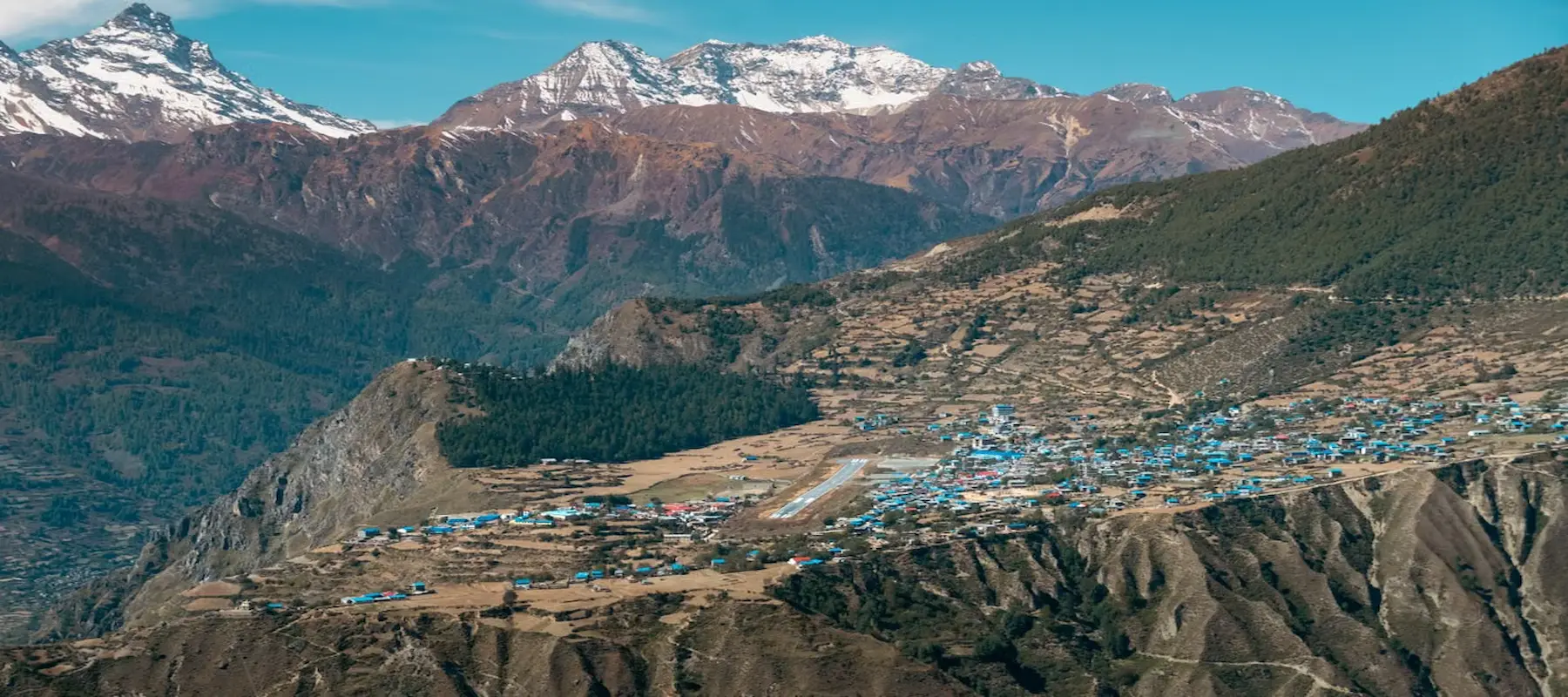
Lukla Airport is one of the world’s most hazardous airports. Also known as Tenzing-Hillary Airport, it is a domestic airport and altiport located in the town of Lukla, Khumbu Pasanglhamu, in Solukhumbu District of Koshi Province in Nepal. The Lukla Airport is renowned throughout the world as the most dreaded airport in the world.
The airport is the starting point for the Mount Everest base camp. The flight is considered dangerous because of the short runway, as well as conditions like unpredictable rain, high winds, cloud cover, and changing visibility, which means flights can be delayed or the airport closed temporarily, and these conditions make the landing quite difficult for the pilot
For anyone trekking to Everest Base Camp, the Kanchenjunga Circuit, or any high-altitude Khumbu trek, Lukla Airport is the gateway. This 5,000+ foot elevation airfield—nestled in the heart of Nepal’s Solukhumbu District—has been the starting point for Himalayan adventures for over 50 years.
District: Solukhumbu District, Koshi Province, Nepal
Elevation: 2,860 meters (9,383 feet)
Nearest City: Kathmandu (140 km west)
Flight Time from Kathmandu: 40-50 minutes (depends on weather conditions)
Town Below: Lukla (population ~2,500)
Back in 1964, Lukla was nothing but a steep hillside in the mountains of the Khumbu Region. Then, Sir Edmund Hillary—the first person to summit Mt. Everest (with Tenzing Norgay in 1953)—returned to Nepal with a vision to give something back to the Khumbu. He was interested in forming a safe access route to this remote area for humanitarian and economic purposes. The only form of modern transportation available to the Sherpa communities of Khumbu was on foot, over mountain passes. Hillary spent time with local Sherpas and international volunteers to dig a trail through the mountainside for the runway. Through hard work, yak power, and manpower, they constructed the original airfield in a few months.
The runway opened in 1964. Planes began flying and suddenly, a journey that took 2 weeks on foot from Kathmandu could be completed in 45 minutes by air.
Official Naming: 2008 – Tenzing Hillary Airport, for 44 years, the airport was simply called “Lukla Airport”—named after the town it serves. In 2008, after Hillary’s death, the Government of Nepal officially renamed it Tenzing Hillary Airport in honor of two legends:
Both men embodied the spirit of the Himalayas and Sherpa determination so, the naming was fitting recognition to Two Legends.
Since 2008, the airport has upgraded significantly:
Today, Lukla Airport handles roughly 80-100 flights daily during peak season (September-October), ferrying 2,000+ trekkers and supplies to the Khumbu region monthly.
Lukla Airport isn’t just remote—it’s geographically constrained in ways most airports never experience.
The Terrain:
To put this in perspective:
What Makes Lukla Different: Aircraft landing at Lukla must make very precise approaches. There’s almost zero margin for error, the pilot can imagine. If a pilot misses the runway or can’t land, there’s nowhere to “go around” and try again. You must abort the approach entirely and return to Kathmandu.
Lukla’s runway is approximately 1/3 of the length of a typical international airport runway, at 1715 m in length.
Impact on Operations:
There are restrictions on aircraft sizes: Only smaller regional aircraft (fewer than 20 seats) are allowed to use Lukla. Wide-body jets? Impossible. Even medium turboprops? No, just smaller Cessnas and Skydives and some special mountain aircraft.
In most parts of the world, runways are flat. Lukla’s runway is 12° down, one of the steepest working runway angles in the world.
Advantage: The down slope can make take-off easier, as speed is increased when going downhill (and braking on landing easier).
Disadvantages:
At 2,860 meters (9,383 feet), Lukla is nearly 3,000 meters higher than Denver, often called “the mile-high city.”
Thin Air Impact:
For instance, if a Cessna requires 1500m at sea level, then it may require 2000+m at Lukla. That means there is virtually no margin for error on a 1,715-meter-long runway.
The weather in the Khumbu region is highly unpredictable, particularly at high altitudes. On a given day, Lukla might have perfect flying conditions at 6 AM. By 10 AM, thunderstorms build.
Common Weather Problems:
The vast majority of approaches to airports are pretty simple: turn onto the landing approach, level off at a standard descent angle, line up with the runway and land.
Lukla’s approach is a geometrically tricky one:
Complete Runway Data:
| Specification | Value | Notes |
|---|---|---|
| Official Name | Tenzing-Hillary Airport | Commonly referred to worldwide as Lukla Airport. |
| ICAO Code | VNLK | IATA Code is LUA. |
| Elevation | 2,846 m (9,337 ft) | Air density requires specialized aircraft engine performance thresholds. |
| Runway Length | 527 m (1,729 ft) | Extremely short STOL facility; leaves zero margin for overshoot. |
| Runway Width | 20 m (65 ft) | Narrow strip flanked by a mountain wall and a deep chasm. |
| Runway Slope | 11.7% to 12% gradient | Uphill landing helps slow planes down; downhill takeoff assists acceleration. |
| Runway Surface | Bituminous Paved Asphalt | Fully paved since 2001 to stabilize runway safety conditions. |
| Orientation | 06/24 | One-way traffic: Land on Runway 06, takeoff from Runway 24. |
| Approach Path | Strict Visual Flight Rules (VFR) | No instrument landing system (ILS) or radar guidance available. |
Active Airlines & Fleet:
As of August 2026, the following airlines operate regular service to Lukla:
| Airline | Fleet | Aircraft Type | Services | Safety Record |
|---|---|---|---|---|
| Tara Air | 3 aircraft | DHC-6 Twin Otter, Dornier Do-228 | Daily scheduled passenger flights (handles Yeti Airlines traffic) | Experienced STOL operators; subject to EU blacklist country restrictions |
| Summit Air | 4 aircraft | Let L-410 Turbolet | Daily scheduled passenger flights & charters | Strong internal maintenance tracking; subject to EU blacklist country restrictions |
| Sita Air | 4 aircraft | Dornier Do-228 | Daily schedules, cargo transport, and charter routes | Highly reliable twin-engine track record; subject to EU blacklist country restrictions |
| Nepal Airlines | 2 aircraft | DHC-6 Twin Otter | Extremely limited/Intermittent flights to Lukla | National flag carrier; severe fleet constraints; subject to EU blacklist country restrictions |
Tara Air
Sita Air
Summit Air
Nepal Airlines
Historical Accidents at Lukla (1964-2026)
| Era / Period | Verified Notable Incidents | Confirmed Fatalities | Operational Safety Context & Regulatory Shifts |
|---|---|---|---|
| 1964–1990 (Early Exploration) |
1 | 0 | Low Flight Volume: The airport was mostly dirt and grass. Flight operations were sparse, restricted to private charters or occasional government cargo. |
| 1991–2000 (Commercial Boom) |
2 | 14 | Rapid Tourism Growth: Air traffic surged rapidly without modern radar or communication infrastructure. A major fatal crash occurred in June 1991 (14 deaths). |
| 2001–2010 (Peak Risk Era) |
4 | 21 | Runway Paving & Congestion: The runway was paved in 2001, drastically increasing daily flights. Heavy mountain fog led to Lukla’s worst disaster in October 2008 (Yeti Airlines, 18 deaths). |
| 2011–2019 (Transition Period) |
3 | 5 | Tightening Regulations: Minor runway excursions occurred. Two fatal incidents involving Summit Air (2017 cargo crash and 2019 ground collision) led to aggressive rule overhauls. |
| 2020–2026 (Modern Safety Era) |
0 | 0 | Strict Modern Enforcements: Zero fatal commercial passenger crashes. The Civil Aviation Authority (CAAN) mandated real-time weather cams, high pilot-experience bars, and seasonal flight diversions to manage traffic. |
| TOTAL (60+ Years) | ~10 major hull losses | 40 | Note: This counts accidents directly at or on immediate approach to Lukla Airport, excluding en-route weather diversions elsewhere in Nepal. |
| Trek | Duration | Difficulty |
|---|---|---|
| Trek to Everest Base Camp | 12 days | Moderate |
| Gokyo Lake Trek | 11 days | Moderate |
| Gokyo Ri Trek | 12 days | Challenging |
| Everest Base Camp + Gokyo Lake Trek | 15 days | Challenging |
| Ama Dablam Base Camp + Kongma La Pass Trek | 13 days | Moderate |
| Cho La Pass Trek | 19 days | — |
| Everest Three High Passes Trek | 17 days | Challenging |
| Ama Lapcha Pass Trek | 16 days | Challenging |
All of these operate in Sagarmatha National Park, flying in and out via Lukla, and route through the classic Sherpa villages (Namche Bazaar, Tengboche, Gorakshep, etc.).
Lukla Airport is genuinely challenging because of its short runway, high elevation, unpredictable mountain weather, and lack of instrument landing systems. However, the “world’s most dangerous airport” label is largely a media description and does not by itself represent current aviation risk.
Yeti Airlines and Sita Air are commonly considered popular choices for Lukla flights, while Summit Air is another option. When choosing an airline, check its current operating status, safety oversight, flight schedule, and recent operational record rather than relying solely on reputation.
Flights can operate during the monsoon, but cancellations and delays are much more common because of cloud, rain, and poor visibility. September onward generally provides more favorable conditions for Lukla flights.
Flying to Lukla is the standard option for trekkers heading toward Everest Base Camp because it saves considerable time. Trekking from the lower Solukhumbu region is possible but adds several days to the itinerary and is better suited to travelers with extra time.
If your flight is cancelled, contact the airline or trekking agency to arrange the next available flight. Delays can last from several hours to multiple days depending on weather and air traffic. Keeping one or two extra days in your itinerary is strongly recommended.
The commonly used baggage allowance is around 15–20 kg of checked luggage plus approximately 5 kg of hand luggage, although the exact allowance can vary by airline and ticket. Confirm the current limit with your airline before departure because excess baggage may incur additional charges.
Yes, direct flights to Lukla operate seasonally, although during busy trekking periods some flights may operate from Manthali/Ramechhap Airport instead of Kathmandu. Flight schedules depend heavily on weather and airline operations.
If you are uncomfortable with small aircraft, trekking from lower elevations is an alternative, but it adds significant time to the journey. For nervous flyers, understanding the short flight duration and mountain-weather procedures can help, but never take medication specifically for flying without appropriate medical advice.
Lukla’s runway is constrained by the surrounding mountain terrain and airport infrastructure. Rather than assuming a major runway expansion, travelers should check current aviation authority and airport updates for any planned improvements or operational changes.
Common mistakes include booking without allowing flexibility for delays, arriving without checking the departure airport, carrying excessive luggage, and scheduling an international flight immediately after returning from the Everest region. Always leave a reasonable buffer between your Lukla flight and onward international travel.
Lukla flight prices vary according to season, airline, departure airport, and passenger category. Peak trekking seasons generally have higher demand and fares. Check the current fare with the airline or trekking agency before booking because prices can change.
Depending on conditions and availability, travelers may consider a helicopter flight to Lukla or alternative routing through Manthali/Ramechhap. Helicopters are significantly more expensive than regular flights, so availability and weather should be confirmed before making arrangements.
Manthali Airport, also known as Ramechhap Airport, is used for some Lukla operations during periods of high air traffic. Travelers may need to travel by road from Kathmandu to Manthali before their flight. Always confirm the departure airport with your airline or trekking agency before traveling.
Early morning flights are generally preferred because mountain weather can become less predictable as the day progresses. However, the exact operating window depends on weather, visibility, aircraft availability, and air traffic conditions.
Yes. Comprehensive travel insurance is strongly recommended for the Everest region. Make sure your policy specifically covers high-altitude trekking at your planned elevation, medical treatment, emergency evacuation, trip interruption, and flight delays or cancellations where applicable.
Lukla Airport is remarkable—a genuine feat of aviation in one of Earth’s most challenging environments. It’s neither “the world’s most dangerous airport” (media hyperbole) nor a completely routine airport (minimizing reality).
It’s a challenging, respected facility that demands excellence from pilots and humility from passengers. Today, flights to Lukla are the norm, especially for trekkers who plan to hike to Everest Base Camp or experience other treks in the Khumbu area. The 45-minute flight is a manageable step in the extraordinary mountain experiences provided by modern safety records, experienced pilots and well-maintained aircraft.
Alliance Treks & Expedition Pvt. Ltd. Once is not enough for naturally and culturally Himalayas