(Viber, Whatsapp, Cell) +977 9851022814

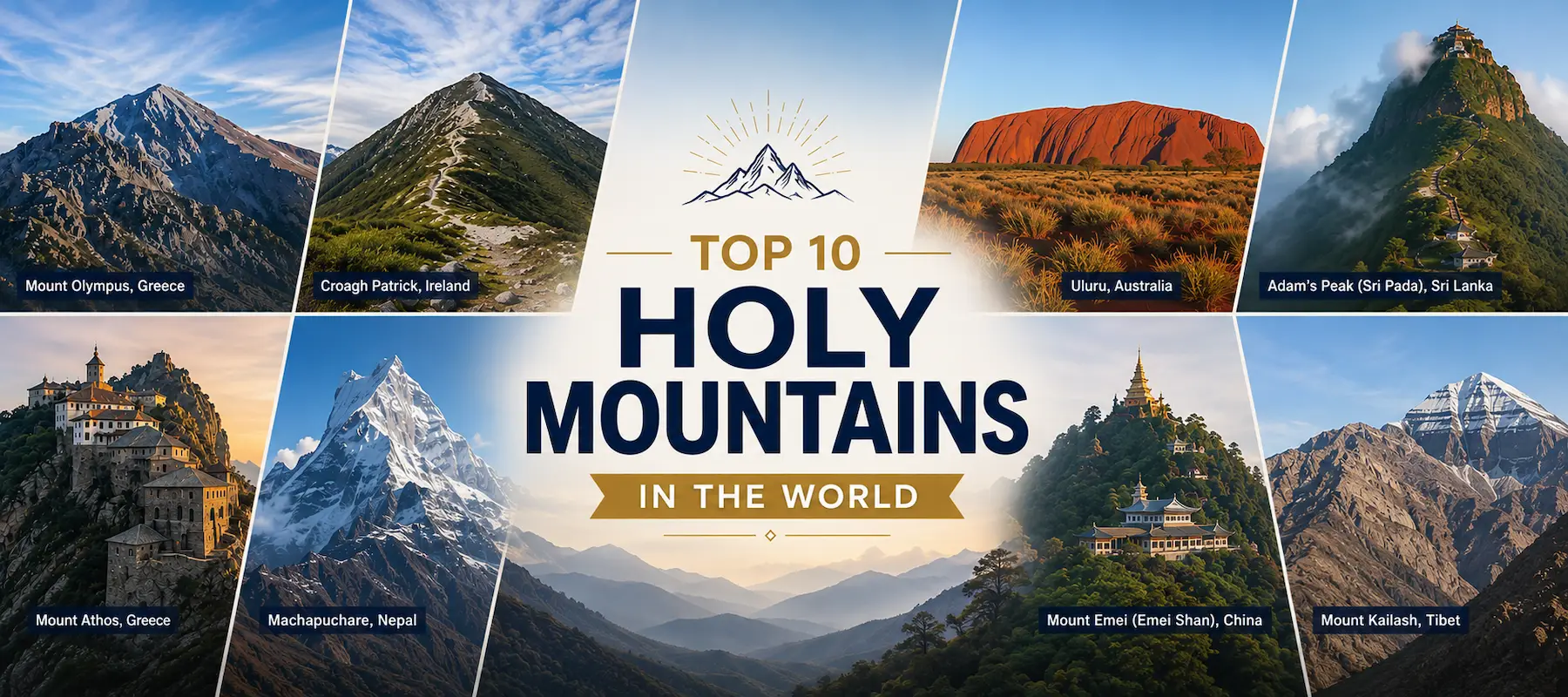
There are over one million mountains in the world. Mountains are worshiped as gods in many communities worldwide; they rise closer to the sky than anything else on earth, and across nearly every culture, that closeness has been read as closeness to the divine. From peaks no outsider is allowed to climb to summits crowded with pilgrims every year, holy mountains represent some of the deepest spiritual traditions on the planet. Here are ten of the most sacred, spanning continents, religions, and thousands of years of devotion.
Mount Kailash is an essential part of the list of holy mountains. Kailash is worshipped by all four major religions of India: Hindu, Buddhist, Jains, and followers of the Bon religion, and is said to be the dwelling place of Lord Shiva by the Hindus. It has never been officially climbed due to its near-perfect pyramidal shape and isolated location in western Tibet, which is seen as sacred, and not necessarily due to a lack of technical skill. Pilgrims, on the other hand, make a tough 52-kilometer pilgrimage around its base, known as circumambulation or ‘kora’.
The highest point in Japan is more than just a pretty landmark; it’s a sacred place for both Shinto and Buddhist beliefs. Climbing the mountain was seen as a religious journey, not a mere adventure, and the mountain was believed to be sacred, home to the goddess Konohanasakuya-hime. Hundreds of thousands still climb it every summer season, many continuing the old tradition of making the climb to the top at dawn to see the sunrise.
Central to Judaism, Christianity, and Islam, Mount Sinai is traditionally identified as the site where Moses received the Ten Commandments. Its religious weight across three major Abrahamic faiths makes it one of the most historically significant holy mountains in the world. At its base sits Saint Catherine’s Monastery, one of the oldest continuously operating Christian monasteries on Earth, and pilgrims still climb through the night to watch sunrise from the summit.
In ancient Greek religion, Mount Olympus was believed to be the literal home of the twelve Olympian gods, including Zeus, Hera, and Athena. While modern Greece practices different faiths today, Olympus remains deeply embedded in cultural and mythological identity, and its status as the mythical seat of the gods still draws hikers and history lovers eager to walk in the footsteps of ancient legend.
Known locally as “the Reek,” Croagh Patrick is Ireland’s most important site of Christian pilgrimage. Tradition holds that Saint Patrick fasted here for forty days in the 5th century, and every year on the last Sunday of July — known as Reek Sunday — thousands of pilgrims climb the mountain, some still barefoot as an act of penance and devotion.
Uluru is one of the most sacred sites for Australia’s Anangu people, deeply woven into their creation stories, or Tjukurpa. For decades it was also a popular tourist climb, but out of respect for its sacred status, climbing was formally banned in 2019 following requests from Anangu traditional owners. Today, visitors are encouraged to experience Uluru through guided cultural walks rather than ascent, honoring its role as one of the most spiritually significant holy mountains in the world.
Few mountains claim reverence across as many faiths as Adam’s Peak. Buddhists believe the rock formation at its summit is the footprint of the Buddha, Hindus associate it with Shiva, Muslims and some Christians link it to Adam, and Sri Lankan Catholics have their own devotional traditions tied to the site. Pilgrims of every background climb its steps together during the annual pilgrimage season, making it a rare example of shared, multi-faith sacred ground.
Mount Athos is a self-governed monastic republic within Greece, home to twenty Eastern Orthodox monasteries and considered the spiritual heart of Orthodox Christian monasticism. Access is tightly restricted — visitors need special permits, and only men are permitted to enter, a centuries-old rule tied to the peninsula’s dedication as a place of prayer and seclusion.
Rising sharply above the Annapurna range, Machapuchare — meaning “Fish Tail” for its distinctive double-pronged summit — is considered sacred to Lord Shiva by local Gurung communities. Out of religious respect, Machapuchare has never been officially summited; a 1957 British expedition stopped just short of the top by agreement, and the peak remains legally closed to climbers to this day.
One of the Four Sacred Buddhist Mountains of China, Emei Shan is where Buddhism is traditionally said to have first taken root in the country. Its slopes are dotted with ancient temples and monasteries, including the Golden Summit, where a massive statue of the bodhisattva Samantabhadra overlooks a sea of clouds. It remains an active pilgrimage site as well as a UNESCO World Heritage location.
Alliance Treks & Expedition Pvt. Ltd. Once is not enough for naturally and culturally Himalayas