(Viber, Whatsapp, Cell) +977 9851022814

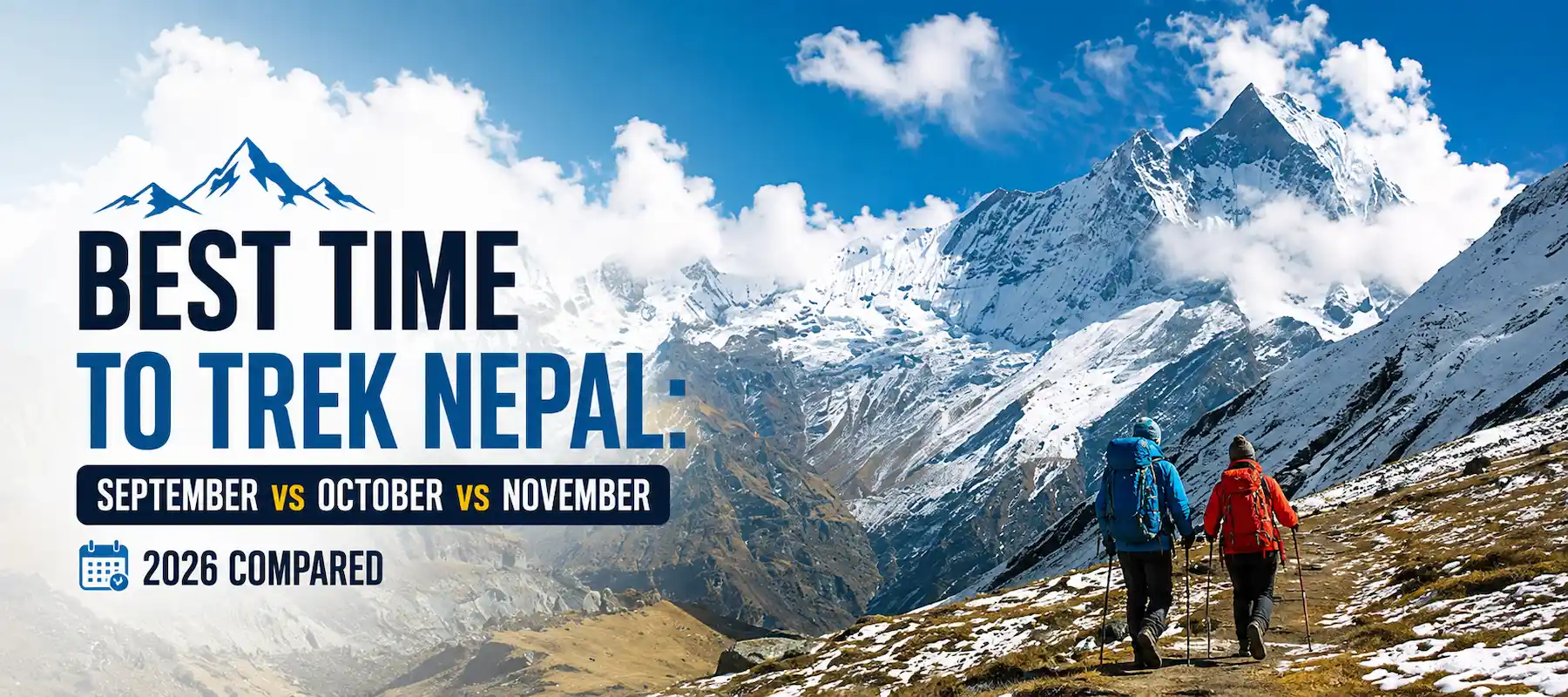
The Best Time to trek in Nepal is as important as choosing the right trek destination. There are three main months of peak season – early September through late November, but these are not equivalent months. Early in September, the trails are virtually empty, but by mid-October, they’re filled with a stream of hikers. By late November, the crowds have returned, and the cold is just starting to bite in the higher elevations. When you’re in the planning stages for a trek in 2 weeks, and you’re trying to find out if you can go in September or October and see the mountains clearly without spending the night of the 29th, the answer varies according to when September, October, and November happen in relation to your trip.
This month-by-month guide explains when you can trek in Nepal, what you can see, how much it will cost, how many people are there and which routes are good at each time of the year, before comparing the options side by side to match your trek to the season that best fits your needs — whether you’re looking for solitude, clear views of the Himalayas, or low-cost options. When appropriate, we have included more detailed route guides at Alliance Treks for each specific trip to help you dive deeper into each month once you have decided on the trip.
Before diving into the details of the best time to trek in Nepal, here’s how the three months stack up across the factors that actually affect your trip.
| Factor | September | October | November |
|---|---|---|---|
| Weather | Transitioning from monsoon, occasional afternoon showers, and clearing skies late in the month | Stable, dry, and generally the clearest skies of the year | Cold and dry, excellent visibility, temperatures dropping fast at altitude |
| Crowd levels | Lowest of the three months, trails feel open | Busiest month of the year, teahouses fill up fast | Moderate, quieter than October but busier than September |
| Cost | Most affordable of peak season | Highest prices, especially for flights and teahouses | Mid-range, some late-month discounts as the season winds down |
| Best for | Early bookers, budget-conscious trekkers, fewer crowds | First-time trekkers wanting guaranteed clear views | Photographers, trekkers who prefer solitude with good visibility |
| Trail conditions | Some residual mud from monsoon, especially first half of month | Dry, firm trails throughout | Dry but cold; ice possible at higher elevations late in the month |
This table is a starting point, not the whole story — each month has its own personality once you look closer.
September is the high season, but it’s not always that high. The rainy season of July/August is coming to a close, although afternoons may still be cloudy, and there could be an occasional shower, especially at lower elevations. After the third week, skies usually become clear and the typical autumn trekking weather begins — cool mornings, and a warm afternoon sun with gradually improved visibility of peaks such as Annapurna and Machhapuchhre.
Many trekkers wait for guaranteed good weather in October, so that September actually sees noticeably less foot traffic. Rooms are still available in all teahouses a month out, even in popular points of view, such as Poon Hill, are far less crowded at sunrise. That’s why September trekking in Nepal is a good time to consider for those who ask themselves if the early season trek in September is worth the little bit of the weather risk – if it’s for their first trek and they don’t like the idea of the early season trek in September, then the trade-off of some cloud for fewer people and lower costs is often worth it.
September is also a better price, as demand has not reached its peak. Shorter queues lead to faster flights to Lukla, faster teahouse rooms, and even faster processing of the permits! However, for the short trekkers who plan for a short Nepal trek (5-10 days), September is a good time to undertake one of the less arduous routes, such as Ghorepani Poon Hill or the lower part of the Annapurna Base Camp trek, where the elevation is not too high, and the residual monsoon moisture is not too worrying.
When is the best time to go on a trek in Nepal in September? Yes, especially from mid-September. It is accommodating of those who don’t mind some rain, and gives up strict time requirements for the more relaxed trails and rates. If Annapurna Base Camp is on your shortlist of treks, we have a guide to Annapurna Base Camp that goes into more detail on month-by-month conditions.
The month of October is the best time to trek in Nepal as the trekking industry is at its best. The monsoon is completely over, the humidity is less, and the sky is generally at its clearest of the year. October is when so many trekkers specifically look for the best trek in Nepal, as it is when the panorama of the mountains is likely to stand out the most, even if a bit hazy in September and in the pre-monsoon spring season.
This clarity is expensive, not only monetarily, but also in terms of sacrifice. The first lesson in trekking season discussions in October is that this is the busiest (and therefore the most expensive) month of the year on popular trekking routes, such as Everest Base Camp, Annapurna Circuit, and Annapurna Base Camp. Hydrawalkers are filling up teahouses by early afternoon, Lukla flights book up months ahead of September and November, and popular viewpoints are crowded with plenty more people than they are during those months. October trekking is no longer a choice of when to book a place to stay and a permit; it’s a choice between a smooth trip and a scramble for a place to stay at 4,000m.
Pricing follows demand. October is usually the most expensive month to trek in Nepal, and premium teahouse rooms, summery flights, and guides and porters who are booked in advance will cost more than the alternatives. If you are a trekker who seeks the best guarantees for clear photography and is okay with sharing the trail, then this is the safest option this year, weather-wise. If you’re considering October versus the less busy options, take the time to read through our comparison notes below before making a date appointment!
Is October a good time to trek in Nepal? As for the weather, it’s probably the best month of the year. Crowd-wise, it is the most challenging. It is a matter of personal choice whether this is the right one or not, as it will vary from person to person based on their preferences for solitude vs certainty.
November is the best time to trek in Nepal, which falls somewhere between the extremes. By mid-October, the crowds that grew so thick in the first 10 days have significantly thinned out, but the clear, dry weather continues, sometimes with even greater clarity as humidity drops. Morning temperatures drop significantly, and by late November, they can be below freezing at higher passes and campsites above 4,000 m. In shaded areas of the trail, there may be some ice.
With the combination of good weather, fewer people, and colder temperatures, November trek Nepal packages are a favorite among photographers and those who have already been through the rigors of October trekking but still want to enjoy the same conditions, just a bit more relaxed. For the November 2026 trek planning, it is normal to favour slightly less steep routes, as the month goes on, as trekking across high passes gradually gets tougher and tougher as temperatures drop.
Generally, November costs are between the September and October range, but not as low as the early season, nor as expensive as the October high, particularly the latter half of the month when demand begins to wane. A late season November trek trip can also be enhanced by having more individualized guide and teahouse services due to the reduced number of trips in the area at one time.
What is the best time to trek in Nepal in November? Yes, particularly the first three weeks. It provides almost the same visibility as during October, but with very few crowds—unless trekkers bring enough gear for a cold night, and not one of September or early October.
Once you’ve read through each month individually, the decision usually comes down to which trade-off matters most to you. The table below breaks that down by priority.
| If your priority is | Best month | Why |
|---|---|---|
| Clearest mountain views | October | Driest air and lowest cloud cover of the year |
| Avoiding crowds | September (or late November) | Lightest foot traffic on major routes |
| Lowest cost | September | Off-peak-adjacent pricing before October demand kicks in |
| Balance of weather and crowds | November | October-level visibility without October-level congestion |
| Cold tolerance is a concern | September or early October | Milder overnight temperatures than late November |
| Photography and sharp panoramas | October or November | Both offer excellent clarity, November edges out on solitude |
Should I trek in September or October? If your dates are flexible and budget matters, September usually wins. If your trip is once-in-a-lifetime and you want the statistically clearest skies regardless of crowd size, October is the safer bet.
What’s the difference between September and October trekking? Primarily, crowd density and price — the weather gap narrows considerably once September reaches its final week, but the number of people sharing the trail with you does not.
Not all trails are suitable for all months. September’s ‘left over’ monsoon rains are easier on shorter lower-level trails than high passes, and November’s chilliness makes some high passes truly difficult.
For September, the Ghorepani Poon Hill trek is a good match: it’s not as high as the trek itself, so you won’t have to worry about any leftover rain, and the famous sunrise viewpoint is off the busloads a month earlier. The lower sections of Annapurna Base Camp are also good, but if you are trekking all the way down to base camp in early September, you should include a day to spare in case of a bad day from a weather standpoint.
October is the best time to trek in the Manaslu Circuit because it is not as crowded during this time of year as the Everest Circuit or Annapurna Circuit, and the restricted-area permits keep the numbers down, but still offer the clear October skies. October is also an excellent time to trek to Annapurna Base Camp or Everest Base Camp for those looking to experience the views of the Himalayas above all else, but with advance booking.
November is a good time for routes that can be done before the cold snap comes in. Conditions will be passable and comfortable on Ghorepani Poon Hill and lower base camp routes for most of November, but the higher circuits like Manaslu or Everest Base Camp are best done in the first half of November, as night temperatures at altitude become very cold.
Is it possible to trek ABC in September? Yes — some afternoon cloud will occur in the first half of the month, but that will be a definite improvement by late September. Is October a good time to trek Manaslu? Yes, but October is probably the best month of the year for this drive, as it has a nice mix of good visibility and not too many people. Does the cold weather in November deter you from trekking? By late November, serious cold-weather clothing is required for most high passes above 5,000m.
The difficulty of a trail is not a given — a trail might be easier or harder depending on the month of the year. September is a good time to trek since the nights are cooler, but some sections may be slippery and muddy from the monsoon season, especially below 3000m. As the trails become dry in the fall season, they are more comfortable to walk on once they reach October, even though the thinner air at altitude does not change with the season. The trails are dry in November, and as in October, firm and stable, but the challenge is one of cold conditions and endurance rather than footing. A moderate hike in November can be quite a bit harder when night temperatures fall well below freezing.
If you are just looking for an easy trek, then you can go on treks such as the Ghorepani Poon Hill trek and short sections of the Annapurna Base Camp trek in September, October, or November. But if you are looking for moderate to hard treks, then you must go on the Annapurna base camp trek, which involves high passes in September, October, and November, and moves into the moderate to hard trek category from mid-November onwards.
| Expense Category | September | October | November |
|---|---|---|---|
| Domestic flights (e.g., Lukla) | Moderate, easier availability | Highest demand, book 4-6 weeks ahead | Moderate to high, especially early month |
| Teahouse accommodation | Most affordable, rooms readily available | Premium pricing, limited availability | Mid-range, more negotiable late month |
| Guide and porter rates | Standard peak-season rates | Highest, book well ahead | Standard to slightly discounted late month |
| Overall trip cost (relative) | Lowest of the three months | The highest of the three months | Middle ground |
Budget trekking in September, October, or November all remain achievable with the right route selection — shorter, lower-elevation treks keep costs down in any month, while longer high-altitude circuits carry a natural premium in October specifically due to demand rather than difficulty. For travellers with limited time and budget, Alliance Treks also has the option for short treks, which can be completed in a short time as well as beginner-friendly.
There’s no single answer — October offers the most reliable, clear weather, September offers the best value and fewest crowds, and November offers a strong middle ground of good visibility with lighter foot traffic than October. Most trekkers get the best overall experience by matching one of these three windows to their own priorities rather than picking a single “best” month.
As mentioned above, the right month depends on whether clear views, low crowds, or budget matters most to you.
For October specifically, aim to confirm flights, permits, and teahouse-heavy routes like Everest Base Camp at least a month in advance. September and November trips can generally be booked with more flexibility, sometimes just a few weeks out.
On major routes like Everest Base Camp and Annapurna Base Camp, yes, it’s the busiest month of the year. Lesser-traveled routes like Manaslu Circuit see the October weather benefits without the same congestion.
For clear views with moderate crowds, Manaslu Circuit is a strong pick. For a shorter October window, Annapurna Base Camp remains the classic choice, booked well in advance.
Layered rain-resistant gear for the first half of the month, transitioning to standard autumn trekking layers as skies clear later in September.
Alliance Treks & Expedition Pvt. Ltd. Once is not enough for naturally and culturally Himalayas