(Viber, Whatsapp, Cell) +977 9851022814

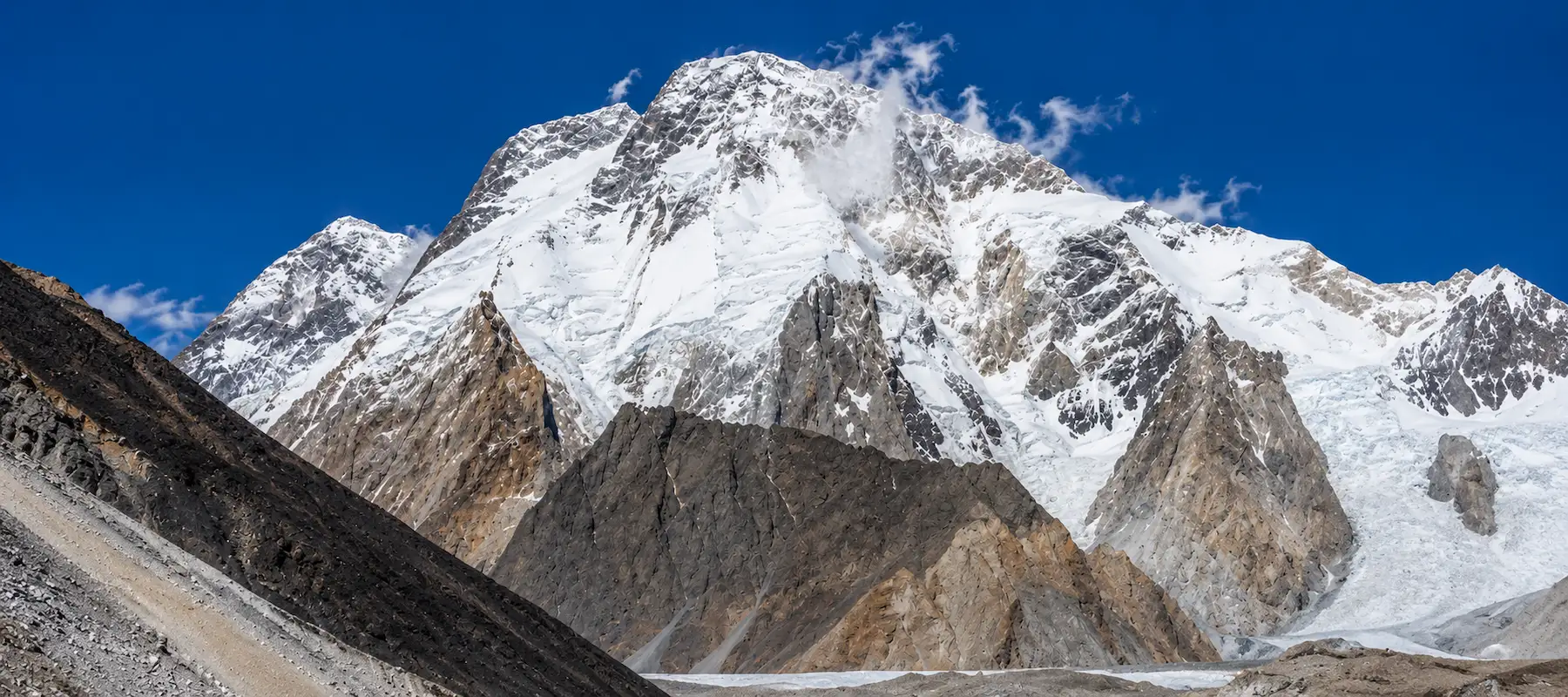
Broad Peak has been in international headlines this year following a devastating avalanche that claimed the lives of ten climbers, including celebrated Nepali mountaineer Nirmal “Nimsdai” Purja. For many people outside the climbing world, this tragedy was their first introduction to a mountain that has quietly challenged elite mountaineers for nearly seven decades.
In this guide, we cover what Broad Peak is, why it draws climbers from around the world, what happened in the July 2026 avalanche, and how it compares to Nepal’s own giant peaks like Manaslu and Annapurna.
Broad Peak, locally called Falchan Kangri, stands at 8,051 meters (26,414 ft), making it the 12th-highest mountain in the world. It is located in the Karakoram Range, Gilgit-Baltistan, Pakistan, only some kilometres away from K2, the second-highest peak in the world. The English name of Broad Peak was given for its uncharacteristically wide summit ridge, which is almost 1.5 km in extent, one of the longest summit ridgelines of any 8,000-meter peak.
In 1957, the Austrian expedition team climbed the mountain, one of the first successful ascents of an eight-thousander without the “siege logistics” used in the eight-thousanders at the time.
Because the two mountains share a base region, they’re often compared directly.
| Feature | Broad Peak | K2 |
|---|---|---|
| Height | 8,051 m / 26,414 feet | 8,611 m / 28,251 feet |
| World Rank | 12th highest | 2nd highest |
| First Ascent | 1957 | 1954 |
| Difficulty | Very high, technical summit ridge | Extremely high, considered one of the hardest 8000ers |
| Location | Karakoram, Pakistan | Karakoram, Pakistan |
Most expeditions follow the West Spur route, approaching from the Godwin-Austen Glacier and progressing through four camps:
The climbing season runs primarily from June to August, when weather windows are most stable, though conditions in the Karakoram can shift rapidly even in summer.
An avalanche released to the slope between Camp 2 and Camp 3 at about 6,600m on July 30, 2026, followed a group of 10 climbers. A group of 10 climbers was swept up by an avalanche on the slope between Camp 2 and Camp 3 at about 6,600m on July 30, 2026. The adventurers, including Nirmal Purja’s team, Elite Expedition, were among thousands who were attempting a summit after a week of the region being battered by heavy snow.
All 10 climbers were swept off the mountain in the avalanche. They were found at the foot of the slope by Karakoram Expeditions, and by August 1 it was confirmed by the Alpine Club of Pakistan and Elite Exped that none survived. It represented the single worst mountaineering disaster in over 10 years.
Nepali-born climber Nirmal “Nimsdai” Purja was among the climbers who went missing, the fastest of all who have climbed the world’s 14 8,000-meter peaks. Several notable Sherpa climbers were also among the mountaineers, highlighting the impact this tragedy had on the Nepalese mountaineering community.
Broad Peak’s risks go beyond altitude alone:
The 2026 avalanche was not the mountain’s first tragedy. Past incidents have included fatal falls near the summit ridge and earlier avalanche deaths, a reminder that even experienced, well-prepared teams face real risk on 8,000-meter peaks.
Nepal is home to eight of the world’s fourteen 8,000-meter peaks, including Everest, Manaslu, and Annapurna. While Broad Peak lies across the border in Pakistan’s Karakoram, it’s often mentioned alongside Nepal’s giants by climbers pursuing all fourteen eight-thousanders.
If you’re drawn to high-altitude adventure but are looking for something more accessible than an 8,000-meter expedition, treks like the Manaslu Circuit Trek and Annapurna Base Camp Trek offer a chance to stand within view of these massive peaks without the technical mountaineering risk. You can also read more about the people and communities of Nepal’s mountain regions who call these landscapes home. For official guidelines and licensed operator requirements, visit the Nepal Tourism Board and TAAN (Trekking Agencies’ Association of Nepal).
For those exploring Nepal trekking more broadly, our guides cover everything from permits to route planning across the Himalayas.
The Broad Peak avalanche claimed the lives of all 10 climbers in the affected expedition. The tragedy occurred on July 30, 2026, when an avalanche swept through the climbing group at high altitude. The incident triggered a difficult search and recovery operation involving Pakistani authorities, local climbers and international mountaineering communities.
The expedition consisted of six Nepali climbers and one climber each from Pakistan, Oman, China and the United States. The victims were:
The avalanche occurred on July 30, 2026, during an ascent of Broad Peak in Pakistan’s Karakoram range. Initial reports placed the incident around midday local time. The climbers were caught on the upper part of the mountain between Camp 2 and Camp 3.
The avalanche struck the climbers on the upper slopes of Broad Peak, between Camp 2 and Camp 3. Reports placed the affected area at roughly 6,450–7,000 meters, illustrating the extreme altitude at which rescuers had to operate.
No. Nirmal Purja was certainly the most internationally recognized name in the group, but the expedition also included highly experienced high-altitude climbers and guides. Among the Nepali members were Kili Pemba Sherpa, Nima Sherpa, Nawang Thindu Sherpa and Gyalu Sherpa. Pakistani climber Sohail Sakhi was also an experienced mountaineer from Hunza.
Nirmal “Nims Dai” Purja became one of the world’s best-known high-altitude mountaineers after completing all 14 of the world’s 8,000-meter peaks in 2019 in just six months and six days. His extraordinary project became the subject of the Netflix documentary 14 Peaks: Nothing Is Impossible.
Broad Peak stands at approximately 8,047–8,051 meters (about 26,400 feet) above sea level, depending on the source’s stated elevation. It is located in Pakistan’s Karakoram range close to K2 and is recognized as the 12th-highest mountain in the world.
It is difficult to rank the two mountains simply as “more dangerous” or “less dangerous.” K2 is widely regarded as one of the world’s most technically challenging mountains because of its steep terrain, exposure, severe weather and complex climbing sections.
Broad Peak presents a different set of hazards. Avalanche exposure, extreme altitude, unpredictable Karakoram weather and the remoteness of the upper mountain can make even a technically less demanding route extremely dangerous.
Several factors contributed to the severity of the accident. The climbers were operating at extreme altitude in difficult terrain, while snow and weather conditions had created significant avalanche concerns.
The avalanche swept the climbers away from the route, leaving rescuers facing unstable slopes and extremely difficult access. Poor weather further complicated helicopter operations and delayed the recovery effort.
Recovering climbers from an avalanche at 6,000–7,000 meters is fundamentally different from a conventional mountain rescue. Rescuers had to contend with extreme altitude and limited oxygen, steep and unstable terrain, continuing avalanche danger, poor visibility and adverse weather, difficult helicopter access, the remote location of Broad Peak, and the physical difficulty of moving bodies through deep snow and technical terrain.
According to an Associated Press report published August 13, eight of the 10 bodies had been recovered. The recovery of Pakistani climber Sohail Sakhi was particularly significant because local volunteers located and brought his body to base camp almost two weeks after the avalanche.
Nadhira Ahmed Abdullah Al Harthy was an accomplished Omani mountaineer. She became the first Omani woman to summit Mount Everest in 2019 and had also climbed other major Himalayan and Karakoram peaks, including K2 and Manaslu. She was among the 10 climbers caught in the Broad Peak avalanche.
Sohail Sakhi was a Pakistani mountaineer and guide from Hunza. He was known within Pakistan’s climbing community and had experience operating in the high-altitude environment of the Karakoram. His body was eventually located by local volunteers after he had remained missing following the July 30 avalanche.
Kili Pemba Sherpa was one of the experienced Nepali high-altitude climbers involved in the expedition. His death was particularly mourned within Nepal’s mountaineering community because of his extensive experience in high-altitude climbing. He was among the six Nepali members of the Broad Peak expedition who lost their lives.
The American member of the expedition was identified in reporting as Sarah Mallory Geis. She was among the climbers caught in the Broad Peak avalanche and was one of the first victims whose recovery was reported after the disaster.
All six Nepali members of the expedition died in the avalanche:
The loss had a profound impact on Nepal’s mountaineering community. According to the Associated Press, the remains of all six Nepali climbers were eventually repatriated to Nepal.
Broad Peak should never be described as a “safe” mountain. Although its normal route is sometimes regarded as less technically difficult than K2, it remains an 8,000-meter peak, where altitude, weather, avalanches and rescue limitations create serious risks.
The 2026 disaster is a reminder that technical difficulty is only one part of mountaineering risk.
The loss of all 10 members of a single expedition makes the July 2026 Broad Peak avalanche one of the most serious mountaineering accidents in Pakistan in recent years.
Its scale was especially devastating because the victims came from several countries and included internationally recognized mountaineers as well as experienced local high-altitude climbers.
At lower elevations, rescuers can often reach avalanche victims relatively quickly. On an 8,000-meter mountain, however, the environment itself becomes a major obstacle.
Rescue teams must consider oxygen deprivation, extreme cold, unstable snow, falling ice and rocks, weather changes and the limited ability of helicopters to operate safely at high elevations. Consequently, even locating victims does not necessarily mean they can be immediately brought down.
The Broad Peak tragedy highlights the unpredictable nature of high-altitude mountaineering. Experience and technical skill can reduce risk, but they cannot completely eliminate hazards such as avalanches and sudden changes in mountain conditions.
It also demonstrates why weather forecasting, snowpack assessment, route selection, turnaround decisions, communication systems and professional rescue planning are essential on 8,000-meter peaks.
Nirmal Purja was more than a successful climber; he had become one of the most recognizable figures in modern Himalayan mountaineering. His rapid completion of the 14 eight-thousanders transformed the perception of what was possible in high-altitude climbing.
His death, alongside nine other climbers, therefore represents not only a personal tragedy for their families and countries but also a major loss for the international mountaineering community.
Alliance Treks & Expedition Pvt. Ltd. Once is not enough for naturally and culturally Himalayas