(Viber, Whatsapp, Cell) +977 9851022814

Dashain 2026 runs from Sunday, October 11 (Ghatasthapana) to Sunday, October 25 (Kojagrat Purnima), with the main Tika day, Vijaya Dashami, falling on Wednesday, October 21. Nepal’s government officially closes banks and offices from Phulpati (October 17) through Duwadashi (October 23), a seven-day block, on top of Ghatasthapana’s separate single-day holiday. If you’re reading this on or around October 2, the festival begins in roughly nine days.
Dashain is Nepal’s longest and most important festival, a 15-day Hindu celebration honoring the goddess Durga’s victory over evil. This guide covers the verified 2026 dates, what actually closes during the festival, how different communities in Nepal celebrate it, what travelers should know before visiting, and how it affects trekking season, information that matters whether you’re planning a trip, trying to understand Nepali culture, or simply wondering why half the country seems to disappear for a week every October.
| Day | Ritual | Date (2026) | Weekday | Bikram Sambat (2083) |
|---|---|---|---|---|
| 1 | Ghatasthapana (Jamara sown) | October 11 | Sunday | Ashwin 25 |
| 7 | Phulpati | October 17 | Saturday | Ashwin 31 |
| 8 | Maha Ashtami | October 19 | Monday | Kartik 2 |
| 9 | Maha Navami | October 20 | Tuesday | Kartik 3 |
| 10 | Vijaya Dashami (Tika Day) | October 21 | Wednesday | Kartik 4 |
| 11 | Ekadashi | October 22 | Thursday | Kartik 5 |
| 12 | Duwadashi (final official holiday) | October 23 | Friday | Kartik 6 |
| 15 | Kojagrat Purnima (festival ends) | October 25 | Sunday | Kartik 8 |
Note: a few travel sites list Maha Ashtami as October 18 rather than 19. That one-day gap comes from how different panchangs (Hindu lunar calendars) handle a tithi that spans across midnight. The dates above follow Nepal’s official 2083 BS government holiday notice, which is the authoritative source Nepali banks and ministries actually schedule around.
As of this writing, the exact Tika muhurat (auspicious time) for October 21, 2026 has not yet been officially published by the Nepal Panchang Nirnayak Samiti, the government body responsible for calculating these timings each year. Some online sources circulate a specific figure (around 11:53 AM), but that number does not appear to come from a confirmed official announcement. The Samiti typically publishes the official muhurat in the national Patro closer to the festival itself, usually in early-to-mid October. In practice, families aren’t rigidly bound to an exact minute regardless; the morning through early afternoon window on Dashami day is broadly considered auspicious for giving and receiving Tika, and most households time it around when extended family can gather rather than the precise muhurat alone.
This is one of the most practically important questions for anyone traveling to or doing business with Nepal in October, and it’s worth answering with real specificity rather than a vague “things slow down.”
| Service | Closure Period | Details |
|---|---|---|
| Banks | October 17–23 (7 days) | Official Nepal Rastra Bank holiday block, Phulpati through Duwadashi; essential services run with minimum staff |
| Government offices and ministries | October 17–23 | Closed for the same seven-day block; Ghatasthapana (Oct 11) is a separate single-day closure |
| Schools and universities | Typically 1–2 weeks | Many close before Phulpati and reopen after Duwadashi, sometimes extending toward Tihar in November |
| Private businesses and local shops | 2–5 days, varies widely | Not legally required to close, but many family-run shops and local restaurants shut for several days around Tika as staff return to hometowns |
| Hotels, tourist restaurants, and trekking agencies | Mostly open | Tourist-facing businesses generally stay operational, though staffing can be lighter and some agency employees take leave for family Tika |
| ATMs and cash access | Unreliable during the core block | Machines can run out of cash with banks closed; carrying extra cash before October 17 is genuinely practical advice, not just caution |
| Public transport | Reduced, then overcrowded | Buses run light in the days right before Tika (everyone’s traveled already) and become extremely crowded just after, as people return to Kathmandu and other cities |
The practical takeaway: if you have banking, visa, or government-office business in Nepal, plan around October 17–23 specifically, not the full 15-day span. If you’re simply traveling, tourist infrastructure largely keeps running, but expect quieter cities, lighter traffic, and some closed local eateries right around Tika day itself.
Dashain, also called Bada Dashain, Bijaya Dashami, or Nauratha in different contexts, marks the mythological victory of Goddess Durga over the buffalo demon Mahishasura after nine nights of battle, a story that runs parallel to the Ramayana’s account of Lord Rama defeating the demon king Ravana on the same tenth day. Both stories carry the same underlying theme: a triumph of righteous force over chaos, which is why the tenth day, Vijaya Dashami, literally means “the day of victory.”
The festival’s roots go back further than its current religious framing, though. Dashain began as an agrarian celebration marking the end of the monsoon and the start of the harvest, a moment for farming communities to give thanks and rest after months of labor. Later, Nepal’s royal family and regional rulers absorbed it into state ceremony, performing elaborate rituals to project both religious devotion and political authority, a dual identity, spiritual and civic, that the festival still carries today.
The first nine days of Dashain (Navaratri) are dedicated to nine distinct forms of Durga, each associated with a different quality and, in yogic tradition, a different energy center in the body:
| Day | Form of Durga | Associated Quality |
|---|---|---|
| 1 | Shailaputri | Grounding and stability |
| 2 | Brahmacharini | Discipline and inner devotion |
| 3 | Chandraghanta | Courage and readiness |
| 4 | Kushmanda | Creative, life-giving energy |
| 5 | Skandamata | Protective, maternal strength |
| 6 | Katyayani | Fierce decisiveness |
| 7 | Kalaratri (Phulpati) | Destroying fear and ignorance |
| 8 | Mahagauri (Maha Ashtami) | Purity after struggle |
| 9 | Siddhidatri (Maha Navami) | Granting spiritual and material accomplishment |
Few visitors realize that many Nepali households perform a small daily puja across all nine nights, not just on the headline days, each form receiving its own brief, specific devotion before the festival builds to its climax on the tenth day.
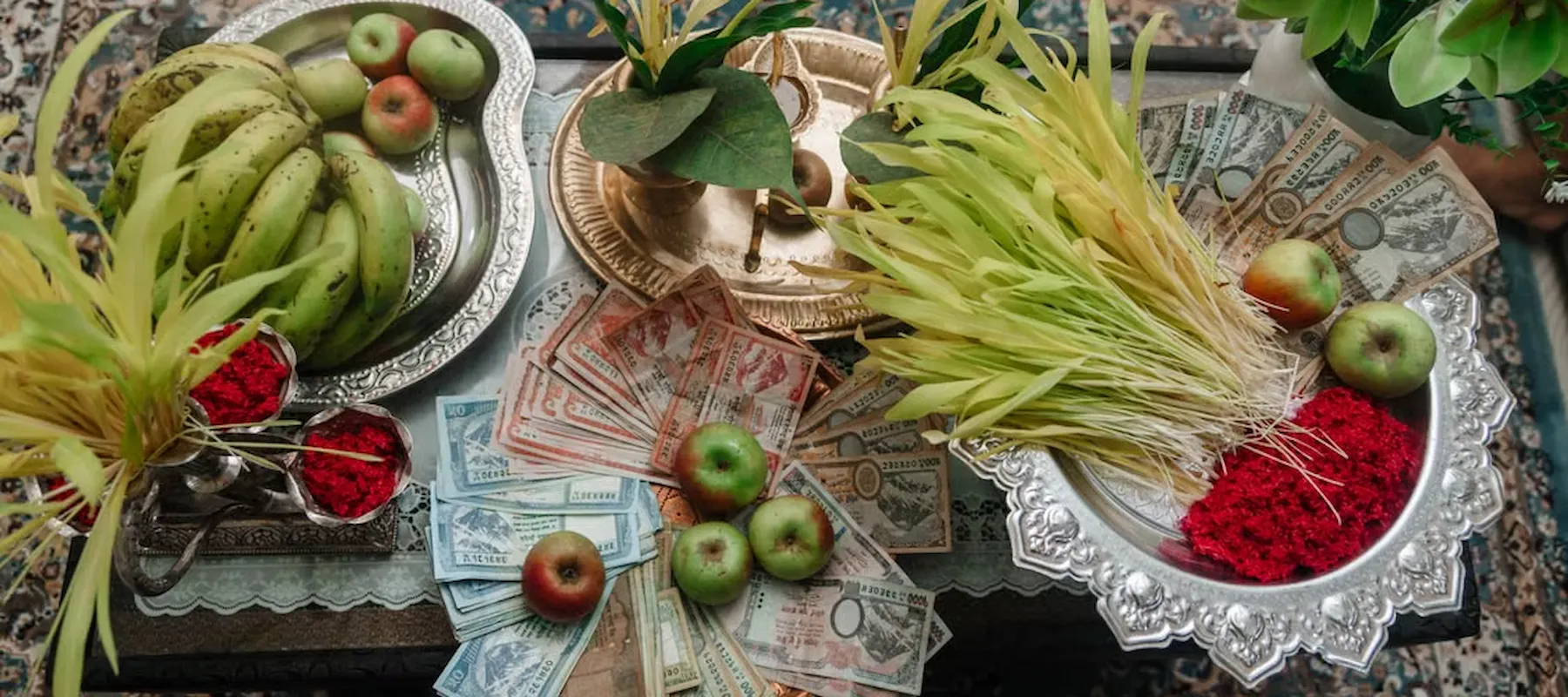
If a traveler witnesses only one Dashain ritual, it’s almost always this one. On Vijaya Dashami morning, elders prepare a fresh mixture of soaked rice, yogurt, and red vermillion powder, pressing a thumbprint of it onto the forehead of each younger family member, a visible mark meant to last for days as a sign the person has received the goddess’s blessing.
Alongside the Tika comes Jamara, pale yellow barley shoots that were planted in darkness on Ghatasthapana and have grown for nine days by the time they’re tucked behind an ear or into hair. Jamara symbolizes fertility and growth; some people briefly touch it to their eyes as a gesture of seeking clearer vision for the year ahead. The exchange typically closes with dakshina, a small cash gift from elder to younger, completing a ritual that’s simultaneously spiritual, familial, and economic.
This is where a lot of Dashain coverage oversimplifies. Nepal is often described as “80% Hindu,” but Dashain’s actual celebration varies meaningfully by community, and understanding that variation gives a far more accurate picture than treating it as a single uniform national event.
This diversity matters for anyone trying to understand Nepal through its biggest festival: Dashain is a genuine national touchstone, but “all Nepalis celebrate it the same way” is a real oversimplification worth correcting.
| Dish | What It Is |
|---|---|
| Khasi ko Masu | Goat curry, the centerpiece of most Dashain feasts |
| Sel Roti | Ring-shaped, deep-fried rice-flour bread, a Dashain staple shared widely |
| Bhutan | Sautéed goat organ meats with garlic, ginger, and timur spice |
| Kheer | Cardamom rice pudding, especially associated with the closing Kojagrat Purnima night |
| Achar | An assortment of pickles, often three or four varieties on a single table |
| Chatamari | A Newar rice-flour pancake with minced meat topping |
| Raksi | Homemade distilled spirit from millet or rice, traditionally offered to elders first |
Goat meat distribution in many households follows a customary system called mar bhag, where specific cuts go to daughters, the family priest, or the household head, a structure that reinforces social relationships as much as it divides food.
Yes, and this is genuinely one of the more welcoming aspects of the festival. You don’t need to be Hindu or Nepali to be included in family gatherings, many Nepali Buddhists, Christians, and people of no religious affiliation participate in Dashain as a cultural rather than strictly religious event, and foreign guests invited into a home for Tika are generally treated with real warmth.
A few points of etiquette worth knowing if you’re invited:
Dashain falls squarely within Nepal’s best trekking window: the clear, stable weather of early-to-mid autumn, which is exactly why so many travelers combine the two. A few things are worth knowing if your trek overlaps with the festival:
Dashain and India’s Dussehra share the same core mythology and fall on the same lunar tithi, but they are not the same festival in practice. Dussehra in most of India is largely a single climactic day, built around burning effigies of Ravana and Ramlila performances. Dashain in Nepal is a full 15-day structure with its own distinct rituals, Ghatasthapana’s Kalash and Jamara planting, the extended Navaratri puja sequence, and the Tika and Jamara exchange, which has no real equivalent in mainstream Indian Dussehra observance. Ravana effigies are not a standard part of Nepali Dashain at all.
Dashain 2026 begins with Ghatasthapana on Sunday, October 11, and concludes with Kojagrat Purnima on Sunday, October 25.
The Nepal Panchang Nirnayak Samiti had not yet officially published the exact muhurat as of this writing; it’s typically announced in early-to-mid October. The broader morning-to-early-afternoon window on October 21 is considered auspicious regardless of the precise minute.
Yes. The official closure block runs from Phulpati (October 17) through Duwadashi (October 23), seven consecutive days, with Ghatasthapana (October 11) as a separate single holiday.
Yes, with planning. Tourist-facing businesses generally stay open, but carry extra cash before October 17, expect some local restaurants to close, and book trekking guides and transport in advance.
Yes. Many non-Hindu Nepalis participate as a cultural rather than religious event, and foreign guests invited into a family’s Tika celebration are generally welcomed warmly.
No. Newar communities observe a parallel festival called Mohani with distinct rituals, and many Janajati and Buddhist communities either don’t celebrate Dashain or observe it in a significantly different, more secular form.
No. They share the same mythological roots and lunar date, but Dashain is a 15-day Nepali festival with unique rituals like Jamara and Tika, while Dussehra in India is typically a single-day event centered on Ravana effigy burning.
It can. Guides and porters may take leave around Tika for family time, so book trekking packages in advance if your trip overlaps with October 17–23, though the festival’s timing within peak autumn trekking season is otherwise a real advantage for weather.
No, not anymore for most families. Many households now perform symbolic rituals instead, and the practice varies significantly by family and region.
Dashain follows the Hindu lunar calendar rather than a fixed date on the Gregorian calendar, so its timing shifts by roughly 10 to 20 days each year relative to the Western calendar.
Dashain is far more than a date on a calendar; it’s the moment Nepal’s agrarian roots, royal history, religious devotion, and family identity converge into a single 15-day arc. For 2026 specifically, remember the two numbers that matter most: October 21 for the main Tika day, and October 17–23 for the official closure window that will actually affect your banking, government business, or travel planning. Whether you’re Nepali returning home for blessings, a traveler timing a trek around the festival, or simply trying to understand why an entire country pauses every October, Dashain rewards a closer look well beyond its headline Tika photos.
Trekking during Dashain means combining some of Nepal’s clearest autumn weather with a rare chance to see mountain village life in full festive swing. Alliance Treks & Expedition Pvt. Ltd. can help you plan a Dashain-season trek on routes like Annapurna Base Camp, Poon Hill, or Mardi Himal, with guides who know the festival calendar and can build family-leave flexibility into your itinerary without disrupting your trip.
Alliance Treks & Expedition Pvt. Ltd. Once is not enough for naturally and culturally Himalayas