(Viber, Whatsapp, Cell) +977 9851022814

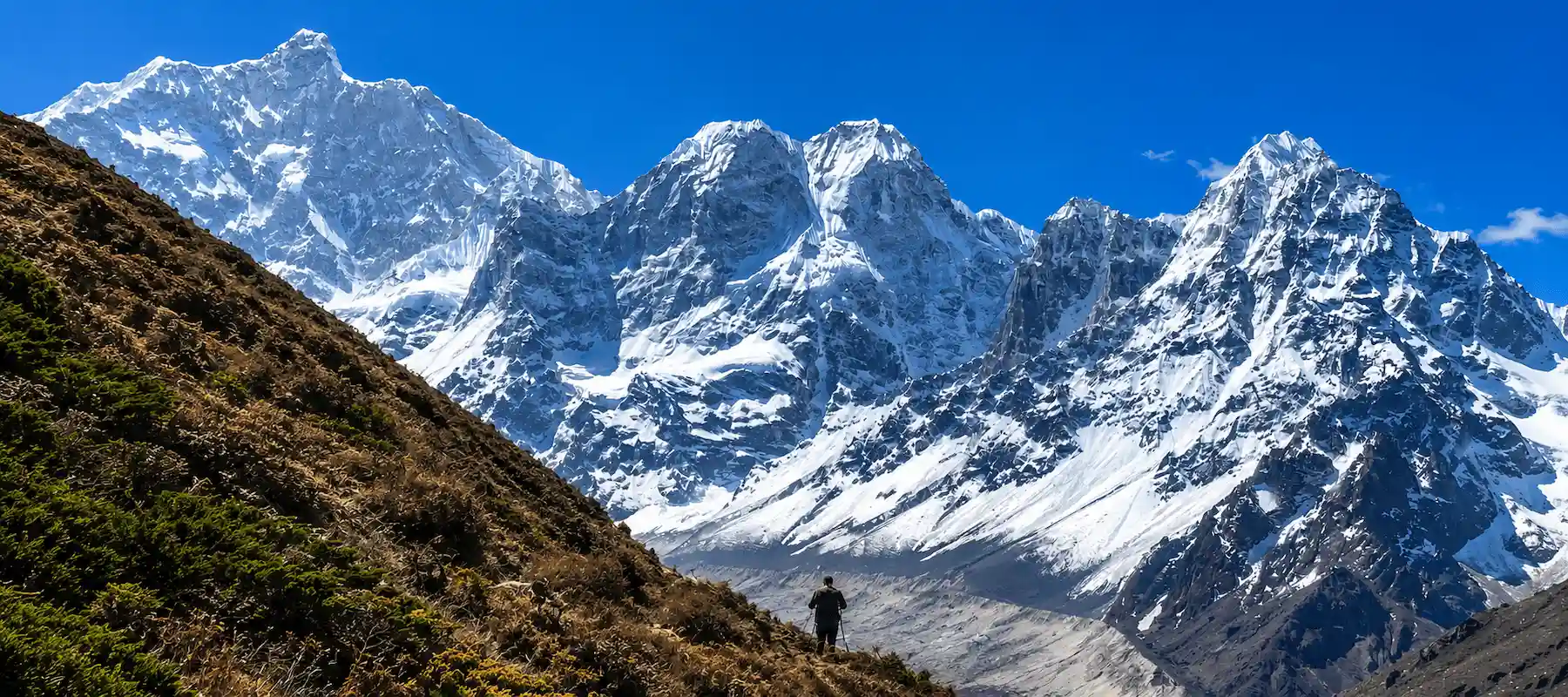
The Kanchenjunga Circuit Trek for beginners is a tough call, and honesty matters more than encouragement here. The trek to base camp (not the mountain’s summit) needs no technical climbing skill. Still, at 21 days, with a maximum altitude of 5,143 m and several consecutive days above 4,000 m in one of Nepal’s most remote regions, it’s a harder starting point than Annapurna Base Camp or even Everest Base Camp. A genuine first-timer with no trekking background should look elsewhere first. A fit beginner who has already completed one moderate multi-day trek can realistically take this on with a licensed guide and solid preparation.
This guide is for people seriously weighing Kanchenjunga as an early trek. It covers the real day-by-day itinerary, permits, a training plan, a packing list, and straight answers to what beginners actually ask, including clearing up a common and important mix-up between trekking to Kanchenjunga’s base camps and climbing the mountain itself.
Kanchenjunga is the third-highest mountain on Earth (8,586 m), sitting on the Nepal-India border in the country’s far eastern corner. The Circuit Trek doesn’t come close to the summit. It follows the Tamor and Ghunsa valleys from lowland Taplejung up through Limbu and Tibetan-influenced villages, crossing high passes to visit both Kanchenjunga’s North Base Camp (Pang Pema, 5,143 m) and South Base Camp (Oktang, 4,780 m) in a single 21-day trip.
That combination, visiting both base camps in one trek, is genuinely rare and part of why this route has a loyal following among trekkers who’ve already done Everest or Annapurna and want something quieter. For a beginner, the appeal is the same untouched, low-crowd landscape. The catch is that “untouched” also means basic lodges, long approach days, and far less backup infrastructure than Nepal’s busier trails.
| Day | Route | Altitude | Time | Key Places |
|---|---|---|---|---|
| 1 | Drive Kathmandu to Birtamode | 112 m | 12–13 hrs | Long lowland drive; overnight in Birtamode |
| 2 | Birtamode to Taplejung | 1,820 m | 11–12 hrs | Shared bus into the eastern hills |
| 3 | Taplejung to Sekathum | 1,660 m | 6–7 hrs | Descends into the Tamor valley; trek proper begins |
| 4 | Sekathum to Amjilosa | 2,510 m | 5–6 hrs | Steep climb through subtropical forest |
| 5 | Amjilosa to Gyabla | 2,730 m | 4–5 hrs | Dense rhododendron and oak forest |
| 6 | Gyabla to Ghunsa | 3,475 m | 5–6 hrs | Tibetan-influenced valley hub; monastery, school, shops |
| 7 | Acclimatization day, Ghunsa | 3,475 m | Rest day | Village exploration, short hikes |
| 8 | Ghunsa to Khambachen | 4,245 m | 5–6 hrs | Tree line ends; open, glacier-lined terrain |
| 9 | Khambachen to Lhonak | 4,790 m | 6–7 hrs | Stark, high-altitude staging camp |
| 10 | Excursion to Kanchenjunga North Base Camp (Pang Pema) | 5,143 m | 7–8 hrs | Direct view of Kanchenjunga’s north face and Jannu; return to Lhonak |
| 11 | Lhonak back to Ghunsa | 3,475 m | 6–7 hrs | Faster descent through Khambachen |
| 12 | Ghunsa to Sele La high camp | 4,200 m | 6–7 hrs | Crosses the Sele La pass complex |
| 13 | Sele La camp to Cheram (Tseram) | 3,870 m | 6–7 hrs | Descends toward the Yalung Glacier valley |
| 14 | Excursion to Kanchenjunga South Base Camp (Oktang) | 4,780 m | 5–6 hrs | Southern face view with Rathong and Kabru peaks; return to Cheram |
| 15 | Cheram to Tortong | 2,995 m | 5–6 hrs | Long forested descent |
| 16 | Tortong to Yamphudin | 2,080 m | 6–7 hrs | Well-known Limbu village, warm hospitality |
| 17 | Yamphudin to Mamankhe | 1,785 m | 5–6 hrs | Gradual descent through lower villages |
| 18 | Mamankhe to Taplejung | 1,820 m | 5–6 hrs | Closes the trekking loop |
| 19 | Taplejung to Birtamode | 112 m | 11–12 hrs | Long return drive |
| 20 | Birtamode to Kathmandu | 1,325 m | 12–13 hrs | Final overland leg |
| 21 | Departure | — | — | Airport transfer |
This is the question that matters most, so here’s the straight version.
What works in a beginner’s favor:
What makes it a genuinely hard starting point:
Bottom line: if you’ve never done a multi-day trek at altitude before, start with Ruby Valley, Poon Hill, or Mardi Himal first. If you’ve completed one of those and want a bigger, quieter challenge next, Kanchenjunga is a realistic step up, not a realistic first step.
| Aspect | Kanchenjunga Circuit | Everest Base Camp | Annapurna Base Camp | Manaslu Circuit |
|---|---|---|---|---|
| Duration | 21 days | 12 days | 7–8 days | 17 days |
| Highest point | 5,143 m | 5,364 m (5,545 m at Kala Patthar) | 4,130 m | 5,160 m |
| Acclimatization days | 1 | 2 | 0 (gradual gain instead) | 2 |
| Base camps visited | 2 (North and South) | 1 | 1 | 0 (circuit, no base camp) |
| Crowd level | Very low | Very high | High | Low |
| Guide required | Mandatory by law | Recommended | Recommended | Mandatory by law |
| Beginner suitability | Not recommended as a first trek | Achievable with preparation | Best true beginner option | Achievable for fit first-timers |
| Permit / Document | Approximate Cost | Notes |
|---|---|---|
| Kanchenjunga Restricted Area Permit | Included in most package prices | Only issued through a registered agency; covers a defined trekking period |
| Kanchenjunga Conservation Area Project (KCAP) Permit | Included in most package prices | Entry to the conservation area |
| TIMS Card | Included in most package prices | Trekker registration and safety tracking |
| Valid passport | — | At least 6 months’ validity |
| Nepal entry visa | $30 (15 days) / $50 (30 days) | On arrival or online in advance |
| Travel insurance | — | Must cover trekking to at least 5,200 m and helicopter evacuation |
As with Manaslu and Upper Mustang, this permit cannot be arranged by an individual trekker — it goes through a registered agency, and a licensed guide is a legal requirement for the entire route.
| Group Size | Price Per Person |
|---|---|
| Solo (1 person) | $2,139 |
| 2 to 5 people | $2,039 |
| 6 to 10 people | $1,869 |
| 11 or more | $1,769 |
Alliance Treks’ package includes full board (breakfast) throughout the trek, an experienced guide, a porter shared between two trekkers, all listed permits, and ground transportation between Kathmandu and Taplejung. Hot showers, battery charging, and trekking equipment rental are excluded.
| Category | Key Items |
|---|---|
| Layers | Thermal base layers, insulating mid-layer, waterproof/windproof shell, warm hat, insulated gloves |
| High-altitude specific | Gaiters, buff or balaclava, microspikes for icy sections near both base camps |
| Footwear | Broken-in waterproof boots with strong ankle support, camp shoes, wool socks |
| Sleep | Sleeping bag rated to at least -15°C (teahouses here are more basic than on Everest or Annapurna) |
| Health | Comprehensive first-aid kit, water purification, altitude medication if prescribed |
| Practical | Headlamp with spare batteries, trekking poles, high-UV sunglasses, sunscreen, power bank, cash in small denominations |
Note: Bring more cash and a more complete first-aid kit than you would for Everest or Annapurna. Resupply options are minimal once you’re deep in the valley, and there are no ATMs past Taplejung.
| Timeline | Focus | Example |
|---|---|---|
| 3–4 months out | Build cardio base | Regular walking, running, or cycling, 3–4 times a week |
| 6–10 weeks out | Add elevation and load | Hill or stair sessions with a loaded daypack |
| 4–6 weeks out | Simulate long days | Weekend hikes of 5–7 hours, in your actual trek boots |
| 2–4 weeks out | Taper | Reduce volume, focus on rest and gear checks |
If you haven’t completed at least one shorter Nepal trek before, consider treating this training plan as a starting point for a smaller trek first, then returning to Kanchenjunga once you know how your body handles multi-day walking at altitude.
| Season | Months | Suitability |
|---|---|---|
| Spring | March–May | Good: rhododendron blooms, milder temperatures |
| Autumn | September–November | Best: clearest skies, most stable weather |
| Winter | December–February | Decent (If you are comfortable with cold weather): heavy snow at altitude |
| Monsoon | June–August | Decent (Only if weather condition are good): landslide risk, poor visibility |
It’s possible for a fit beginner who has already completed at least one shorter multi-day trek, but it’s not recommended as someone’s very first trek, given its 21-day length and remote, basic infrastructure.
No, and this distinction matters. The Circuit Trek stops at base camp (up to 5,143 m) and needs no climbing skill. Summiting Kanchenjunga itself (8,586 m) is a separate, elite mountaineering expedition requiring advanced technical skill.
The standard itinerary is 21 days from Kathmandu to Kathmandu, including the long overland approach and return.
It’s graded moderate to challenging by most operators, with genuinely demanding elements: long daily walking hours, remote terrain, and only one formal acclimatization day for a trek this long.
The Kanchenjunga Restricted Area Permit, the Kanchenjunga Conservation Area Permit (KCAP), and a TIMS card, all arranged through a registered agency.
No. A licensed guide is legally required for the entire route, and the restricted-area permit cannot be issued to an individual trekker.
With Alliance Treks, prices range from $1,769 per person for groups of 11 or more up to $2,139 for a solo trekker, including full board, guide, porter, and permits.
Autumn (September–November) offers the most stable weather, followed by spring (March–May).
It can be, mainly because the trek involves two separate high-altitude excursions (North and South Base Camp) and only one dedicated rest day, compared to two on Everest Base Camp or Manaslu.
Yes, on clear days Everest is visible in the distance from certain high points along the route, distinct from the closer Kanchenjunga massif.
The Kanchenjunga Conservation Area is genuinely biodiverse, with musk deer, Himalayan tahr, and blue sheep regularly sighted, and rare chances of red panda or snow leopard.
Start with Annapurna Base Camp or Poon Hill to build multi-day trekking experience, then return to Kanchenjunga with a stronger sense of your own pacing and altitude tolerance.
Kanchenjunga rewards patience and preparation more than any other trek in this beginner series. It isn’t the trek to start with if you’ve never walked more than a day at a time, and pretending otherwise would do you a disservice. But for a fit trekker who has done one moderate multi-day route already and wants genuine solitude, two base camps, and a landscape barely touched by mass tourism, few treks in Nepal deliver as fully. Go in with realistic expectations, train properly, and it becomes a genuinely achievable and unforgettable second or third Himalayan trek.
Alliance Treks & Expedition Pvt. Ltd. has organized treks across Nepal’s remote eastern regions since 1990 and handles the full restricted-area permit process, including the Kanchenjunga Restricted Area Permit, KCAP, and TIMS, directly on your behalf. Their 21-day package includes full board throughout the trek, an experienced guide, a porter shared between two trekkers, and all ground transportation between Kathmandu and Taplejung, with transparent group-based pricing and no hidden costs. For a beginner taking on this level of trek, having every logistical detail, permits, food, and transport handled by an established agency removes much of the uncertainty that makes remote treks feel intimidating.
Alliance Treks & Expedition Pvt. Ltd. Once is not enough for naturally and culturally Himalayas