(Viber, Whatsapp, Cell) +977 9851022814

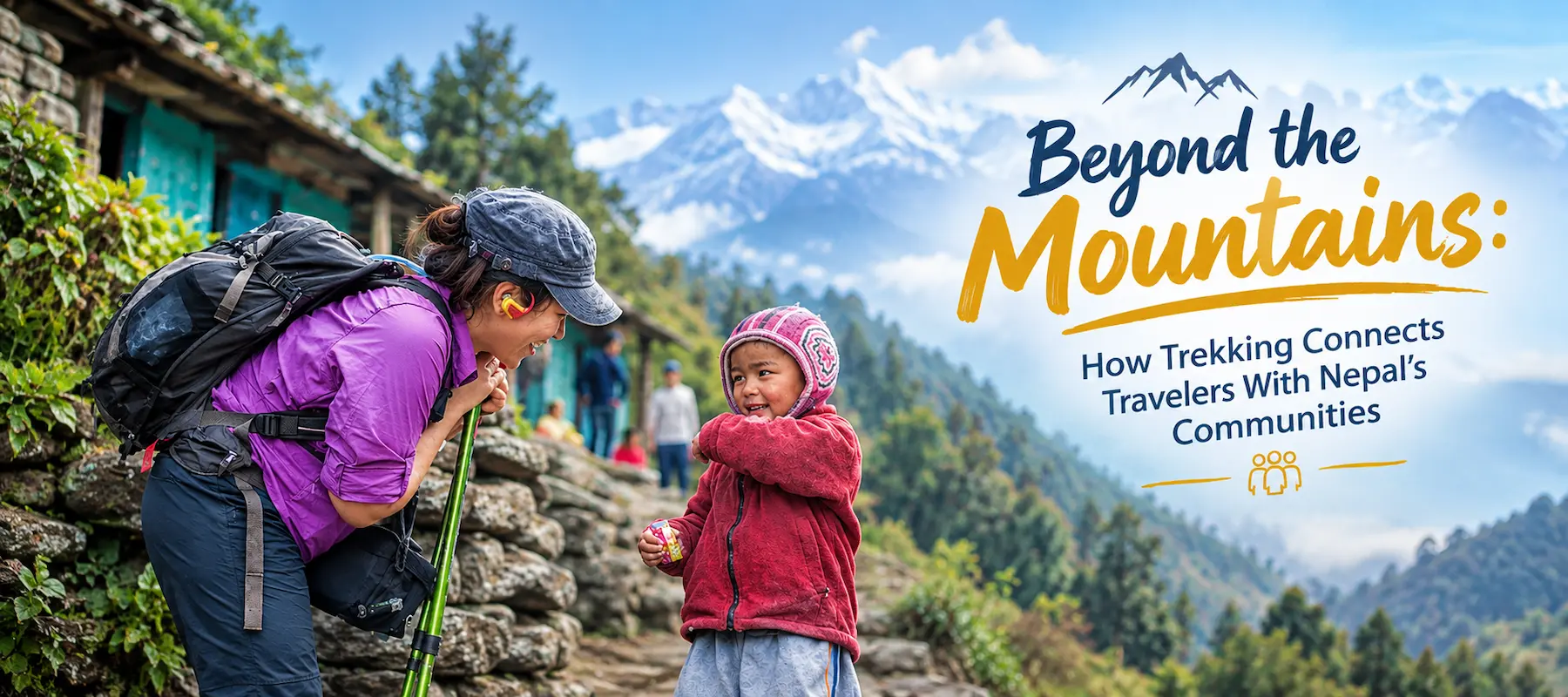
There’s a moment on almost every trek in Nepal that has nothing to do with altitude. It might be a teahouse owner in Ghandruk pulling out a second blanket without being asked, a porter in the Khumbu quietly correcting your pronunciation of a village name and laughing when you get it right, or an elderly woman in a Tamang village offering you tea before you’ve even set your pack down. The peaks get the photographs, but it’s these small, human exchanges that most trekkers actually remember years later. Trekking connects people and also helps to get socialize.
Community-based trekking in Nepal isn’t a separate category of travel — it’s simply what happens when you walk through a country where the trail runs directly through people’s homes, farms, and daily lives rather than around them. This piece looks at why that connection matters so much, what it actually looks like on the ground, when it’s most visible during a trek, how travelers can engage with it respectfully, and where in Nepal it tends to be strongest.
Unlike many trekking destinations where trails wind through uninhabited wilderness, Nepal’s major routes almost always pass directly through inhabited villages. There’s no way to walk from Lukla to Everest Base Camp, or from Nayapul to Poon Hill, without staying in someone’s teahouse, buying tea from someone’s kitchen, or crossing a bridge someone’s community maintains. The infrastructure of trekking itself — lodges, porters, guides, mule trains carrying supplies — is built almost entirely from local labor and local ownership, which is part of why the connection feels less like a tourist transaction and more like an actual exchange.
This structure also means trekking tourism functions as a direct economic engine for mountain communities that otherwise have limited access to markets, healthcare, or education funding. Where a beach resort might funnel most revenue to a distant hotel chain, a Nepal teahouse trek tends to keep money circulating locally — paying the family who owns the lodge, the farmer who grew the vegetables on your plate, and the guide whose income supports an entire extended household through the trekking season.
“Community-based trekking” isn’t a single fixed model — it spans several overlapping forms of local involvement:
| Form of Community Connection | What It Looks Like on the Trail |
|---|---|
| Teahouse lodging | Family-run lodges where meals, rooms, and hospitality come directly from the household living there. |
| Homestay programs | Sleeping and eating within a local family’s actual home rather than a dedicated guesthouse. |
| Local guides and porters | Trekking staff drawn from the immediate region, often sharing their own village’s history along the trail. |
| Community-managed trails and bridges | Trail maintenance, bridge upkeep, and conservation area fees managed by local cooperatives. |
| Cultural and craft exchanges | Weaving demonstrations, monastery visits, or traditional meals hosted by village cooperatives. |
| Village-run conservation initiatives | Locally staffed checkpoints and reforestation efforts tied to conservation area permit fees. |
Each of these represents a different depth of contact — a teahouse stay is a light, everyday form of connection, while a homestay or a cultural exchange program invites a much closer look at how a community actually lives, eats, and organizes its days.
The sense of connection tends to build gradually rather than arriving all at once, and certain moments during a trek bring it into sharper focus:
Genuine connection depends on how a traveler shows up, not just where they walk. A few practices make a real difference:
| Practice | Why It Matters |
|---|---|
| Choose locally owned teahouses and homestays where possible | Keeps a larger share of your spending directly within the community you’re visiting. |
| Hire local guides and porters through registered agencies | Supports fair wages and insurance coverage for trekking staff from the region itself. |
| Ask before photographing people | A simple courtesy that turns a transactional snapshot into a genuine interaction. |
| Learn a few words of Nepali or the local language | Even basic greetings are often met with warmth and can open a conversation further. |
| Buy snacks, crafts, and tea locally rather than stocking up in Kathmandu | Every purchase on the trail supports the household or cooperative selling it. |
| Respect religious and cultural sites | Many trails pass directly by stupas, mani walls, and monasteries that are active places of worship, not photo backdrops. |
| Tip guides and porters fairly | A customary and meaningful way to acknowledge the labor that makes the trek possible. |
None of this requires major lifestyle changes on the trail — it’s mostly a matter of paying attention and choosing, where there’s a choice, the option that channels more of your trip directly into the community you’re walking through.
Some regions and route types lend themselves especially well to community-focused trekking:
| Region / Trek | Community Highlight |
|---|---|
| Ghandruk & Annapurna foothills | Deeply preserved Gurung village culture, museums, and homestay programs. |
| Everest (Khumbu) region | Sherpa villages, monasteries, and mountaineering heritage woven into daily life. |
| Langtang Valley | Tamang Heritage Trail communities, known for distinct cultural identity and craft traditions. |
| Manaslu Circuit | Tibetan-influenced villages with less tourism infrastructure and more unfiltered daily life. |
| Helambu region | Popular, accessible homestay circuit close to Kathmandu, ideal for shorter cultural immersion. |
| Upper Mustang | Trans-Himalayan Buddhist culture with strong ties to Tibetan tradition, largely untouched by mass tourism. |
Shorter, lower-altitude routes near Kathmandu and Pokhara — including many of the region’s homestay-based day tours — offer some of the most concentrated cultural exchange per day of walking, since trekkers spend more time in villages relative to time on the trail itself.
It refers to trekking routes and experiences built around direct interaction with local villages, teahouses, guides, and homestay families, rather than isolated wilderness travel.
Not necessarily. Many homestay programs are priced similarly to standard teahouse lodging, with the difference being the depth of interaction rather than the cost.
The Ghandruk area in the Annapurna region and the Helambu homestay circuit near Kathmandu are both strong entry points for cultural immersion, alongside deeper options like the Manaslu Circuit and Upper Mustang.
Direct cash gifts are generally discouraged, as they can create dependency or local imbalance. Supporting community-run guesthouses, buying local goods, and fair tipping through proper channels are usually better ways to contribute.
Trekking tourism creates direct income for teahouse owners, guides, porters, and local cooperatives, while conservation area permit fees can support trail maintenance and environmental protection managed by local communities.
Alliance Treks & Expedition Pvt. Ltd. can help you choose routes and homestay options that prioritize genuine local connection, from Ghandruk village stays to the Tamang Heritage Trail:
Alliance Treks & Expedition Pvt. Ltd. Once is not enough for naturally and culturally Himalayas