(Viber, Whatsapp, Cell) +977 9851022814

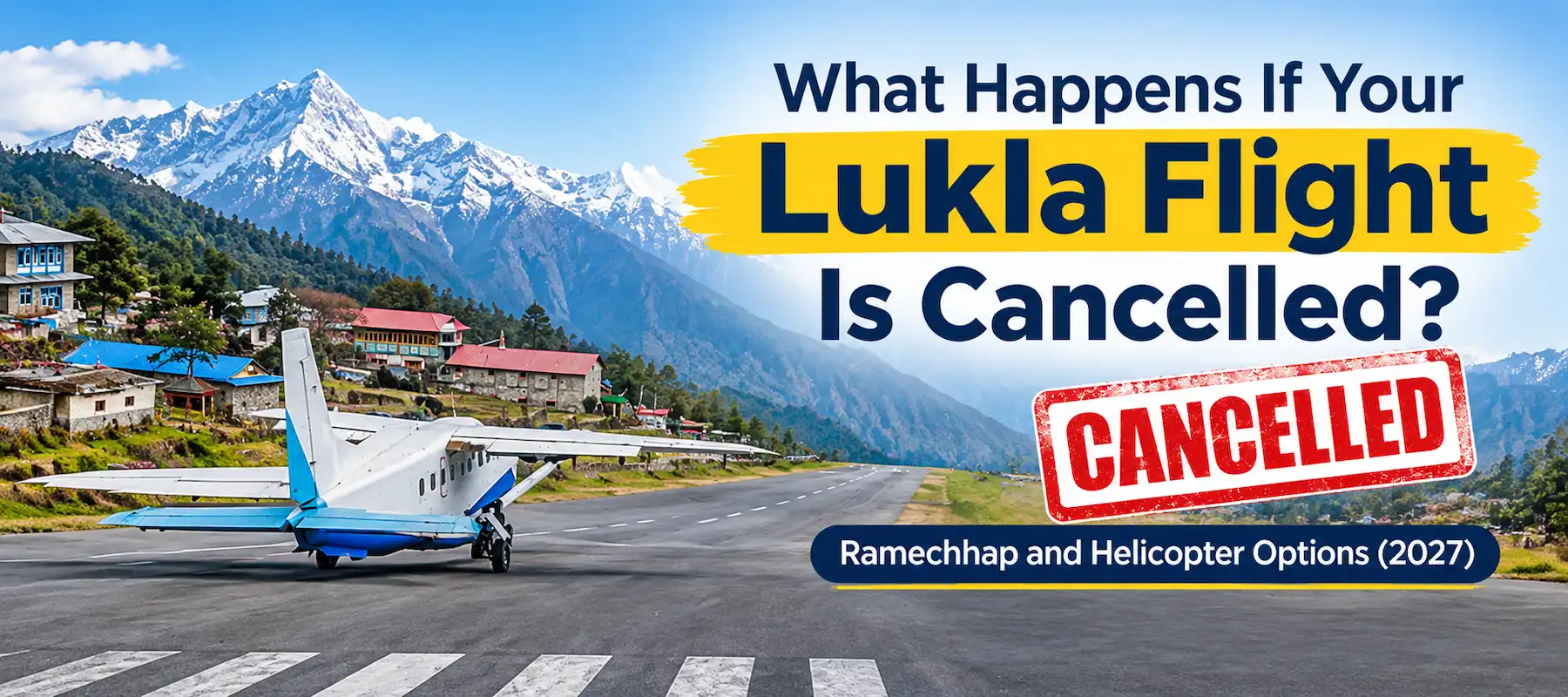
When a Lukla flight is cancelled, you can rebook the next morning, share or charter a helicopter, fly to Phaplu and continue from there, walk in from Jiri, or reshape the trek. Most trekkers rebook first and switch to a helicopter only when their spare days run out. Tenzing-Hillary Airport has a runway of just 527 metres and operates in daylight only, so one cloudy morning can wipe out an entire day of departures. Many tourists are panicked after a Lukla flight cancelled, so this guide will help those tourists who are searching for alternatives after the cancelation.
| Option | Typical extra cost | Time impact | Best when |
|---|---|---|---|
| Rebook next morning | Usually none; the ticket is moved, not lost | Lose 1 day or more | You have 1–2 buffer days |
| Helicopter to Lukla | About USD 450–650 per seat shared; USD 2,400–3,200 per private charter (up to 5 people) | Back on schedule the same day | Your flight home is fixed |
| Fly to Phaplu, then trek or helicopter | Fare difference plus any helicopter leg | Adds walking days if you trek | Ramechhap is jammed but Phaplu is open |
| Walk in from Jiri | Road transfer, no airfare | About 6 extra days (18-day itinerary vs 12) | You have time and want a quieter start |
| Reshape the itinerary | Varies by trek | Flexible | A long weather block hits your dates |
Prices are operator-quoted ranges collected in November 2026 and move with demand. Confirm the final figure, including taxes, before you commit.
Lukla cancellations come from weather and geometry. The runway climbs toward a mountainside; pilots must see the strip on approach, and cloud drifting up the Dudh Koshi valley can close the window while Kathmandu sits under blue sky. Mornings are usually the calmest, so early departures tend to fly, and afternoon ones go first.
Three patterns explain most of the chaos:
The practical lesson: treat the Lukla flight as a weather-dependent leg, not a fixed appointment. Our 12-day Trek to Everest Base Camp is built with that in mind, and the rest of this guide shows what to do when the window closes anyway.
Speed matters because seats, helicopter slots and Ramechhap beds all disappear quickly when hundreds of people react at once. Work through this order:
If you are travelling with Alliance Treks, message your trip leader first and ask for both a rebooking and a helicopter quote so you can compare. Reach the team through our contact page.
Rebooking is the cheapest move and the right one if you have a day or two to spare. The catch is that “tomorrow” depends on where you fly from.
In peak trekking months, most Lukla departures leave from Manthali Airport in Ramechhap rather than Kathmandu, which relieves congestion at Tribhuvan. Travellers drive from Kathmandu to Ramechhap, then fly onward. Alliance Treks itineraries state the same pattern: flights typically leave from Ramechhap in March, April, May, September, October and November, and from Kathmandu in the quieter months (see Day 1 of the Trek to Everest Base Camp).
What the Ramechhap leg means for a cancellation
Tip: Early-morning slots are the most dependable, and afternoon flights from Ramechhap carry a higher cancellation risk. If an agent offers you a choice, take the earliest.
For 2026 season fares, one booking guide lists Kathmandu–Lukla at USD 238 and Ramechhap–Lukla at USD 198; fares were revised on 1 March 2026, so verify the current price when you book.
A helicopter is the fastest way to get back on schedule, because you pay to leave today instead of waiting for tomorrow’s weather. It improves your odds rather than guaranteeing them: helicopters can often operate when fixed-wing flights are held, but a closed valley closes them too.
What it costs. Operators quote a wide band, so treat these as planning ranges:
| Format | Typical price (one way, Kathmandu to Lukla) | Notes |
|---|---|---|
| Shared seat | About USD 450–650 per person | Depends on other travellers joining the same flight |
| Private charter | Roughly USD 2,400–3,200 per helicopter, up to 5 people | Split five ways, about USD 480–640 each |
How to choose between them
Money back on your plane ticket. Several operators credit or refund the unused fixed-wing fare when a cancelled traveller switches to a helicopter. Ask before you pay so you are not charged twice.
Skip the drive entirely. A Kathmandu helicopter departure removes the early-morning road transfer to Ramechhap, which is why some trekkers choose it even without a cancellation. Alliance Treks lists this as an option on the Trek to Everest Base Camp itinerary for those who prefer to avoid the drive.
Phaplu (the airstrip serving Salleri) sits lower in the Solukhumbu hills, and it sometimes stays workable when Lukla does not. During a prolonged weather block in a past autumn season, hundreds of trekkers waiting at Ramechhap flew to Phaplu instead, and Tara Air reportedly favoured Phaplu because the onward helicopter hop to Lukla is shorter than from Ramechhap. The same coverage describes trekkers walking down to Surke and taking a helicopter from there.
There are two ways to use it:
Two honest caveats. Phaplu schedules are thinner than Lukla’s and can change at short notice, and the walking option is physically harder than the standard route. Ask your operator for current availability before you count on it, and see our guide to how hard the Everest Base Camp trek really is if you are weighing the extra effort.
There is no bus from Kathmandu to Lukla, but there is a road to Jiri, the old roadhead for Everest expeditions. Starting there turns a flight problem into a trek. Alliance Treks’ Jiri to Everest Base Camp Trek runs 18 days against 12 for the fly-in version. It begins with a 9–10 hour drive, crosses ridges including Lamjura La at about 3,530 m, and joins the main Everest trail near Ghat and Phakding.
The gradual altitude gain is a real benefit, since the route gives many trekkers better natural acclimatisation than flying straight to 2,860 m. The trade-offs are time and effort: about a week of extra walking, repeated steep ups and downs, and a strenuous grade overall. It suits trekkers with spare days who would happily trade a flight for a quieter first week.
When weather blocks stretch past two days, flexibility beats fighting the schedule. Depending on your fitness and dates, a trekking agency can swap or extend the route once you reach the Khumbu, for example:
The point is to decide deliberately rather than burn days hoping. A calm decision on day two almost always beats an expensive scramble on day four.
The right answer depends less on your budget than on how many days you can afford to lose. Match your situation to the row below.
| Your situation | Best first move | Escalate to |
|---|---|---|
| No spare days, fixed flight home | Helicopter to Lukla (shared seat first) | Private charter if no seats |
| One spare day | Rebook the next morning | Helicopter after a second cancellation |
| Two to three spare days | Rebook for up to two mornings; ask about Phaplu | Helicopter on day three |
| Four or more spare days, flexible dates | Rebook, or switch to Salleri or Jiri on foot | Reshape the trek |
| Tight budget, weather block expected to last | Wait it out or walk in via Jiri | Phaplu fare plus walking |
The two-strike rule. If a second morning is cancelled, stop waiting and move to the next option on your list. Each extra wait spends a spare day, a hotel night and your energy, while the odds that tomorrow is any better rarely change enough to justify it.
A quick break-even test. Add up what one more lost day costs you: hotel, meals, the buffer it burns, and any change fees on your flight home. If that total is close to the price of your share of a helicopter, the helicopter is the better buy because it also returns your day.
Most Lukla stress is avoidable with planning done weeks earlier.
For a wider planning checklist, the Alliance Treks travel guide and our guide to tipping your guide and porter cover the rest of the trip budget.
A cancelled return flight feels worse than a cancelled outbound one, because your international flight is usually fixed. The same logic applies in reverse: first aim for the earliest rotation out, then escalate.
Two habits remove most of the risk. Reconfirm your return flight with your guide the evening before, and schedule your last night in Kathmandu with at least a one-day cushion before you fly home. Our 12-day Everest Base Camp itinerary returns you to Kathmandu, so add a spare day before your international flight to absorb a delay.
You are normally rebooked on the next available morning flight at no extra charge. If you cannot afford the delay, you can pay for a helicopter, fly to Phaplu, or start walking from Jiri. Your trekking agency usually coordinates these changes.
Shared seats from Kathmandu are commonly quoted at about USD 450–650 per person one way, and a private charter at roughly USD 2,400–3,200 per helicopter for up to five passengers. Prices change with demand, so confirm the total before booking.
No. There is no road to Lukla. The nearest roadhead on the classic approach is Jiri, from which the walk to the Everest trail takes about a week.
During peak trekking months, airlines move Lukla departures to Manthali Airport in Ramechhap to reduce congestion at Kathmandu’s Tribhuvan Airport. Trekkers travel by road for about 4–5 hours first, then take a short flight.
In peak season, Ramechhap is generally considered the more dependable departure point because the flight is shorter and the airport serves almost only Lukla traffic. Weather at Lukla remains the deciding factor from either airport.
Policies differ by airline and agency. Commonly, the ticket is rebooked rather than refunded, and some operators credit the unused fare when you switch to a helicopter. Ask your operator to confirm in writing.
Allow one to two extra days at the start, and keep a day of cushion before your international flight home. In a prolonged weather block, even that may not be enough, which is why having a helicopter or Phaplu fallback matters.
Yes. You can switch to a helicopter, use the Phaplu route, or trek from Jiri. Alliance Treks offers both the Salleri to Everest Base Camp Trek and the Jiri to Everest Base Camp Trek as flight-independent routes.
The best protection against a cancelled Lukla flight is a plan that already contains the answer. Alliance Treks has guided trekkers in the Himalayas since 1990, and the Everest team can build a buffer day, a helicopter fallback or a flight-independent route into your itinerary from the start.
Ready to talk dates? Send a message through our contact page, follow the how-to-book steps, or WhatsApp the team at +977 9851022814 / 9841451681.
Alliance Treks & Expedition Pvt. Ltd. Once is not enough for naturally and culturally Himalayas